


1920s Walnut Bedside Tables
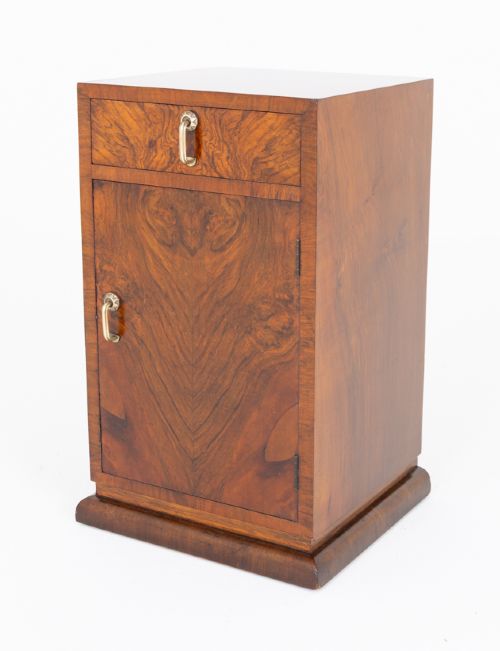
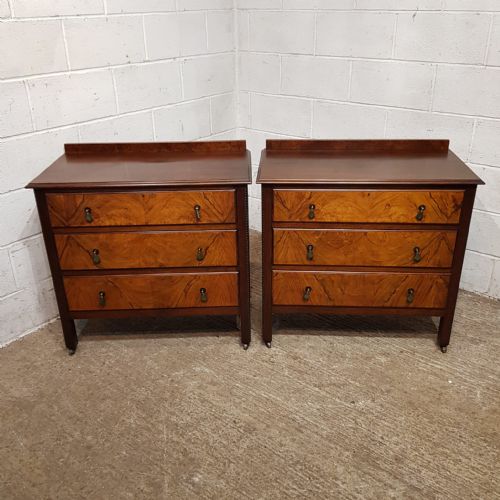
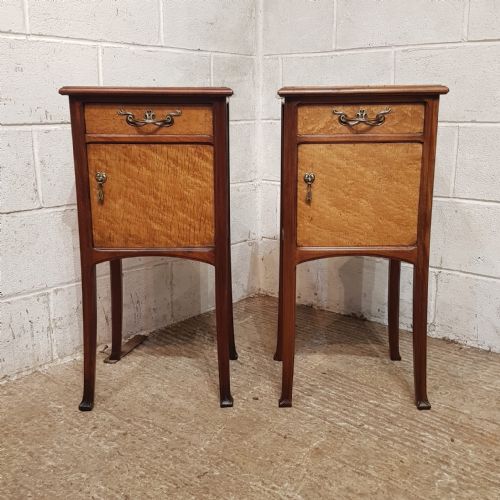
These 1920s walnut bedside tables bring striking grain patterns and practical bedside storage, shaped by the distinct styles of the period.
1920s Walnut Bedside Tables
When you search for 1920s walnut bedside tables, you are looking for compact bedroom furniture designed to sit alongside a bed, offering surface space and enclosed storage. The selection here spans the 1920 and 1930 periods, encompassing both bedside cabinets and open tables.
You are most likely to meet pieces finished in walnut, burr walnut, and walnut veneer, frequently paired with marble tops or brass details. Forms range from freestanding French and Italian cabinets to integrated headboards with attached bedside tables.
Stylistically, the pieces draw heavily on Art Deco alongside Georgian Revival, Rococo Revival, and French Provincial influences. This mix reflects a transitional era where traditional forms met bold, modern geometric lines.
How they were made
Many examples incorporate inset marble tops, particularly on French and Italian pieces, providing a durable and cool surface next to the bed. Hardware components such as brass handles and mounts complete the construction, secured to the timber carcasses with traditional joinery.
Listings combine pieces from both the 1920 and 1930 periods, demonstrating how Art Deco design overlapped with traditional revival styles.
What varies in quality
The choice of surface veneer determines much of the visual appeal, with figured burr walnut commanding attention through complex, organic patterns rather than plain grain. The quality of the veneer matching across paired cabinets dictates how harmoniously the furniture sits on either side of a bed.
Integration of materials also separates standard production from finer examples, such as heavy, well-veined marble slabs fitted precisely into the wooden frames. The crispness of carved details in the Rococo Revival and French Provincial styles further defines the standard of craftsmanship.
The 1920s Walnut Bedside Tables Glossary
- Burr walnut
- A thin slice of wood taken from a tree growth or burl, prized for its swirling, highly figured grain patterns. It is frequently utilised on the primary visual surfaces of Art Deco cabinets.
- Walnut veneer
- A thin layer of superior walnut timber applied over a secondary wood base to provide decorative elegance without structural instability. This technique was standard practice across the 1920 and 1930 periods.
- Art Deco
- A design style characterised by sleek geometric shapes, streamlined forms, and modern ornamentation that emerged between the wars. It dominates the aesthetic of the bedside cabinets in this selection.
- Rococo Revival
- A decorative style echoing the ornate, asymmetrical scrollwork and flowing curves of the eighteenth century. Pieces in this style often feature elaborate wooden shaping.
- French Provincial
- A rustic yet refined style originating from regional French furniture traditions, combining simple utility with gentle curves. It offers a softer contrast to linear Art Deco designs.
1920s Walnut Bedside Tables: Frequently Asked Questions
What styles are common in 1920s walnut bedside tables?
The pieces draw predominantly on Art Deco aesthetics, featuring streamlined geometry and bold grain presentation. You will also encounter Revival styles that look back to earlier decorative traditions.
Alongside these, French Provincial and Italian regional designs appear, often incorporating traditional forms with local marble tops.
Were these tables made as pairs?
Many examples are offered as matched pairs designed to sit symmetrically on either side of a bed. This reflects the standard bedroom layouts of the 1920 and 1930 periods.
Single tables also occur, originating from integrated headboard units or freestanding bedside cabinets intended for smaller spaces.
What materials feature on these bedside tables?
Walnut is the primary timber, appearing as solid wood and as highly figured burr walnut veneer. Mahogany and metal also support the core construction of certain cabinets.
Marble tops provide a contrasting surface on several French and Italian variants, while brass supplies the metal hardware and handles.
How do I fit them into a modern bedroom?
Their compact proportions make them suitable as functional bedside storage alongside contemporary or period beds. The neutral tones of walnut and marble integrate easily with various interior palettes.
Enclosed cabinets keep bedroom clutter hidden, while open side tables offer quick access to reading material and lighting.