
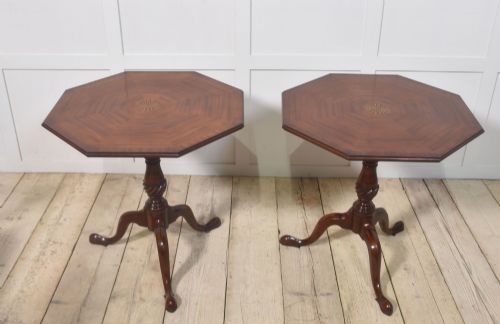

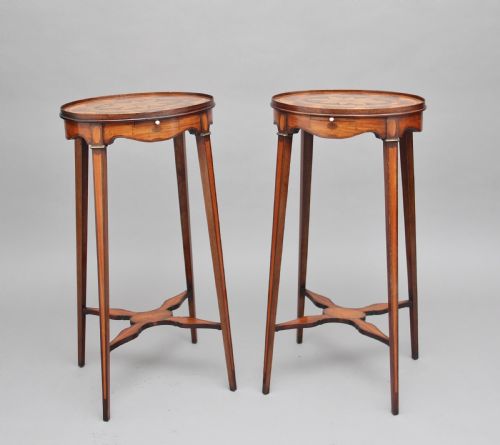


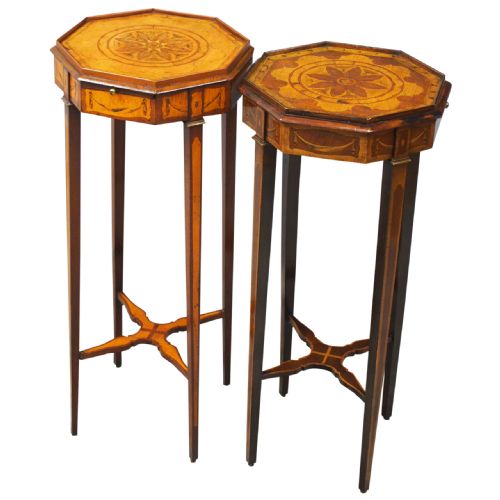

Pair Inlaid Wine Tables
Pair inlaid wine tables bring unmatched symmetry and warmth to a room, offering compact surfaces crafted from rich woods with delicate decorative banding.
Pair Inlaid Wine Tables
Pair inlaid wine tables are matching small-scale stands designed for serving drinks or holding objects, appearing frequently in mahogany, walnut, and ash across periods from the eighteenth century to the early twentieth century. These furnishings take several forms, including circular occasional tables, urn stands, kettle stands, and tall wine tables, often displaying Sheraton revival or George III neoclassical styling.
Buyers seeking pair inlaid wine tables will encounter matching sets that combine utility with refined decorative woodwork. The selection on this page ranges from late eighteenth century occasional tables to Edwardian and early twentieth century tripod designs, all featuring timber surfaces enhanced by contrasting wood inlay.
How they were made
Cabinetmakers utilised solid timbers and veneers of mahogany, walnut, satinwood, and ash, building stable tripod bases and circular or oval tops. Structural joinery supported slender stems, sometimes featuring spiral fluting turned by hand on a lathe.
Decorative detailing relied on precision cutting of contrasting woods and bone to create complex banded borders and motifs set flush into the primary timber surface. Certain examples incorporated cast brass fittings to accent the legs or borders.
Some tall wine tables were built narrow enough to stand beside a chair without tripping the dog.
What varies in quality
Quality in these pieces depends upon the crispness of the timber selection and the precision of the inlay work. Finer examples display tightly figured mahogany or satinwood paired with sharp, cleanly fitted decorative banding that remains flush with the surrounding top.
The architectural balance of the tripod base and the turning of the central stem distinguish superior work from simpler production. Better proportioned tables maintain absolute stability on three legs while exhibiting refined edge profiles and harmonious grain matching across the pair.
The Pair Inlaid Wine Tables Glossary
- Inlay
- A decorative technique where pieces of contrasting wood, bone, or other materials are fitted into recesssed pockets flush with the surface.
- Tripod base
- A support structure consisting of three curved legs radiating from a central vertical stem, common on small eighteenth and nineteenth century tables.
- Urn stand
- A tall, slender table originally designed to hold a heated water urn for tea service, often sharing dimensions with wine tables.
- Satinwood
- A pale, lustrous timber native to the tropics, prized for its golden sheen and used extensively in Sheraton and neoclassical decorative banding.
- Sheraton
- A neoclassical furniture style originating in the late eighteenth century characterised by straight tapered legs, delicate proportions, and classical inlay.
Pair Inlaid Wine Tables: Frequently Asked Questions
What were pair inlaid wine tables used for?
These tables served primarily in dining rooms and drawing rooms to hold decanters, glasses, or hot water urns during social gatherings.
Their compact footprint allowed servants to move them easily around seated guests as needed.
How do I identify a Georgian wine table?
Georgian pieces typically display dense, patinated mahogany timber with hand-cut joinery and restrained neoclassical inlay patterns.
They exhibit proportions and turning styles distinct from later Victorian or Edwardian revival interpretations.
Where should I place these in a modern home?
Their matched nature makes them well suited to flanking a fireplace, sofa, or entryway console where symmetry adds formal balance.
They function effectively as lamp tables or resting spots for small decorative objects in a sitting room.
What is the difference between a wine table and an occasional table?
Wine tables traditionally featured small circular tops specifically sized for a single bottle and glasses, supported by a central pillar and tripod feet.
Occasional tables encompass a broader category of small movable stands, including oval and rectangular shapes used for general hospitality.