
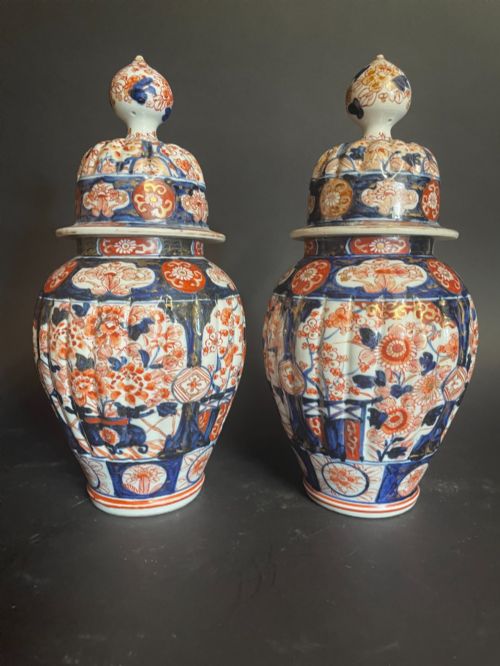


Pair Imari Urns Lids
These pair imari urns lids are striking lidded vessels combining traditional Japanese aesthetics with European tastes, offering collectors a bold focal point for a mantelpiece.
Pair Imari Urns Lids
When you search for pair imari urns lids, you encounter robust lidded vessels originating primarily from nineteenth-century productions alongside seventeenth and eighteenth-century examples. These pieces typically take the form of lidded jars, decorative vases, and large urns designed to stand symmetrically in a room.
The objects on this page bridge Japanese Arita traditions and European decorative schemes, frequently reflecting Edo period influences or Victorian interpretations. Buyers most commonly meet nineteenth-century manifestations in this category, often featuring matching covers and substantial proportions.
Makers ranged from traditional Arita kilns to European houses such as Samson and Mason's producing Imari style wares. This mix provides both authentic Japanese export pieces and sophisticated European imitations from later periods.
How they were made
Potters shaped these vessels from high-fired porcelain or ironstone china, applying cobalt blue underglaze to establish the foundational blue tones before glazing the surface. Artisans then added rich enamel colours and gilding or gold leaf highlights.
Many of the grander examples incorporated cast or chased ormolu mounts to secure the porcelain bodies and enrich the decorative scheme. Firing techniques required precise temperature control to achieve the characteristic depth of the glazes and the brilliance of the overlying metallic details.
Listings feature porcelain, ironstone china, enamel, gilding, gold leaf, and ormolu across multiple centuries.
What varies in quality
The sophistication of the hand-painted enamel work and the crispness of the cobalt blue underglaze determine the visual weight of the piece. Finer examples display meticulous brushwork and balanced compositions across both matching urns.
The presence of original lids that fit the neck securely without excessive wobble elevates the integrity of the pair. Additionally, the quality of any supplementary gilding, ormolu mounts, or ironstone body alters the tactile presence of the object.
Samson·Mason's
The Pair Imari Urns Lids Glossary
- Imari
- A style of Japanese porcelain originating from the port of Imari in Arita, traditionally decorated in underglaze blue, iron red, and gold. This palette creates a vibrant contrast beloved by collectors across centuries.
- Arita
- The Japanese town central to the production of porcelain since the early Edo period. Kilns here supplied domestic markets and European export trade.
- Ironstone
- A type of durable heavy earthenware patented in the nineteenth century by manufacturers such as Mason's. It mimics porcelain while offering robust utility.
- Ormolu
- Gilt bronze mounts applied to furniture and ceramics, particularly popular during the Victorian era. It provides a luxurious metallic frame for porcelain vessels.
- Underglaze blue
- Pigment applied to the raw clay body before glazing and firing, ensuring the colour remains protected beneath a glassy surface. This technique allows for sharp and enduring cobalt patterns.
Pair Imari Urns Lids: Frequently Asked Questions
Are these urns purely decorative?
These vessels served primarily as decorative garnitures and ornamental urns in grand interiors rather than utilitarian containers. Their striking scale and rich palettes made them centrepieces for mantelpieces and side tables.
Over time, collectors have prized them for their visual impact rather than practical use, displaying them in matched pairs to anchor a room's symmetry.
How do I spot an earlier piece?
Earlier pieces from the seventeenth and eighteenth centuries often display thinner potting, distinct iron-foot rims, and cobalt blue tones that sink deeper into the body. Examining the weight, the ironstone or porcelain composition, and the style of the hand-painted enamel helps distinguish Edo period items from later Victorian productions.
European interpretations, such as those by Samson, often reveal subtle differences in paste texture and enamel application when compared directly to Japanese originals.
Do the lids usually match?
Most pieces listed as pairs retain their original matching covers, which is crucial for the overall harmony of the vessels. Because lids were easily separated or damaged over the centuries, finding an intact pair with corresponding decoration is a significant advantage.
Inspecting the interior rims and the continuity of the pattern across the join confirms whether the lid belongs properly to the jar.
How should I clean them?
Dusting gently with a soft, dry brush is the safest method for maintaining the surface of these porcelain and gilt surfaces. Avoid using wet cloths or chemical cleaners, which can damage delicate overglaze enamels and gold leaf highlights.
Keeping them away from direct sunlight and sudden temperature changes will preserve the vibrancy of the cobalt blue and iron red pigments.