
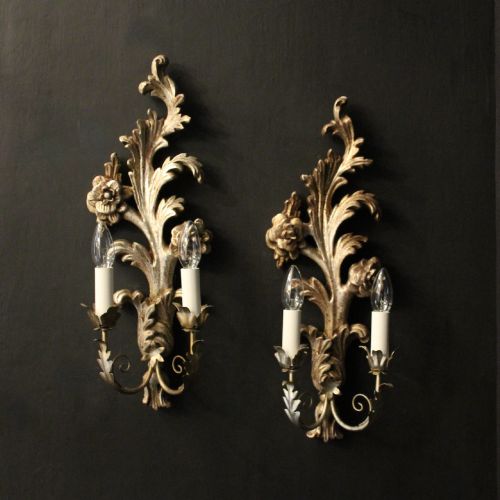
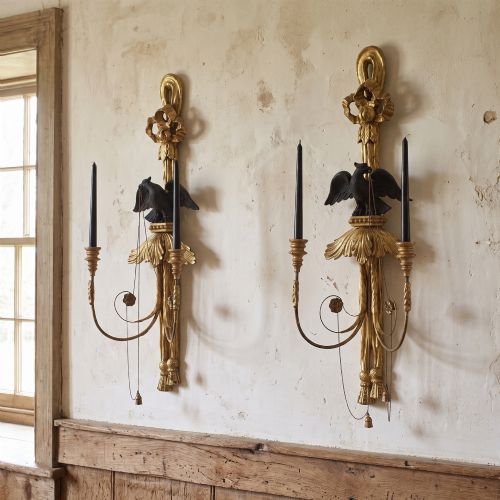
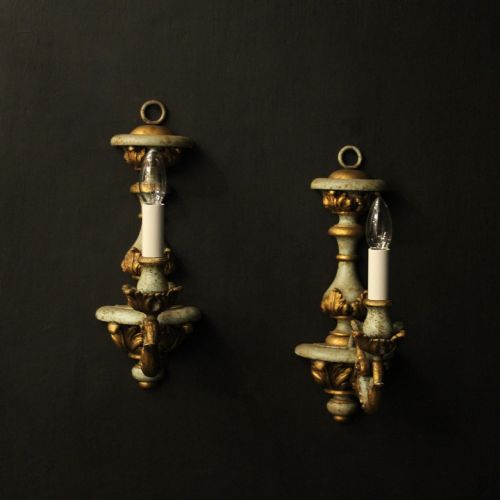
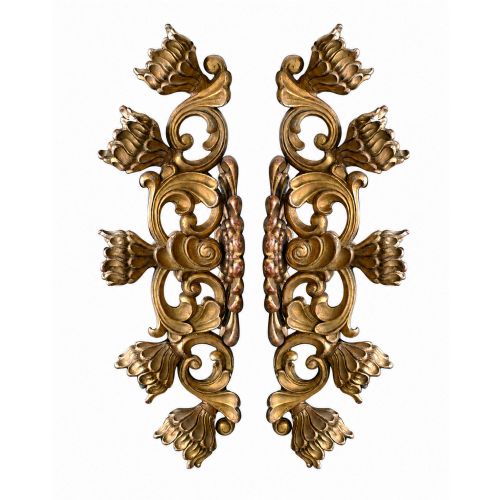


Pair Giltwood Appliques
Pair giltwood appliques bring rich classical illumination to a room, offering sculpted wooden frames coated in brilliant gold leaf.
Pair Giltwood Appliques
When buyers search for pair giltwood appliques, they examine decorative wall lighting fixtures designed to hold candles or electrical fittings. These pieces function as ornamental wall sconces and brackets, projecting light outwards while adding sculptural presence to an interior. The selection draws heavily from Florentine workshops and French provincial designs.
The objects span centuries of craftsmanship, ranging from seventeenth-century origins through eighteenth-century Venetian creations up to twentieth-century revivals. Among these, twentieth-century Florentine and French interpretations appear most frequently on this page. These later iterations often emulate earlier baroque and rococo aesthetics with carved wooden armatures.
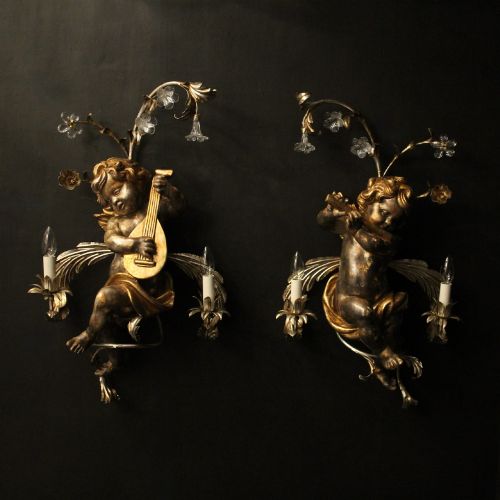
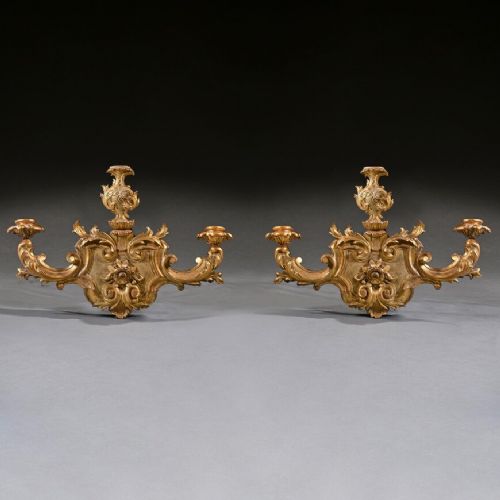
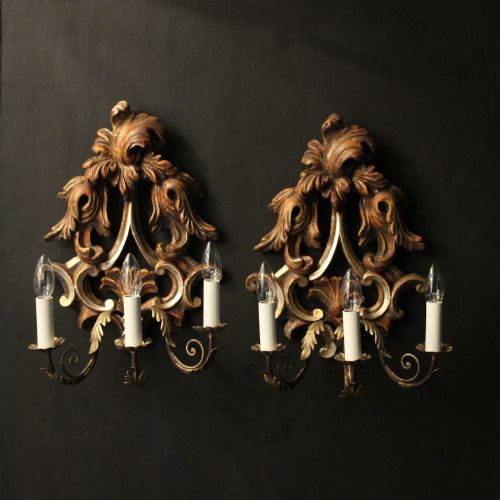
Forms vary from single-arm brackets to elaborate multi-armed configurations featuring twin, triple, or quadruple branches. Certain examples incorporate mirror backs or carved cherub motifs, while others adopt classical lyre shapes. The unifying characteristic remains the paired symmetry and the golden surface finish.
Materials and construction methods
Carvers shaped the foundational structure from wood, utilising timber bases that received detailed chisel work before finishing. Artisans frequently applied a layer of gesso over the carved wood to create a smooth, responsive ground for subsequent gilding. This plaster-like preparation allowed for sharp relief details in scrolls, acanthus leaves, and figural elements.
The decorative surfaces received applications of gold leaf or silver leaf, adhered carefully to the prepared gesso base. Some pieces incorporated polychrome pigments or ebonised sections to contrast against the metallic lustre. Metal components reinforced the armatures and weight-bearing joints where wall lights held branching candle nozzles.
The inventory records Italian, French, and English design idioms, including Florentine Rococo, Italian Baroque, and George III styles.
Assessing quality in giltwood lighting
The crispness of the hand-carving defines the upper tier of production, distinguishing deeply undercut foliage and expressive figures from soft, mechanical moulding. Master carvers achieved fluid motion in rococo scrolls and precise symmetry in neoclassical frames. Lesser examples rely heavily on thick gesso build-up to simulate detail where the underlying wood carving lacks definition.
The integrity of the surface preparation and metal leaf application dictates long-term visual depth. Superior pieces display thin, burnished gold leaf that catches ambient light across varied planes, while standard production shows flatter, more uniform metallic coatings. Original patination and minimal modern intervention preserve the historical character of the gesso and wood underneath.
The Pair Giltwood Appliques Glossary
- Giltwood
- Wood that has been coated with gold leaf or metal powder over a prepared ground. This technique provides a luminous metallic surface while utilising a lighter timber core.
- Gesso
- A mixture of gypsum, chalk, and size used to coat carved wood. It creates a smooth, absorbent surface ideal for holding leaf and capturing fine sculptural detail.
- Applique
- A decorative wall-mounted lighting fixture or sconce. The term typically denotes ornamental wall brackets designed to hold candles or lamps.
- Sconce
- A wall-mounted light fitting with arms that project forward into the room. These fixtures often mirror the decorative language of contemporaneous furniture and architecture.
- Rococo
- An ornate design style characterised by asymmetrical scrolls, C-curves, and naturalistic shell motifs. It originated in France during the eighteenth century and inspired later revival pieces.
- Polychrome
- Decorated in multiple colours. In these pieces, painted pigments accent specific areas alongside standard gilding.
Pair Giltwood Appliques: Frequently Asked Questions
How do I install pair giltwood appliques?
These wall lights require secure mounting to wall studs or appropriate masonry fixings to support the weight of the carved wood and metal arms. Electrical wiring must be channeled safely through the wall bracket or adapted for modern surface wiring.
Professional installation by an electrician ensures that internal fittings comply with safety standards while protecting the fragile gilded surface from handling damage.
Were these wall lights wired originally?
Historical examples were designed exclusively for wax candles, utilising wooden or metal drip pans to catch melted wax beneath the nozzle. Many surviving pieces received electrical conversions during the twentieth century to accommodate internal wiring.
Conversion methods vary between internal channels drilled through the timber and discreet external cords routed along the rear mounting plate.
How do I distinguish eighteenth-century pieces from later revivals?
Eighteenth-century examples display hand-split pine or hardwood backing plates, organic wear patterns in the gesso, and genuine hand-applied gold leaf that thins naturally over high points. Tool marks left by early gouges and chisels differ significantly from twentieth-century reproduction techniques.
Revival pieces from the early twentieth century often utilise standardised machine-cut components, denser modern gesso, and uniform chemical patination designed to simulate age.