






Pair French Pier Tables
Pair french pier tables bring architectural balance to a room, offering matched surfaces designed to stand against a wall beneath a mirror or window.
Pair French Pier Tables
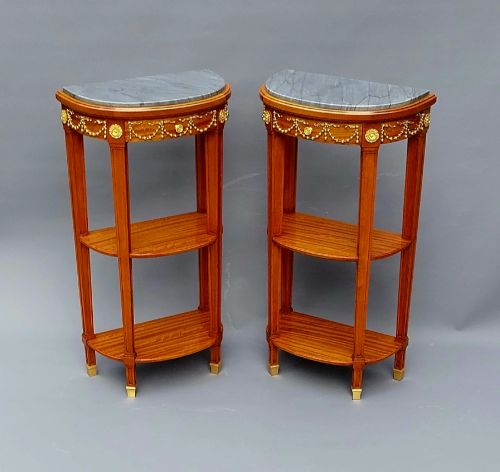
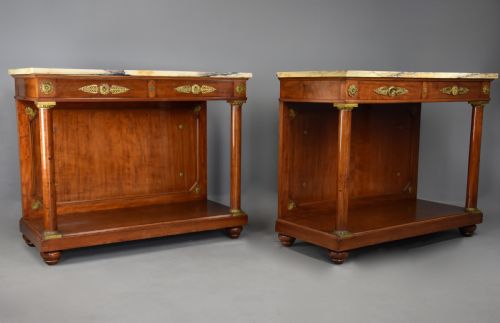
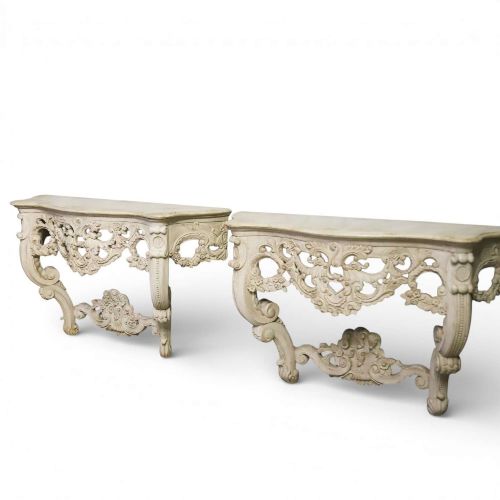
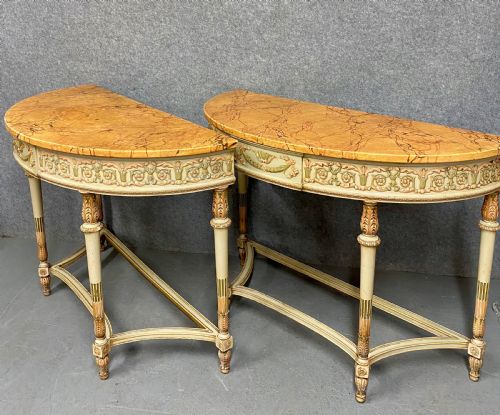
Pair french pier tables take the form of console or side tables designed to stand flush against a wall, frequently featuring demilune or semicircular shapes. These matching examples emerge primarily from the eighteenth and nineteenth centuries, alongside twentieth-century interpretations, carrying stylistic influences from Louis XV, Louis XVI, and Empire designs.
The assortment relies heavily on matching pairs configured for wall placement, often constructed as console tables with heavy stone tops. Makers and workshops from various decades applied historic revival idioms, notably Rococo and Neoclassical vocabularies, to formal domestic interiors.
How they were made
Construction relies on timber framing using mahogany, walnut, and various woods shaped into complex curves, sometimes finished with hand-carved details or painted surfaces in antique white. Carved giltwood and painted wood treatments provide decorative texture to the structural carcase.
Surfaces are typically completed with heavy marble slabs fitted to the top, while ornamental metalwork utilises ormolu or gilt bronze mounts. Individual pieces show evidence of marquetry work and maker stamps applied directly to the timber framework.
Pair French Pier Tables Retail Price Guide 2026
Typical asking prices for pair french pier tables among the pieces listed under this phrase on Sellingantiques today, from the lower quarter to the upper quarter. They describe what is for sale here now, not the wider market.
Several tables retain antique white finishes applied decades ago, catching the light just as their makers intended in grand Parisian salons.
What varies in quality
Quality rests upon the crispness of the hand-carving in the wood or giltwood elements, where deeply undercut foliage and confident scrollwork distinguish superior examples from simpler production. The integration of the marble top with the wooden base dictates the structural harmony of the piece.
Attribution to known workshops, indicated by stamps such as Krieger Paris or makers like Jean Joseph Chapuis, elevates the standing of individual pairs. The precision of the gilt bronze mounts and the retention of original painted finishes further separate standard items from finer masterworks.
Krieger Paris·Jean Joseph Chapuis
The Pair French Pier Tables Glossary
- Demilune
- Half-moon shape denoting a semicircular table top with a flat rear edge designed to sit against a wall. This profile dominates the lighter console and side table formats.
- Ormolu
- Gilded bronze ornamentation applied to furniture mounts, cast and chased for decorative effect. This technique highlights key architectural joints and structural lines.
- Giltwood
- Timber treated with a thin layer of gold leaf over a prepared gesso ground. It provides a reflective, ornate surface typical of formal period furnishings.
- Marquetry
- The art of applying pieces of veneer to a structure to form decorative patterns. Craftsmen utilised contrasting timbers to create pictorial or geometric designs on table tops.
Pair French Pier Tables: Frequently Asked Questions
Where should I place these tables?
These matching consoles suit placement in entrance halls, drawing rooms, or dining spaces where symmetrical arrangement matters. They anchor vertical wall space effectively when positioned beneath large mirrors or artworks.
Because they are designed as matching pairs, they work best when balanced on either side of a fireplace or between tall windows.
How do I care for the marble tops?
Marble surfaces require gentle cleaning with a damp cloth and mild, pH-neutral soap to preserve the polished finish. Avoid acidic substances like citrus or vinegar, which can etch the stone.
Using coasters and mats prevents scratching and staining on antique marble.
Are these tables sturdy enough for daily use?
These tables function primarily as decorative architectural furniture rather than heavy-use utility surfaces. Their slender legs and wall-fixed designs mean they are often secured to the wall for stability.
Placing lamps, decorative objects, or floral arrangements on top is entirely appropriate for everyday living.
How do I identify the period style?
Period styles reveal themselves through characteristic motifs, such as the asymmetric curves of Rococo revival or the strict symmetry of Neoclassical and Empire designs. Finer details like ormolu mounts and hand-carved giltwood point towards specific nineteenth-century revivals of earlier French aesthetics.
Construction methods and timber choices further help date the pieces accurately.