







Louis XVI Demilune Table
A louis xvi demilune table brings architectural symmetry and refined French Neoclassical proportion to a hallway or drawing room.
Louis XVI Demilune Table
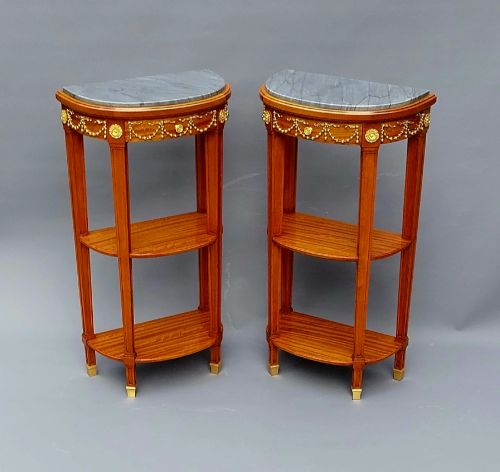
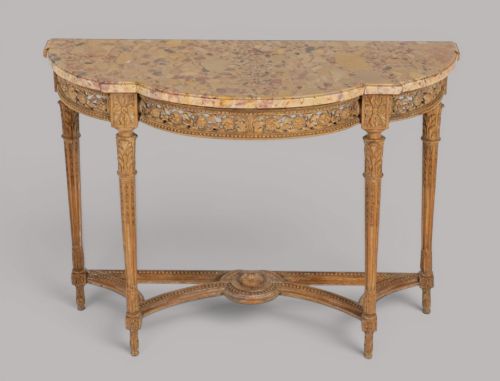
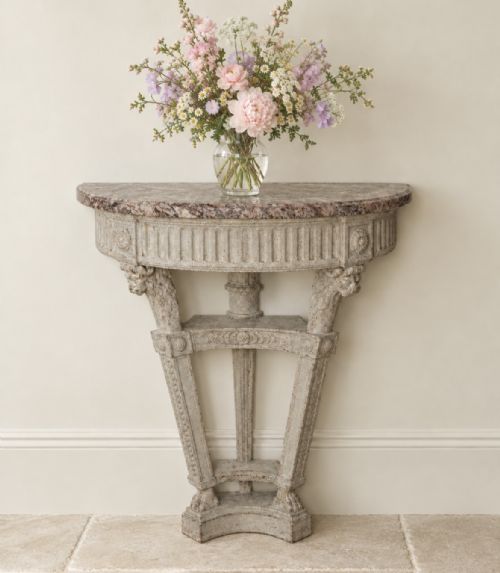
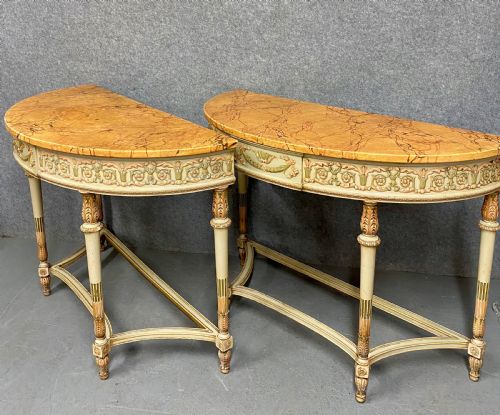
A louis xvi demilune table takes the form of a half-moon console or card table, built in styles spanning the eighteenth century through to the revival periods of the nineteenth century. These tables serve primarily as console or hall tables, alongside occasional bedside and card tables.
Most examples found on this page date from the nineteenth century, including revival pieces from around eighteen eighty to nineteen hundred, sitting alongside authentic eighteenth-century items. The forms rely on classical restraint, straight tapered legs, and semicircular tops.
Makers and workshops of the nineteenth century frequently drew upon earlier French Neoclassical designs, creating pieces that echo the proportions of the original period while utilising the timber and decorative finishes of their own time.
How they were made
Construction relies upon traditional timber framing in walnut and carved wood, providing a stable carcase for stone tops and decorative surfaces. Cabinetmakers shaped the half-moon tops to receive fitted slabs of marble.
Decorative finishes include gesso, gold leaf, and paint, applied to create the giltwood and painted surfaces characteristic of the style. Parquetry inlay appears on specific card table forms, requiring precise geometric placement of wood veneers.
Louis XVI Demilune Table Retail Price Guide 2026
Typical asking prices for louis xvi demilune table among the pieces listed under this phrase on Sellingantiques today, from the lower quarter to the upper quarter. They describe what is for sale here now, not the wider market.
The listings on this page span the eighteenth and nineteenth centuries, including specific production dates from eighteen eighty to nineteen hundred.
What varies in quality
Quality rests in the crispness of the carved wood details and the handling of the gesso and gold leaf. Finer tables display sharply defined classical motifs rather than softened or repetitive cast decoration.
The choice of materials also distinguishes the range, particularly the selection of the marble top and the depth of the walnut timber beneath the paint or polish.
The Louis XVI Demilune Table Glossary
- Demilune
- A half-moon shape used for console and card tables designed to stand flat against a wall.
- Neoclassical
- A style drawing inspiration from the classical art and architecture of ancient Greece and Rome.
- Parquetry
- Geometric wood inlay work arranged in patterns across the surface of a table top.
- Giltwood
- Timber treated with a thin layer of gold leaf applied over a prepared gesso ground.
Louis XVI Demilune Table: Frequently Asked Questions
Where should I place a demilune table?
These half-moon tables suit narrow entrance halls, reception rooms, and spaces where a full round table projects too far into the room. Their flat back sits flush against the wall.
They also function effectively beneath a mirror or painting, providing a surface for lamps or decorative objects without blocking movement.
How do I tell an eighteenth-century table from a nineteenth-century revival piece?
Examination of the timber construction, tool marks, and wear patterns helps determine the age of the carcase. Eighteenth-century examples show the natural ageing of walnut and early joining techniques.
Nineteenth-century revival pieces, including those from the eighteen eighties and nineties, often display different secondary woods and interpretations of Louis XVI details.
What is the difference between a console table and a card table?
A console table is designed purely to stand against a wall as a decorative and functional surface, frequently topped with heavy marble. These often feature fixed bases.
A card table includes a folding or pivoting top that opens to reveal a playing surface, intended for gaming and entertaining.
How do I care for a painted or giltwood finish?
Painted and giltwood surfaces require gentle dusting with a dry, soft cloth to prevent the accumulation of grit. Moisture and harsh cleaning agents damage gold leaf and historical paint.
Keeping these tables away from direct sunlight and sudden temperature changes protects the gesso and wood underneath.