



Pair Floral Wall Lights
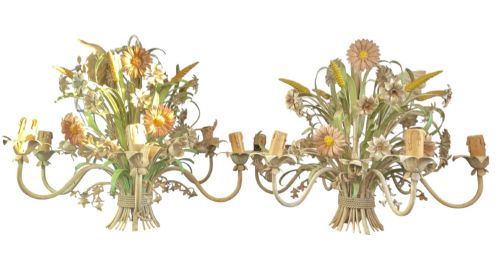
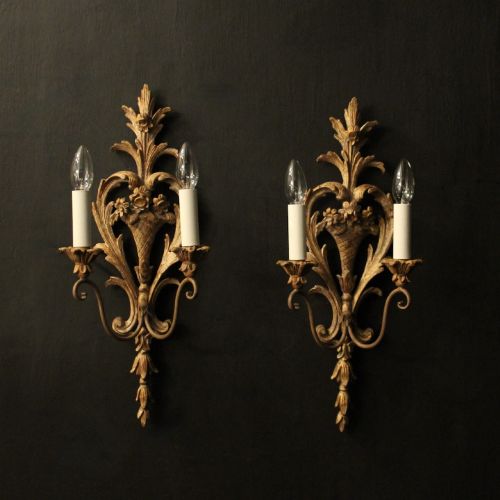
These pair floral wall lights bring botanical brass, giltwood and painted metal branches directly to your walls, offering matching illumination from the nineteenth and twentieth centuries.
Pair Floral Wall Lights
When you search for pair floral wall lights, you are looking at matched sets of decorative illumination modelled after natural flora and foliage. These fixtures are designed to mount directly onto vertical surfaces, providing balanced light distribution from two opposing sides of a room.
The versions you are most likely to meet on this page originate predominantly from French workshops during the nineteen-thirties, constructed as toleware or painted metal. Alongside these French pieces, you will encounter examples styled in Florentine giltwood, Anglo-Indian mirrored designs, and Art Nouveau ironwork.
Forms range from single arm variations to twin arm and three branch configurations, often incorporating sculpted leaves and painted petals. They bridge the gap between functional wall sconces and sculptural wall art, bringing botanical motifs into interior spaces.
How they were made
Makers constructed these fixtures using a combination of forged metals, carved timber and formed glass. Wrought iron and gilt metal provide the structural armature, whilst toleware employs painted sheet metal to shape realistic floral petals and leaves.
Giltwood examples utilise carved hardwood finished with gold leaf, reflecting Florentine traditions of woodcraft. Polychrome and painted metal finishes rely on layered pigments applied directly to the metal surface to create naturalistic floral colouration.
Pair Floral Wall Lights Retail Price Guide 2026
Typical asking prices for pair floral wall lights among the pieces listed under this phrase on Sellingantiques today, from the lower quarter to the upper quarter. They describe what is for sale here now, not the wider market.
Several pairs feature green daisy designs, proving that interior decorators a century ago were just as fond of cheerful garden motifs as we are today.
What varies in quality
The distinction between standard and superior examples lies in the finesse of the botanical modelling and the integrity of the materials. Hand-carved giltwood and finely beaten wrought iron demonstrate a level of artisan precision that mass-produced stamped metal simply cannot replicate.
Depth of finish also dictates value, with layered polychrome paintwork and genuine gilding holding up better to visual scrutiny than flat, uniform factory coatings. The complexity of the arm configurations, moving from simple single arms to ornate three branch structures, further separates the ordinary from the exceptional.
The Pair Floral Wall Lights Glossary
- Toleware
- Painted or lacquered sheet metalware that gained popularity in France and Britain for decorative household items. It allows artisans to shape thin metal into convincing floral petals and foliage.
- Giltwood
- Timber that has been coated with a thin layer of gold leaf or powder. This technique gives carved wall lights a luminous metallic sheen.
- Sconce
- A wall-mounted light fixture that uses brackets to support candles or electric lamps. In older pieces, these often feature mirrored backs to amplify the illumination.
- Polychrome
- Decorated in multiple colours. This refers to the painted floral details found on metal and wooden wall light surfaces.
- Art Nouveau
- A stylistic movement from the late nineteenth and early twentieth centuries characterised by organic, sinuous lines. Pieces from this period frequently incorporate plant-inspired motifs.
Pair Floral Wall Lights: Frequently Asked Questions
How do I install antique wall lights?
Most period wall lights require hardwiring into your electrical circuit by a qualified professional. You should consult an electrician to ensure the vintage mounting brackets align safely with modern wall boxes.
Older fixtures may need rewiring with modern flex and lamp holders to meet current safety standards. Many sold pieces indicate they have already been updated for contemporary electrical use.
Where should I place wall lights?
These fixtures work best mounted at eye level in hallways, living rooms, or flanking a fireplace or mirror. Placing them in pairs creates symmetry and balanced illumination across a vertical space.
Consider the height of your ceilings and the reach of the arms when positioning them to avoid obstructing pathways. The botanical forms make them effective focal points even when unlit.
How do I date a pair of wall lights?
Examine the materials, construction methods, and stylistic cues such as Art Nouveau curves or Florentine carving techniques. The inventory includes pieces dated across the nineteenth and twentieth centuries.
Hand-forged ironwork and early toleware finishes often display tool marks and material ageing indicative of their specific era. Comparing the wiring components can also provide clues, though many older fixtures have been rewired.