
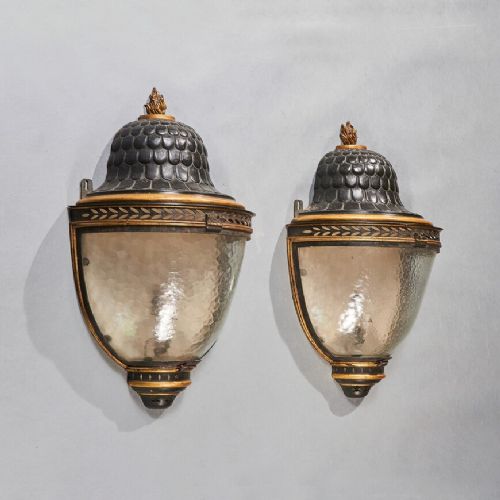


Painted Metal Wall Lights
These painted metal wall lights bring warmth and character to a room, offering functional illumination through decorative metalwork.
Painted Metal Wall Lights
When you search for painted metal wall lights, you encounter fixtures designed to mount directly onto interior walls for illumination. The pieces on this page span several decades and centuries, ranging from the early nineteenth century through to nineteen thirty.
You are most likely to meet French designs in this selection, including styles such as French provincial, French neoclassical, and French rococo. Makers often fashioned these lights as pairs or sets, utilising forms like wall sconces, wall lanterns, and twin arm fixtures.
The materials recorded in these listings extend beyond simple painted metal to incorporate glass, wrought iron, gesso, brass, and copper. Decorative details frequently include floral motifs, polychrome finishes, parcel gilt accents, and porcelain flowers.
How they were made
Artisans constructed these lighting fixtures using robust metals such as iron, copper, and brass as the foundational structure. They shaped the metal components through forging and smithing, particularly evident in wrought iron wall sconces.
Surface decoration relied heavily on toleware techniques, applying paint and polychrome finishes directly to the metal substrate. Artisans often enhanced these painted surfaces with parcel gilt details and added elements like glass and porcelain flowers to complete the ornamentation.
Painted Metal Wall Lights Retail Price Guide 2026
Typical asking prices for painted metal wall lights among the pieces listed under this phrase on Sellingantiques today, from the lower quarter to the upper quarter. They describe what is for sale here now, not the wider market.
Listings feature items from the nineteenth century up to nineteen thirty, with French styles predominating across the selection.
What varies in quality
The refinement of the decorative metalwork distinguishes finer examples from simpler utilitarian pieces. Superior items display meticulously formed floral motifs, hand-painted polychrome details, and integrated parcel gilt work that shows careful hand execution.
The complexity of the form also establishes a hierarchy among these fixtures. Twin arm configurations, lanterns with glass panels, and matched pairs or sets demand a higher level of craftsmanship than single, plain wall brackets.
The Painted Metal Wall Lights Glossary
- Toleware
- Painted or lacquered metalware, typically tin or steel, decorated with motifs that often mimic Asian lacquerwork. This technique creates durable and colourful decorative objects.
- Parcel gilt
- A decorative treatment where specific areas of an object are partially gilded with gold leaf. This method highlights carved details and metal ornamentation.
- Polychrome
- The practice of decorating architectural elements, sculptures, or metalwork in a variety of colours. It adds visual depth and realism to floral and fruit motifs.
- Wrought iron
- Iron that has been heated and shaped with tools by a blacksmith. This material provides strong structural support for wall sconces.
- Bouillotte
- A style of light fixture traditionally associated with a card game of the same name. These often feature adjustable shades and multiple candle arms.
Painted Metal Wall Lights: Frequently Asked Questions
How do I mount painted metal wall lights?
These fixtures attach directly to wall surfaces using standard bracket fixings. Professional electrical installation ensures safe connection to your home wiring.
Consider the height of placement relative to furniture and doorways to achieve balanced illumination.
Are these lights electrified or for candles?
The listings comprise historic lighting fixtures that have often been adapted for electricity over time. Some retain traditional forms intended for candle use.
Checking the individual details of each piece clarifies its current wiring status and bulb configuration.
How do I clean painted metal wall lights?
Gentle dusting with a soft, dry cloth preserves the painted and gilt surfaces. Avoid harsh chemical cleaners that might strip the historic finish.
Careful handling prevents damage to delicate elements like porcelain flowers or glass components.
What periods do these wall lights come from?
The pieces span from the early nineteenth century through to the nineteen thirties. Victorian and early twentieth-century examples feature prominently in the selection.
Stylistic cues such as neoclassical symmetry or rococo curves help identify the design era.