




Pair Corner Cupboards
Pair corner cupboards are matched sets of fitted storage units designed to occupy the meeting point of two walls.
Pair Corner Cupboards
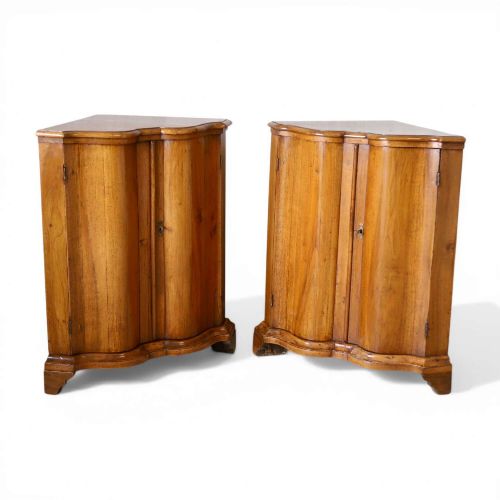
Pair corner cupboards turn neglected angles into display and storage space, appearing in forms from tall floor-standing cabinets to small hanging units and military lockers. The selection on this page spans centuries of domestic storage, with examples originating from English, French, Italian, and Dutch workshops.
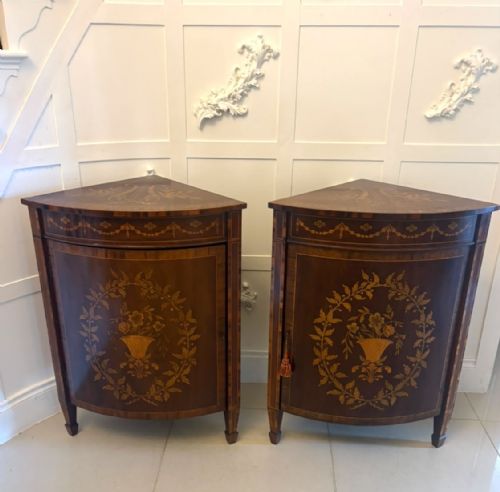
Most pieces encountered here date from the eighteenth and nineteenth centuries, taking the shape of corner cabinets, side cabinets, and display cases. Walnut and mahogany dominate the offerings, frequently enhanced with marquetry or fruitwood inlay.
Makers adapted the form across changing decorative tastes, producing neoclassical revival pieces alongside utilitarian campaign lockers bound in brass. Buyers select these matches to balance symmetrical interiors while concealing tableware, books, or collections.
How they were made
Cabinetmakers constructed carcases in mahogany, walnut, oak, and pine, applying veneers of kingwood, burr walnut, and goncalo alves to prominent surfaces. Timber selection governed both the structural integrity and the decorative impact of the front elevation.
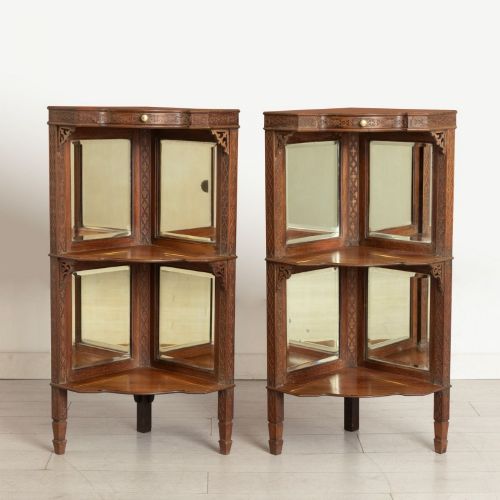
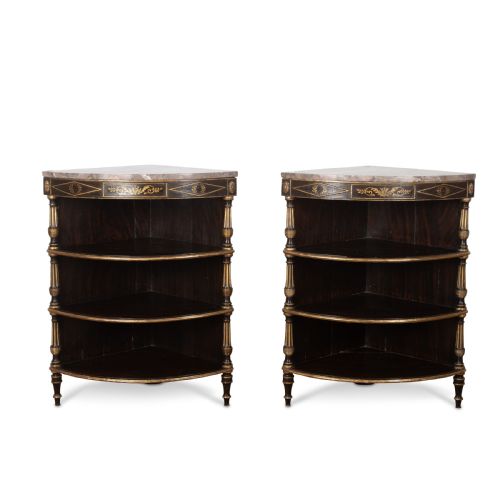
Marquetry and fruitwood inlay provided intricate surface decoration, whilst brass hardware, ormolu mounts, and marble tops added functional contrast. Glazed doors appeared on display variants, requiring precise joinery to house glass panels securely.
The archive and active listings span multiple centuries, touching the eighteenth, nineteenth, and twentieth periods.
What varies in quality
Quality rests upon the selection of timbers and the precision of the veneer work, where matched grain patterns on opposing doors reveal superior workshop standards. Finer examples display meticulous hand-cut marquetry and crisp carving rather than repetitive stamped ornament.
Original hardware, sound door alignment, and intact internal shelving separate master-carpenters' commissions from standard commercial output. The integration of specialised materials like marble tops or heavy brass mounts elevates certain specimens above simpler utility pieces.
Edwards & Roberts
The Pair Corner Cupboards Glossary
- Marquetry
- Decorative veneer work formed by fitting together small pieces of tinted wood, ivory, or shell to create pictorial designs. It transforms plain cabinet faces into intricate canvases.
- Encoignure
- A French term for a corner cupboard or cabinet designed to fit flush into a room angle. These frequently feature curved or bow fronts.
- Campaign style
- Portable furniture built in sections with brass corners and recessed handles for military transport. Such pieces prioritize robust construction and disassembly.
- Kingwood
- A dense, heavy Brazilian timber featuring rich dark brown tones with golden streaks. Cabinetmakers utilised it extensively for high-end decorative banding.
- Ormolu
- Gilded bronze used for furniture mounts and decorative hardware. It provides a bright metallic accent against dark hardwoods.
Pair Corner Cupboards: Frequently Asked Questions
How do I hang a wall cupboard?
Hanging corner cupboards require secure fixing to solid wall studs or masonry using appropriate internal brackets. The weight of timber doors demands stable wall anchoring to prevent displacement.
Ensure the unit is leveled precisely before final tightening so the doors swing correctly within their frames.
What rooms suit corner cabinets?
These units suit dining rooms, drawing rooms, and hallways where empty angles benefit from functional furniture. Their angled backs utilise neglected space without obstructing room flow.
Matching pairs frame fireplaces, windows, or doorways to create balanced symmetrical interior layouts.
How do I identify Victorian pieces?
Victorian examples often feature dark mahogany or burr walnut timbers with machine-assisted carving or rich marquetry inlay. Cabinet construction during this era frequently incorporated standardised brass hardware and factory-produced hinges.
Reference the secondary woods inside the carcase, as pine and oak usage shifted across the nineteenth century.
Can I mix wood tones?
Mixing woods works well if the period styles share similar proportions and surface finishes. Mahogany and walnut pieces complement each other when united by common decorative elements like brass mounts.
Allow the grain patterns to create visual dialogue rather than forcing exact colour matches across the room.