

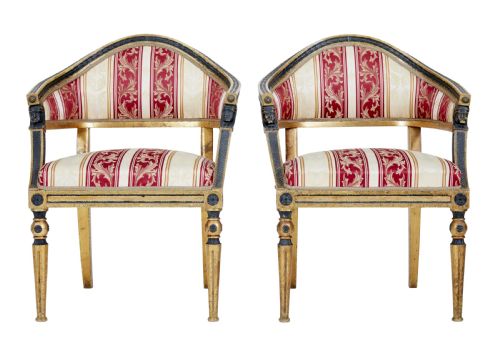


Pair Classical Armchairs
Pair classical armchairs bring symmetrical architectural dignity to a room, offering structured seating shaped by centuries of revivalist design.
Pair Classical Armchairs
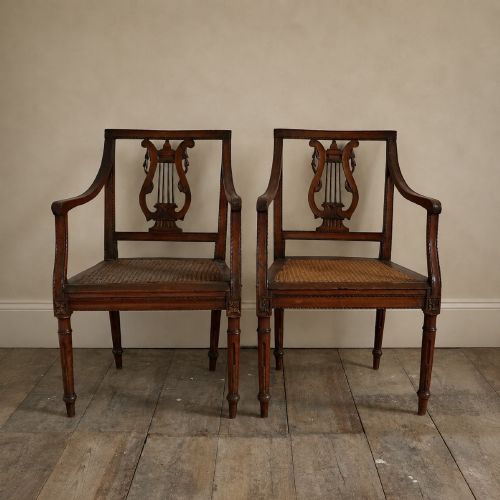
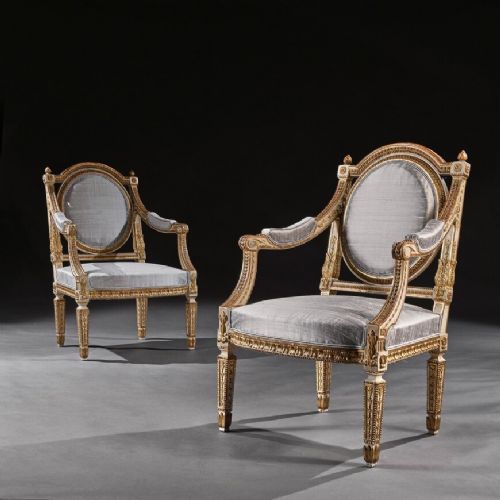
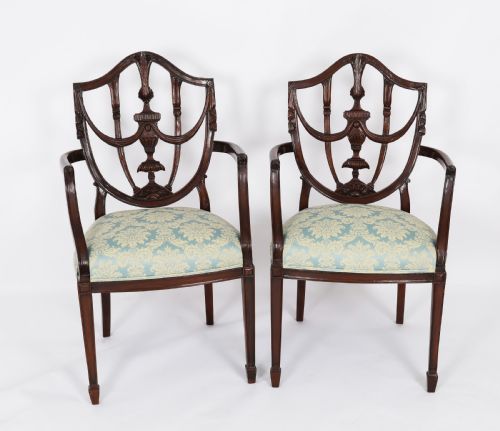
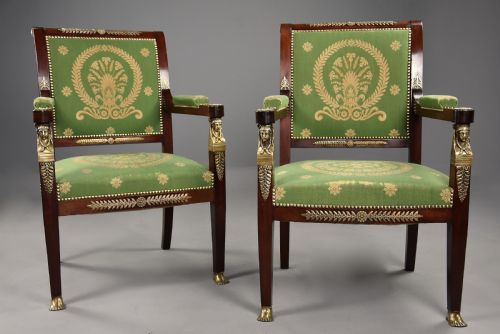
These pair classical armchairs draw upon the formal vocabularies of Regency, French Empire, Italian Neoclassical, and Federal Revival styles. Symmetrical seating of this scale demands balanced placement within a drawing room, library, or formal salon.
The evidence shows forms ranging from lyre-backed mahogany frames to gilded Italian armchairs and Swedish birch designs. Buyers frequently encounter nineteenth-century pieces alongside revival pieces from the early twentieth century.
Open armchairs, known as fauteuils, sit alongside solid elm and mahogany frames, often accompanied by cane seats or modern upholstery. Each pair reflects the enduring influence of classical antiquity upon domestic seating.
What varies in quality
The crispness of the carving defines the visual success of the frame, distinguishing sharp acanthus leaves and fluted legs from softer, moulded interpretations. Hand-carved detail in mahogany or giltwood requires a steady chisel and deep understanding of proportion.
The integrity of the structural timber and the retention of original gilding or paint surfaces dictate the historic value of the pair. Uniformity across both chairs determines whether the pair remains a cohesive artistic unit.
Lyre-backed chairs let you pretend your sitting room is a municipal hall dedicated entirely to ancient Greek stringed instruments.
The Pair Classical Armchairs Glossary
- Neoclassical
- A style spanning the eighteenth and nineteenth centuries that revived the motifs of ancient Greece and Rome. It relies on symmetry, straight lines, and classical ornamentation.
- Giltwood
- Timber coated with gold leaf or powder over a gesso ground. This finish creates a brilliant, reflective surface favoured in formal European salons.
- Fauteuil
- An open-framed wooden armchair with upholstered seat and back, and uncovered wooden armrests. Originating in France, it became central to classical seating design.
- Parcel Gilt
- A decorative treatment where only specific carved elements of a painted or stained wooden surface are highlighted with gold leaf. This technique emphasises structural details like rosettes and borders.
Pair Classical Armchairs: Frequently Asked Questions
Where should I place pair classical armchairs?
These chairs demand a symmetrical setting, such as flanking a fireplace, positioned opposite a sofa, or anchoring either side of a large console table. Their architectural lines work best when given adequate floor space to be viewed as a matched set.
Because they originate from formal rooms of the nineteenth and early twentieth centuries, they naturally establish a focal point in a modern drawing room or study.
How do I care for antique giltwood frames?
Giltwood requires gentle treatment to preserve the delicate gold leaf layer applied over gesso. Dusting should be done lightly with a dry, soft brush rather than a cloth that might snag on carved edges.
Keep these chairs away from direct sunlight and fluctuating humidity to prevent the underlying wood from expanding and the gesso from cracking.
Are these chairs comfortable for daily use?
Classical armchairs were designed for upright posture in formal reception rooms rather than lounging. While some feature padded seats and upholstered backs, their frames prioritize architectural symmetry and supportive posture.
Many examples retain or have been updated with supportive interior webbing and padding suitable for conversational seating in a living space.
How can I tell nineteenth-century frames from revival pieces?
Nineteenth-century originals often exhibit hand-cut joinery marks, dense native timbers, and surface wear consistent with age. Revival pieces from the early twentieth century may employ machine-assisted construction alongside traditional hand-finishing.
Examining the underside of the seat rails and the patina of the wood helps reveal the true period of manufacture.