

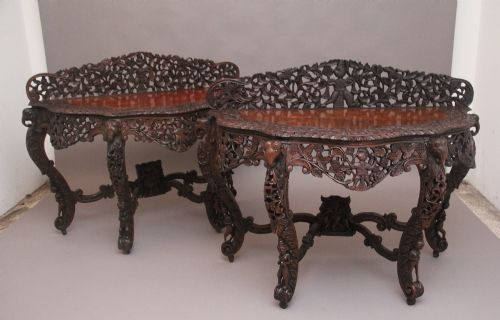
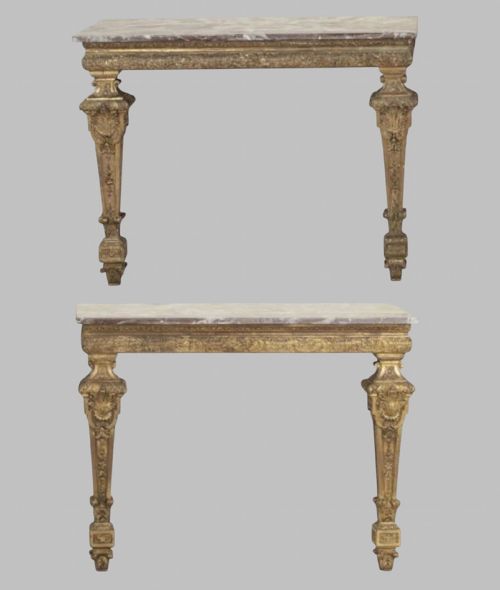

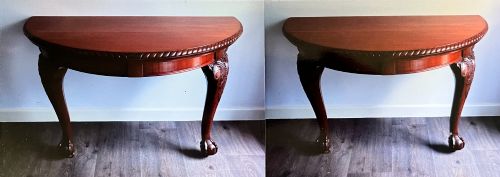
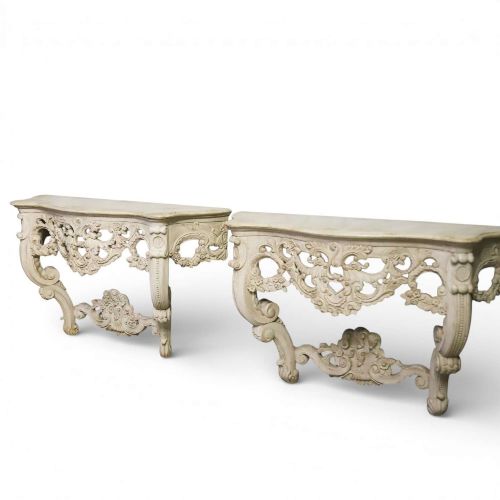


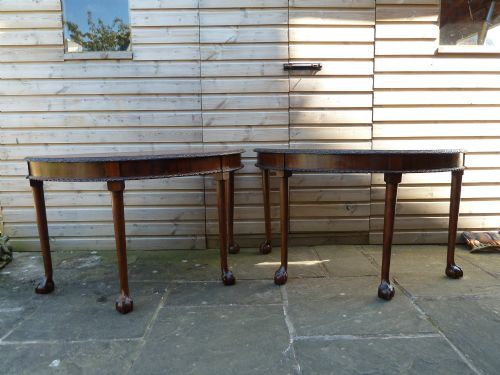

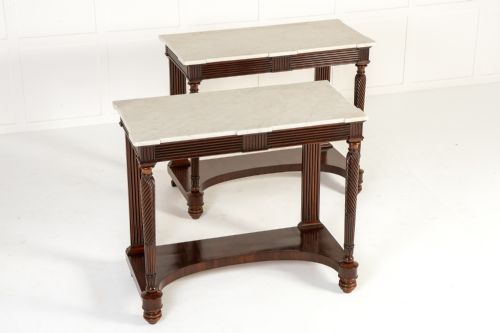


Pair Carved Wall Tables
These pair carved wall tables bring architectural balance to a room, offering surface space anchored firmly to the wall without taking up floor area.
Pair Carved Wall Tables
When you search for pair carved wall tables, you find console tables, wall consoles, and side tables designed to be fixed against a vertical surface. The forms span the eighteenth, nineteenth, and twentieth centuries, appearing in matched pairs that create symmetry in a hallway, drawing room, or dining space.
The material selection on this page ranges from solid timber like mahogany and walnut to gilded gesso and painted finishes. Marble tops frequently appear, providing a durable and cool surface that contrasts with heavily carved wooden bases.
Origins stretch across Britain, France, and Italy, bringing regional stylistic shifts from Georgian proportions to elaborate Italian Baroque revival designs and French chateau influences.
How they were made
Makers shaped these tables from dense hardwoods such as mahogany and walnut, alongside lime wood and softer timbers intended for paint or gesso applications. Carving was executed entirely by hand, creating deep relief foliage, scrolls, and figurative supports.
Surfaces received finishes ranging from clear polish and parcel-gilding to antique white paint and heavy gold leaf over gesso layers. Stone masons fitted heavy slabs of marble, including breccia varieties, directly to the wooden frameworks.
Pair Carved Wall Tables Retail Price Guide 2026
Typical asking prices for pair carved wall tables among the pieces listed under this phrase on Sellingantiques today, from the lower quarter to the upper quarter. They describe what is for sale here now, not the wider market.
What varies in quality
The depth and crispness of the hand carving separate standard production from exceptional pieces, particularly where acanthus leaves, figures, or lion paw supports are rendered with anatomical and botanical precision. Superior tables retain their original stone tops and ground gilding without modern re-painting masking the underlying timber.
Construction integrity dictates longevity, with tight joinery at the wall plate and solid structural frames determining whether a console supports heavy decorative objects safely over decades.
Jean Joseph Chapuis
The Pair Carved Wall Tables Glossary
- Console table
- A table designed to be fixed against a wall, frequently supported by front legs or console brackets while relying on the wall for ultimate stability.
- Demilune
- A half-moon shape used for the surface and frame of tables designed to sit flush against a wall.
- Giltwood
- Timber that has been coated with thin gold leaf or powder over a prepared gesso and size ground.
- Breccia marble
- A composite stone made of broken fragments of minerals cemented together in a fine-grained matrix, creating a variegated surface pattern.
- Parcel-gilt
- Woodwork or metalwork where only specific raised details or carved highlights are gilded, leaving the underlying wood or paint exposed elsewhere.
Pair Carved Wall Tables: Frequently Asked Questions
Do pair carved wall tables need wall fixing?
Most consoles of this type require anchoring to the wall for stability because their front-heavy design and heavy marble tops can cause them to tip forward.
Securing them properly protects both the table and any items displayed on the surface.
Where should I place these tables?
They suit entrance halls, dining rooms, and drawing rooms where a matched pair creates formal symmetry on either side of a fireplace or doorway.
Because they do not require deep floor space, they fit narrow circulation areas effectively.
How do I distinguish revival styles from original pieces?
Revival pieces often combine decorative motifs from earlier centuries with construction methods and secondary timbers typical of their actual production period.
Examining the tool marks and ageing of the wood helps clarify the true age of the piece.
Are marble tops original to these tables?
Many console tables were designed specifically to carry stone surfaces, matched to the weight and dimensions of the timber base.
Matching the bevel, thickness, and stone type to the period of the base confirms originality.