
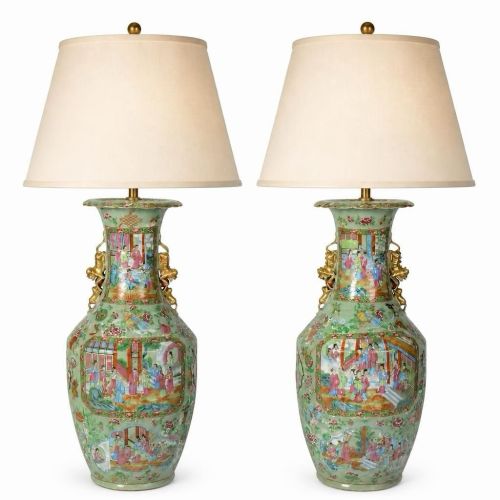


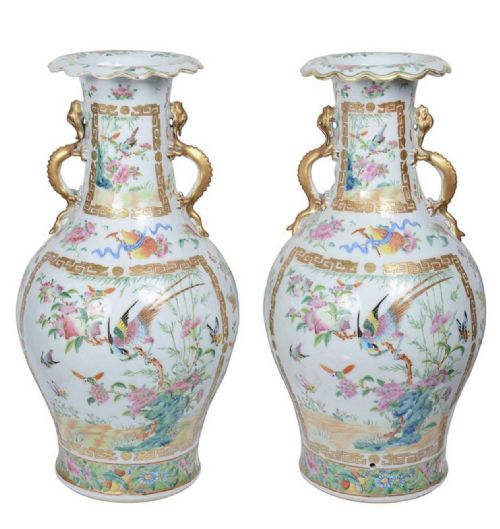
Pair Canton Porcelain Lamps
Pair canton porcelain lamps bring vibrant narrative scenes and rich gilding into a room, originating mostly from the nineteenth century.
Pair Canton Porcelain Lamps
When you search for pair canton porcelain lamps, you encounter nineteenth-century Chinese export vases that have been converted into table lamps. These pieces originate from the Guangdong province, historically known to Europeans as Canton, and carry the distinctive aesthetic of Qing Dynasty production.
The objects seen here are overwhelmingly formed from nineteenth-century vases decorated in the Rose Medallion or Famille Rose palettes. Vases were adapted during their period of export or later in Europe, frequently mounted with brass, ormolu, or gilt bronze to serve as lighting.
You will notice that table lamps dominate the selections, alongside decorative vases that share the same stylistic roots. The forms range from standard vase bodies to oil lantern conversions, maintaining their vibrant painted panels depicting figures, birds, and flowers.
Materials and technique
The foundation of these pieces is Chinese porcelain, painted by hand using enamel pigments that include the characteristic pinks of the Famille Rose palette. Artisans applied these mineral colours in complex panels, often dividing the surface into geometric compartments filled with narrative scenes and natural motifs.
Mounts play a structural and decorative role, executed in brass, ormolu, and gilt bronze to elevate the porcelain bodies into lamps. Wood and fabric elements appear in the broader construction and shading, while glass occasionally supplements the fittings.
The listings show nineteenth-century dates spanning from 1870 to 1920, utilising porcelain, brass, fabric, enamel, gilt bronze, wood, ormolu, and glass.
Distinctions in quality
Quality separates along the crispness of the hand-painted enamel work and the complexity of the compartmentalised panels. Superior examples display finely rendered facial expressions on figures and meticulously detailed bird and flower motifs that remain crisp across the porcelain surface.
The integration of the metal mounts also defines the tier of the piece, particularly where heavy ormolu or gilt bronze mounts are cast with precision. Finer conversions respect the original proportions of the nineteenth-century vases without compromising the painted narrative.
The Pair Canton Porcelain Lamps Glossary
- Canton
- A historical term used by Western traders for the Chinese port city of Guangzhou, the primary export hub for these ceramics. It designates porcelain decorated locally for the Western market.
- Famille Rose
- A palette of opaque enamel colours dominated by pink or rose, introduced to Chinese ceramics during the Qing Dynasty. This palette defines the visual character of most nineteenth-century export wares.
- Rose Medallion
- A specific style of Canton porcelain decoration featuringquartered panels filled with alternating scenes of figures, birds, and flowers surrounding a central medallion. It represents the most common aesthetic found on these lamps.
- Ormolu
- Finely ground high-carat gold applied to a bronze base, frequently utilised for the French-style mounts added to nineteenth-century vases. The technique provides a rich, warm metallic lustre.
- Chinese Export
- A classification for goods manufactured in China specifically for export to Western markets from the seventeenth to the nineteenth centuries. These items often blend traditional Chinese craft with European functional requirements.
Pair Canton Porcelain Lamps: Frequently Asked Questions
Are these lamps converted from old vases?
Most pair canton porcelain lamps originate from nineteenth-century Chinese export vases that were later fitted for electricity or oil lighting.
This conversion process often involved adding brass, ormolu, or gilt bronze mounts to the base and top to secure the electrical components.
How do I identify Rose Medallion?
Rose Medallion is characterised by panels of painted figures, birds, and flowers arranged around a central medallion on the porcelain body.
The palette relies heavily on rose pink enamels combined with greens, golds, and blues in dense, orderly compositions.
Where were these porcelain pieces made?
These porcelains were produced in China, specifically within the Guangdong province, and shipped through the port of Canton to Western buyers.
They reflect the taste of Qing Dynasty export production tailored for European and American interiors.
What metals are used in the mounts?
The metal mounts accompanying these porcelain bodies typically consist of brass, ormolu, or gilt bronze.
These materials were chosen both to stabilise the tall vase forms and to complement the abundant gilding present in the hand-painted designs.