
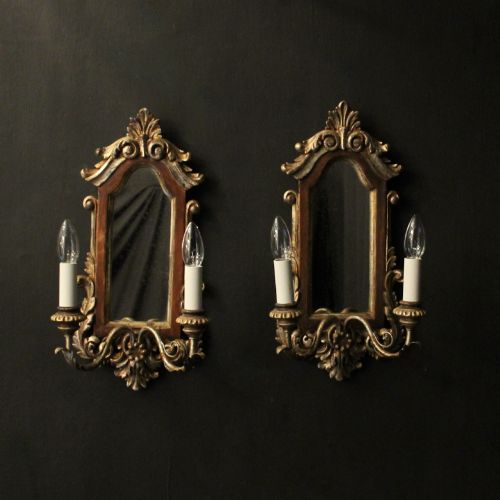
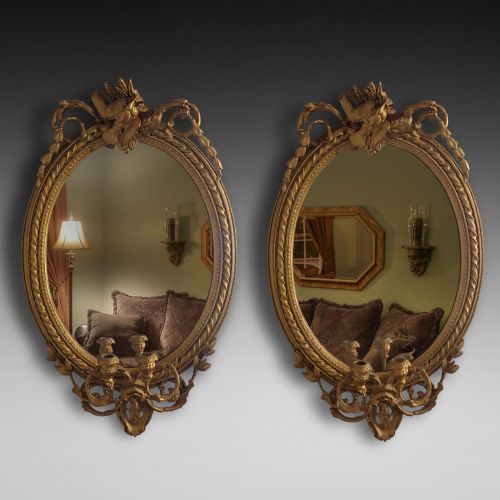
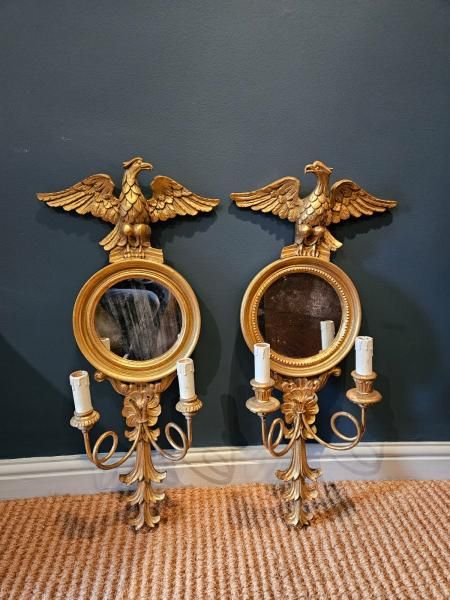
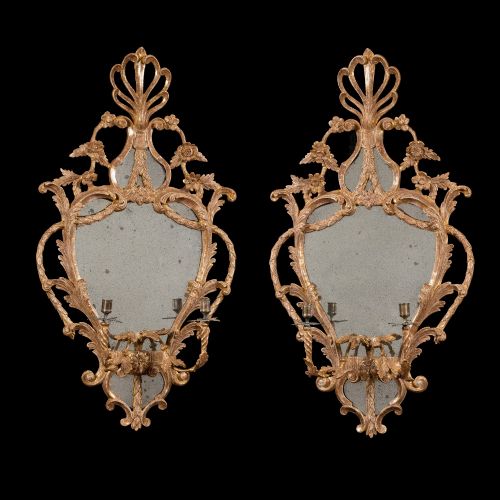

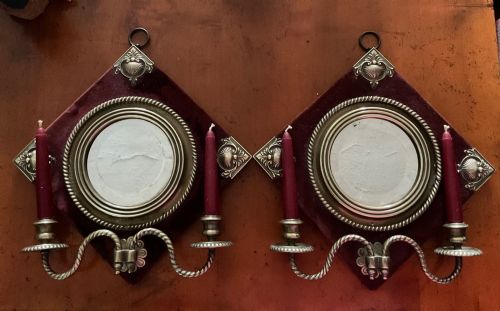


Pair Candle Sconce Mirrors
These pair candle sconce mirrors combine reflected light and branching candle arms, bringing warmth and symmetry to any wall.
Pair Candle Sconce Mirrors
When you search for pair candle sconce mirrors, you encounter reflective glass mounted alongside projecting candle arms designed to double the flicker of candlelight. The pieces seen on this page span from the eighteenth century through the nineteenth and twentieth centuries, capturing periods like the Victorian, Georgian, and Regency eras.
You find various regional interpretations among these listings, including Florentine giltwood girandoles, French bronze ormolu designs, and North Indian mirrored sconces. Formats range from carved wooden frames to cast metal and gilt-painted compositions intended for symmetrical placement on either side of a mantel or doorway.
How they were made
Makers constructed these frames using carved wood, giltwood, and gesso, alongside cast metals such as bronze, brass, copper, and ormolu. Artisans applied thin layers of gold leaf or gilt paint to wooden and plaster surfaces to catch the ambient light.
Mirror glass was set into rebated frames behind protruding candle nozzles, often supported by twin or single arms screwed or pinned directly to the structure. Crystal drops and velvet backing panels appear on select examples to enrich the reflective surface.
One signed Paris piece carries a specific production number, proving that even eighteenth-century lighting ideas had serial numbers.
What varies in quality
The distinction between standard examples and finer works lies in the crispness of the hand-carving or the intricacy of the metal casting. Pierced gesso ornament, deeply chased bronze, and well-balanced proportions signal superior workshop output.
The integrity of the original mercury or silvered mirror plates and the structural soundness of the candle arm fixings further separate modest production from exceptional pieces.
E.G Paris
The Pair Candle Sconce Mirrors Glossary
- Girandole
- A branched wall-light or candle sconce incorporating a mirror. These pieces reflect the flame from the candle to multiply the illumination in a room.
- Giltwood
- Wood that has been coated with gold leaf or gold dust over a prepared gesso ground. This technique creates a luminous surface common on eighteenth and nineteenth-century frames.
- Ormolu
- Gilded bronze used for decorative mounts and fittings. The technique involves applying a gold amalgam to a bronze base and heating it.
- Neoclassical
- A style drawing inspiration from classical antiquity, featuring symmetrical forms and restrained ornamentation. It appears frequently in Georgian and Victorian designs.
Pair Candle Sconce Mirrors: Frequently Asked Questions
Where should I hang pair candle sconce mirrors?
These pieces traditionally flank a fireplace mantelpiece, a central painting, or a doorway to create balance and reflect light across the room.
Ensure they are anchored securely into wall studs due to the combined weight of the glass and metal arms.
How do I date these mirrors?
Dating relies on identifying the underlying materials, framing styles, and the manufacturing characteristics of the mirror glass itself. Georgian and Victorian pieces show distinct shifts in carving depth and metal composition.
Comparing the backboards and fixings to known period examples provides further chronological context.
Can I still burn candles in them?
While many examples retain their original candle sockets and drip pans, modern users often choose to use LED candles to protect antique frames from soot and heat damage.
If you use real wax candles, monitor the flame closely to prevent smoke staining the gilt surfaces or old mirror glass.
What is the difference between a sconce and a girandole?
A wall sconce is any light fixture fixed to a wall, whereas a girandole specifically denotes a mirrored sconce designed to reflect candle or gas light.
Many listings use the terms interchangeably when describing antique wall lights with reflective glass backs.