
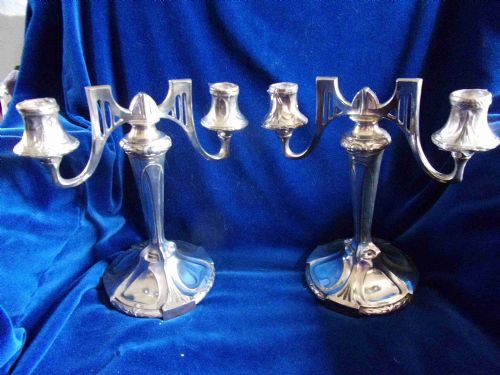


Pair Art Nouveau Candlesticks
Pair art nouveau candlesticks bring fluid organic curves and sinuous floral motifs directly into domestic interiors from the turn of the twentieth century.
Pair Art Nouveau Candlesticks
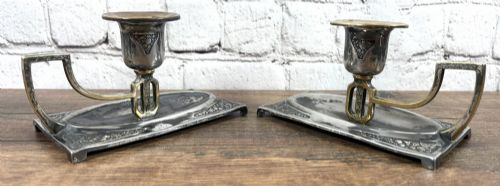
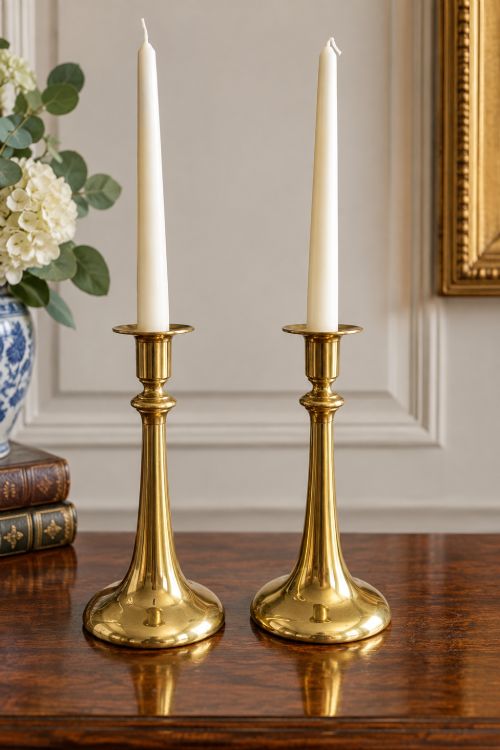
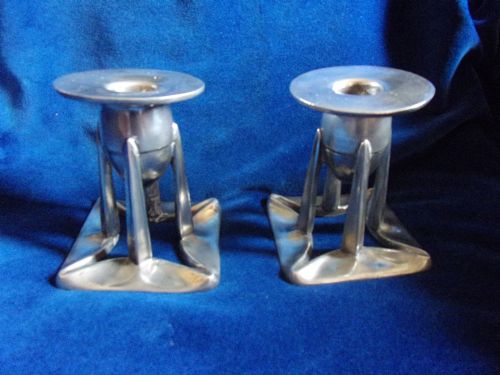
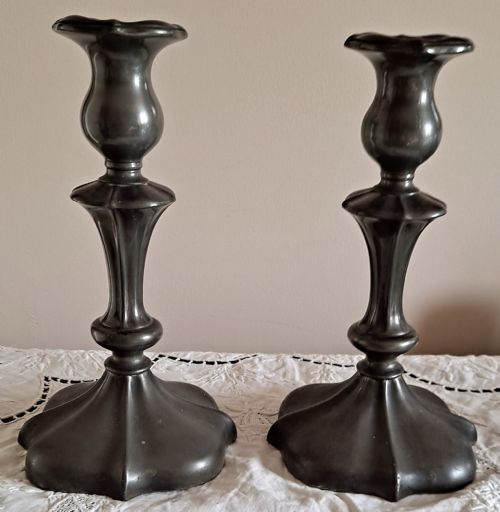
Pair art nouveau candlesticks represent lighting fixtures shaped by the decorative movement that flourished around nineteen hundred, embracing asymmetrical natural forms and plant-inspired lines. Buyers encounter these objects primarily as matched sets configured to hold standard candles or featuring central prickets for pillar candles.
The selections span standard candlesticks alongside smaller candelabra and single candle holders fashioned across the nineteen hundreds, nineteen tens, and nineteen twenties. British, continental European, and domestic English workshops produced these pieces during the Edwardian era and the late nineteenth century.
Makers utilised distinct regional variations, ranging from British Tudric pewter and Liberty designs to German metalwork and French bronze castings. The forms incorporate stylistic overlaps with Arts and Crafts, Jugendstil, Secessionist, and Amsterdam School movements.
How They Were Made
Metal fabrication dominates the construction of these lighting pairs, with pewter, brass, and copper appearing most frequently alongside silver plate, silvered pewter, bronze, and wrought iron. Artisans employed casting, hammering, and silversmithing techniques to shape malleable metals into undulating stems and stylized floral capitals.
Specialised decorative elements involve applied enamel cabochons set into pewter surfaces, carved wood details, and painted finishes applied to iron or brass bases. Manufacturers like WMF utilised specialised plating methods to coat base metal alloys with silver for a luminous finish.
Materials documented across the inventory comprise pewter, brass, copper, silver, bronze, wrought iron, and silvered pewter.
What Varies in Quality
Quality diverges significantly based on the crispness of the cast detailing and the depth of the hand-finishing applied to the metal surfaces. Superior examples retain intricate organic relief without smoothing, while lesser pieces exhibit softened contours from worn production moulds.
The integrity of secondary materials, such as intact enamel insets or original patination on copper and bronze, elevates the standing of a pair. Signed works associated with known designers or prominent manufacturing houses carry distinct artistic merit compared to anonymous factory output.
WMF·Archibald Knox·Liberty and Co·Abel Landry·Hugo Berger Goberg·Alexandre Clerget·Walker and Hall·William Comyns
The Pair Art Nouveau Candlesticks Glossary
- Pricket
- A sharp metal spike set in the drip pan to secure a pillar candle rather than a socket that holds a taper. This traditional feature appears frequently on continental brass and iron designs.
- Jugendstil
- The German manifestation of the art nouveau movement, characterised by dynamic linear rhythms and abstract floral ornamentation. This style appears on continental European metalwork.
- Secessionist
- An aesthetic movement associated with artists breaking away from traditional academic institutions, marked by geometric stylisation of natural forms. Pieces in this taste show restrained, architectural curves.
- Tudric
- The trade name used by Liberty and Company for a specific range of pewter wares, often featuring blue-green enamel accents. Archibald Knox designed many of these notable items.
- Silvered pewter
- A base metal alloy treated with a thin silver coating to simulate solid silver tableware while remaining accessible. WMF utilised this technique extensively for figural candelabra.
Pair Art Nouveau Candlesticks: Frequently Asked Questions
What is a pricket candlestick?
A pricket candlestick uses a sharp upward-pointing metal spike to impale and hold a candle in place instead of a cylindrical socket. This configuration relates closely to altar lighting and continental interior styles.
Such examples often appear in brass or wrought iron during the early twentieth century. They suit pillar candles rather than standard tapered dinner candles.
How do I care for antique pewter candlesticks?
Antique pewter requires minimal intervention to preserve its historical surface and stable oxidation layer. Gentle dusting with a dry microfibre cloth protects the soft metal.
Avoid abrasive metal polishes that strip away the aged patina. Storing them away from direct moisture prevents surface degradation.
Were these candlesticks used for dining?
Matched pairs functioned primarily on dining tables, mantelpieces, and sideboards to provide ambient illumination before electric lighting became universal. Their decorative presence matched the domestic interior tastes of the era.
Heavier bronze and brass versions anchored larger rooms, whilst pewter and silvered variants adorned intimate parlours.
How do I distinguish art nouveau from arts and crafts?
Art nouveau focuses on asymmetric, whiplash lines and organic plant motifs that mimic growing stems and blossoms. The aesthetic prioritises fluid movement and naturalistic curves.
Arts and crafts design emphasises visible hand-craftsmanship, structural honesty, and simpler geometric or medieval-inspired forms. Many pieces successfully bridge both movements through metalworking techniques.