
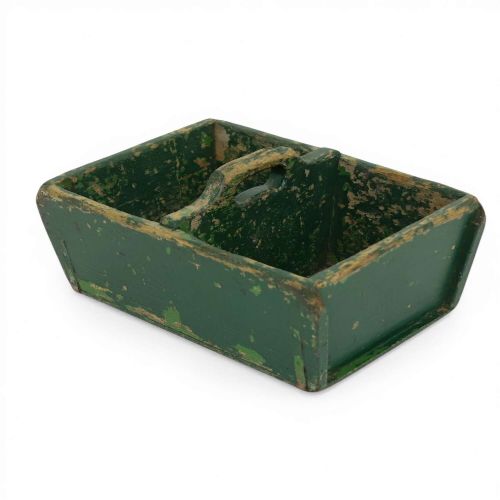


Painted Wooden Caddy
A painted wooden caddy brings colour and pattern into a room through hand-applied ornament on timber boxes made to store tea, games or keepsakes.
Painted Wooden Caddy
When you search for a painted wooden caddy, you enter a field of small decorative containers that span the Georgian, Regency, and Victorian periods. These pieces combine utilitarian wooden forms with surface art, ranging from delicate penwork to bold regional folk decoration.
The versions you meet most often on this page are Georgian and Regency tea caddies or games boxes, alongside 19th-century Scandinavian and Welsh vernacular pieces. Their forms include sarcophagus shapes, rectangular boxes, and fitted interiors designed originally for dry leaf tea or cards.
Origins vary widely across the selection, moving from English workshops employing fine mahogany and satinwood to rural Scandinavian pine and Italian lacquer. Each piece reflects the interior taste of its decade, whether that means classical Chinoiserie motifs or robust local utility.
How they were made
Joinery on these boxes relies on standard cabinet timbers such as mahogany, pine, oak, and satinwood, constructed to house precious contents securely. Craftsmen shaped these woods into precise geometric forms or country trays before preparing the ground for decoration.
Surface ornament involves direct application of paint, lacquer, and gold leaf, often finished with detailed penwork or hand-painted floral vignettes. Makers sealed these decorated surfaces to protect the pigments from daily handling during tea service or games evenings.
Listings feature woods such as mahogany, pine, satinwood, and burr walnut, alongside decorative media including gold leaf, lacquer, and paint.
What varies in quality
The distinction between ordinary and exceptional work lies in the confidence of the brushwork and the preservation of the original pigment. Finely rendered penwork and crisp Chinoiserie motifs show a higher level of artisan skill than heavy or faded regional coats.
Construction details also separate the tiers of quality, visible in the snugness of lid closures, the integrity of internal compartments, and the selection of base timber. A box that retains its original brass fittings and undisturbed surface layers holds greater integrity than one with heavy modern restoration.
The Painted Wooden Caddy Glossary
- Penwork
- Decoration created using fine ink lines on a prepared wood ground to simulate inlaid ivory or engraved metal. This technique was popular during the Regency period for games and work boxes.
- Chinoiserie
- European theatrical interpretation of Chinese artistic motifs, featuring figures, pagodas, and landscapes. It frequently appears in gold and black or yellow lacquer on Georgian boxes.
- Sarcophagus
- A burial-vault shape with a domed lid and sloping sides that became fashionable for tea caddies during the Regency era. The form gives a substantial architectural presence to small wooden boxes.
- Vernacular
- Regional domestic objects made by local makers for everyday use rather than high-style urban workshops. Welsh and Scandinavian pine or painted items fall into this practical category.
- Lacquer
- A hard varnish finish applied in multiple layers and polished to a smooth decorative surface. Italian and Georgian examples use this technique to achieve a glossy, light-reflecting exterior.
Painted Wooden Caddy: Frequently Asked Questions
How were these boxes used originally?
Tea caddies were kept in the parlour or dining room to store expensive tea leaves under lock and key, protecting them from servants and damp air. Other boxes served to hold game counters, stationery, or personal trinkets for ladies.
Because tea was a costly commodity in the Georgian and Regency periods, the caddy was both a practical container and a status object displayed prominently on furniture. Later 19th-century boxes shifted toward general keepsake storage and domestic utility.
How do I tell a Regency box from a Victorian one?
Regency boxes often feature neoclassical symmetry, delicate penwork, and Chinoiserie motifs on mahogany or satinwood carcasses. The forms tend to mimic classical architecture, including sarcophagus shapes and sarcophagus-influenced curves.
Victorian pieces introduce broader material experimentation, including burr walnut, porcelain plaques, and Italian lacquer work. Their decorative schemes reflect the heavier, more eclectic tastes of the later 19th century.
How do I care for an antique painted box?
Keep painted and lacquered wooden boxes away from direct sunlight and extreme humidity to prevent the timber from warping and the pigments from fading. Dust them gently with a dry, soft cloth without applying modern liquid polishes.
Because original paint and lacquer surfaces are delicate, avoid abrasive cleaners or heavy wax buildup. Maintaining stable indoor conditions preserves the remaining pigment and the underlying wood.