
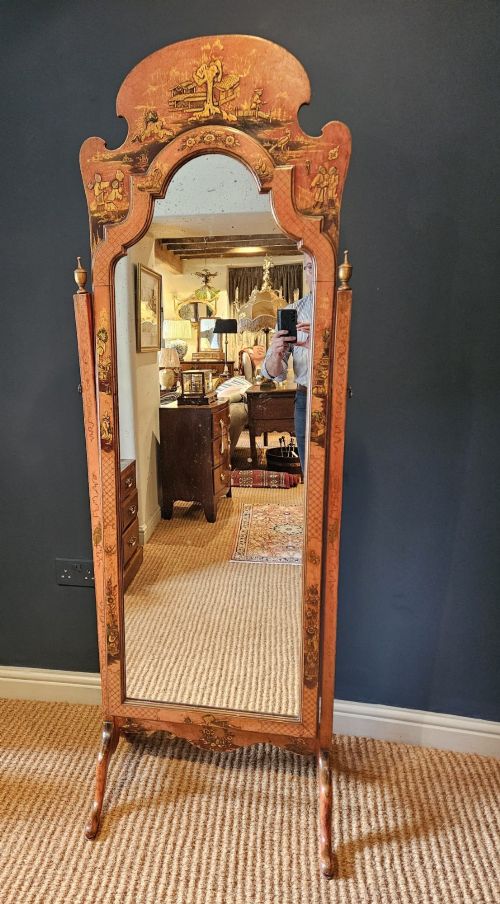
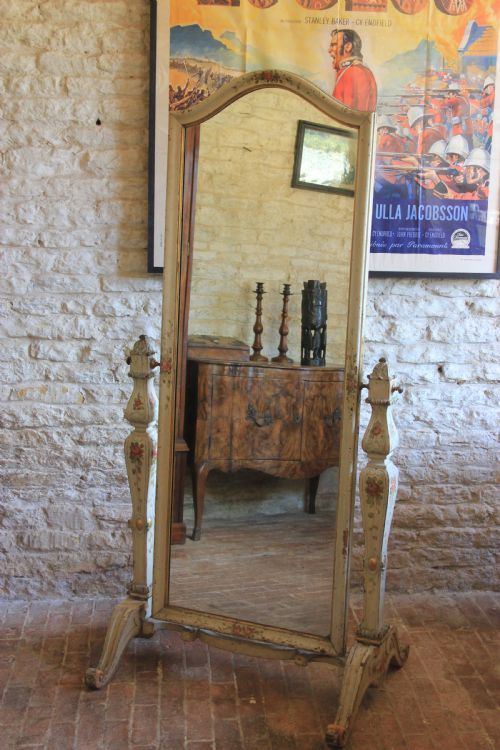


Painted Wood Full Mirror
These painted wood full mirror pieces are substantial antique and twentieth-century looking-glasses that bring scale and historic surface texture to an interior.
Painted Wood Full Mirror
When searching for a painted wood full mirror, buyers encounter a selection dominated by large nineteenth-century French and English wall and cheval mirrors. These objects range from tall decorative glasses to architectural column-framed pieces designed to reflect light and expand spatial perception.
The most frequent examples on this page are French items from the nineteenth century, often featuring carved wood and gesso frames with original paint layers. Alongside these stand smaller groups of Italian country, Chinoiserie, and twentieth-century interpretations.
Forms vary between upright wall mirrors with arched or plain tops and freestanding cheval mirrors that tilt within their frames. Each type relies on the combination of a timber substrate, applied gesso, and historic paint schemes to achieve its finished appearance.
How they were made
Makers constructed these frames using timber bases of wood, which were then layered with gesso to create smooth surfaces or relief details. Carved wood elements added structural definition and ornamentation before the application of paint or gilt finishes.
Surface treatments incorporated paint, overpainting, and lacquer, sometimes paired with gilt wood accents to highlight mouldings and carved motifs. Glass plates were then fitted into the prepared frames, securing the reflective surface within the decorated border.
Several mirrors retain the honest bumps and slight paint flakes of French bistros, proving they spent decades reflecting lively conversations.
What varies in quality
Quality in these mirrors rests upon the depth of the initial carving and the integrity of the gesso application beneath the paint. Finer examples show crisp hand-carved details that retain their definition despite multiple historic layers of surface finish.
The character of the paint surface itself distinguishes the work, with original pigment layers and subtle wear offering more visual interest than later, flat overpainting. Proportion and scale also dictate worth, as larger, well-balanced frames command greater presence in a room.
The Painted Wood Full Mirror Glossary
- Cheval mirror
- A freestanding mirror supported on a frame with vertical pivots that allow the glass to swing. This form provides a full-length reflection and typically stands on four legs or feet.
- Gesso
- A plaster mixture applied to wood frames to create a smooth surface for painting or gilding. It allows for intricate relief moulding before decoration takes place.
- Chinoiserie
- A European decorative style reflecting Chinese artistic influences, popular in certain painted and lacquered mirror frames. It employs whimsical motifs and painted scenes.
- Bistro mirror
- A style of plain or simply framed mirror associated with French commercial interiors. These pieces focus on utilitarian scale and straightforward painted borders.
- Vitruvian scroll
- A classical ornamental band composed of wave-like scrolls often carved into frame mouldings. This motif appears on architectural nineteenth-century pieces.
Painted Wood Full Mirror: Frequently Asked Questions
Where should I hang a large painted wood mirror?
Large painted wood mirrors suit principal living spaces, hallways, or bedrooms where their scale can anchor the room. Positioning them opposite a window maximises natural light distribution.
Ensure the wall construction supports the considerable weight of timber and gesso frames. Secure them using appropriate heavy-duty fixings matched to the wall type.
How do I care for antique painted wood frames?
Dust the carved and painted surfaces gently with a dry, soft cloth to prevent particulate buildup. Avoid chemical cleaners or excessive moisture that might compromise historic paint layers.
Keep the mirrors away from direct heat sources and dramatic humidity fluctuations. Stable environmental conditions protect the underlying wood and gesso from warping or cracking.
What is the difference between wall and cheval mirrors?
Wall mirrors mount directly onto vertical surfaces, serving as architectural focal points above furniture or on open walls. They remain fixed in position once installed.
Cheval mirrors are freestanding floor pieces that tilt within a stable wooden frame. They allow users to adjust the viewing angle and move the entire unit across a room.
Are these mirror frames made of solid wood?
The structural elements consist of timber frames, often enhanced with applied gesso and carved wooden details. This combination provides the necessary strength to support heavy glass plates.
Different periods utilise various woods beneath the gesso and paint layers, depending on regional workshop practices and the desired weight of the finished object.