
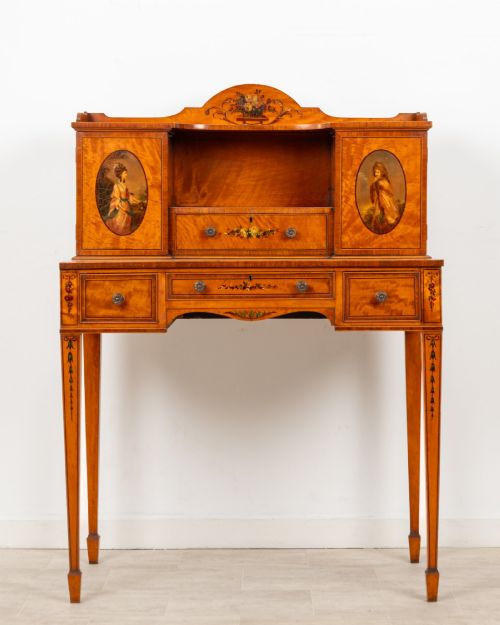
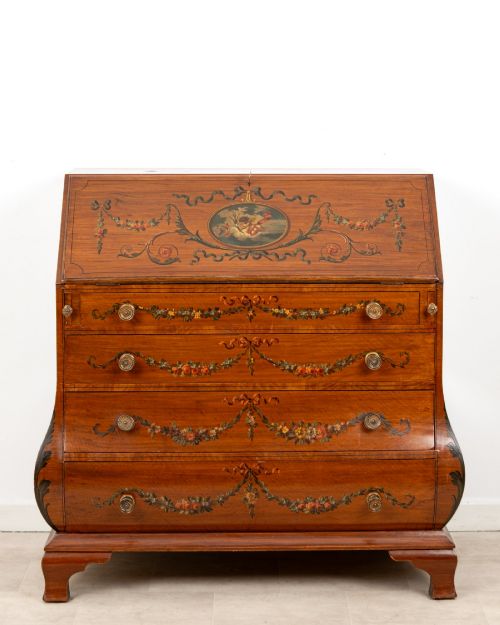
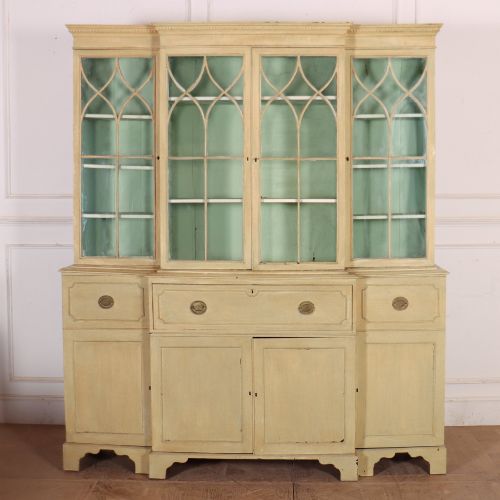


Painted Secretary Desk
A painted secretary desk brings surface artistry and enclosed workspace together, offering decorated panels alongside drop-front writing surfaces.
Painted Secretary Desk
A painted secretary desk combines a writing flap with storage compartments, appearing across periods from the eighteenth century through the Edwardian era. These pieces manifest primarily as bureaux, bureau bookcases, and writing cabinets with integrated drop fronts.
Regional variations span English painted pine and satinwood designs alongside continental Scandinavian country pieces and Chinese export lacquer. Buyers frequently encounter Edwardian satinwood examples and eighteenth-century English bureau bookcases on this page.
Materials and construction
Construction relies on wood substrates such as pine, satinwood, and kingwood, finished with paint, lacquer, or glass elements. Brass hardware typically secures the drawers, hinges, and drop-front mechanisms.
Surface decoration ranges from hand-painted floral details to Chinoiserie scenes and black lacquer finishes applied over timber frames. Cabinetmakers built these pieces to house books and writing materials behind fitted interior pigeonholes.
Listings feature satinwood, pine, glass, and brass materials across eighteenth-century, nineteenth-century, and Edwardian periods.
Assessing quality in painted secretary desks
Quality differentiates by the finesse of the painted surface work and the selection of underlying woods like satinwood or pine. Finely executed hand-painted motifs and lacquer depth elevate a piece above simpler utilitarian finishes.
Structural integrity of the drop-front mechanism and the preservation of original brass fittings dictate the standard of execution. The harmony between the cabinetry proportions and the decorative scheme separates standard production from finer examples.
The Painted Secretary Desk Glossary
- Bureau
- A writing desk featuring a sloping hinged lid that opens to form a writing surface over drawers. It often includes internal compartments for letters and stationery.
- Secretaire
- A cabinet or desk containing a built-in writing drawer or fold-down writing flap. The term frequently applies interchangeably with bureau.
- Chinoiserie
- European decorative style imitating Chinese artistic traditions, featuring motifs of figures, landscapes, and pavilions. It appears frequently on lacquered and painted furniture.
- Satinwood
- A durable hardwood with a natural golden sheen, favoured for fine cabinetmaking and decorative painted surfaces. It is characteristic of Edwardian writing furniture.
- Escritoire
- A writing desk or cabinet, typically standing upright with multiple compartments and a fall-front desk surface. Continental European examples often utilise painted pine.
Painted Secretary Desk: Frequently Asked Questions
What is a painted secretary desk?
A painted secretary desk is a piece of furniture featuring a sloping or fold-down writing surface combined with decorated exterior surfaces and internal storage compartments. These items function as compact writing spaces while displaying artistic paintwork.
Such desks range from simple pine escritoires to elaborate satinwood bureaux and bureau bookcases dating from the eighteenth century to the twentieth century.
How do I date a painted secretary desk?
Dating relies on examining the construction methods, timber choices, and stylistic traits associated with specific periods like the Georgian era or Edwardian times. Details such as brass hardware, dovetail joints, and underlying wood types provide chronological markers.
The specific style of paintwork, whether Chinoiserie, Scandinavian country, or floral satinwood, also assists in identifying the era of production.
Where were these painted desks made?
These desks originate from various regions, including England, Sweden, Denmark, France, and China for export markets. Each region contributed distinct regional aesthetics, such as Scandinavian country painted pine or English satinwood.
Cabinetmakers utilised local timbers appropriate to their workshop traditions while applying decorative surface schemes popular in their respective periods.
How do I care for a painted surface?
Maintaining painted and lacquered surfaces requires avoiding direct sunlight and harsh chemical cleaners that can degrade the decorative finish. Gentle dusting with a soft, dry cloth preserves the integrity of the paintwork.
Stable indoor humidity levels prevent the underlying wood from expanding or contracting, which protects the painted panels from cracking.