


Painted Earthenware Spaniels
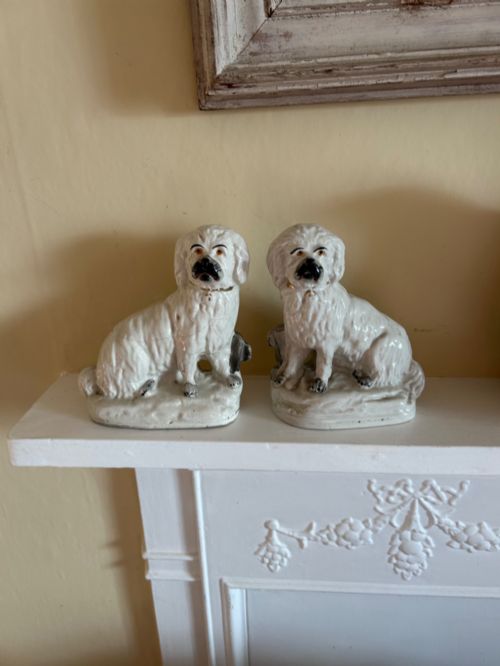
These painted earthenware spaniels are classic Victorian Staffordshire mantel ornaments, brought home by collectors for their domestic charm.
Painted Earthenware Spaniels
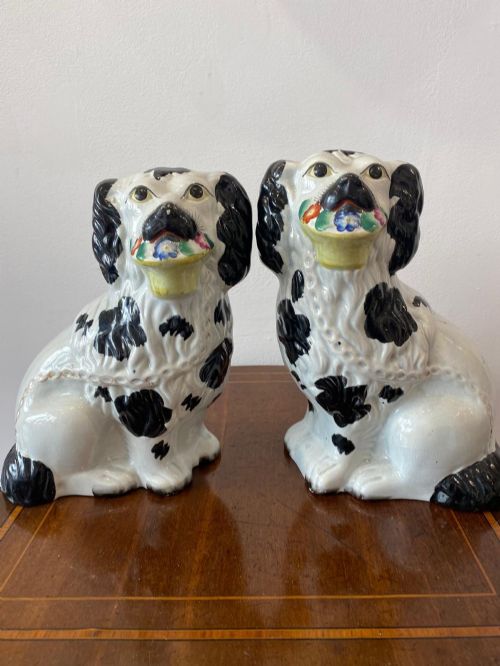
Painted earthenware spaniels are ceramic figures produced in Staffordshire during the nineteenth century, most commonly encountered as symmetrical pairs. These decorative objects often represent the seated comforter spaniels that guarded Victorian hearths.
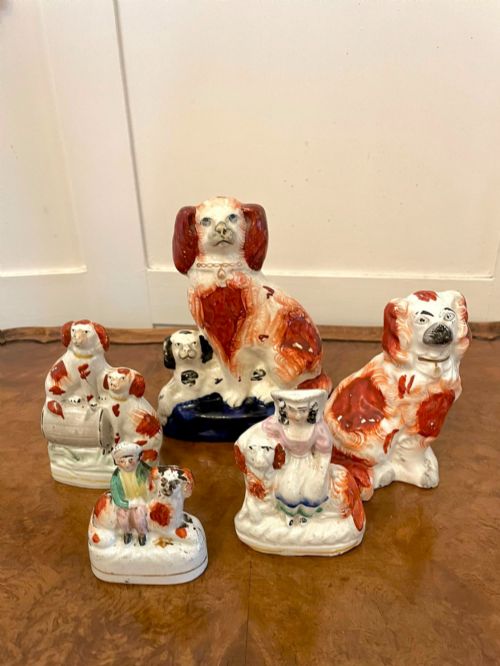
The listings show these decorative figurines span several decades of the nineteenth century, including specific dates from eighteen-sixty through to nineteen-hundred. Alongside spaniels, the selection includes Maltese terriers and groups of pottery figures in collections of various sizes.
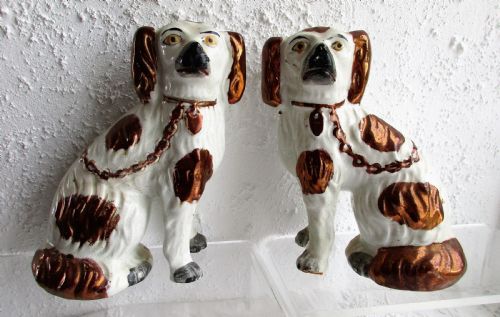
Makers shaped these ceramic figures in earthenware and finished them with glaze and enamel paint, occasionally incorporating copper lustre details. They survive primarily as Victorian decorative objects designed for display on mantelpieces and shelves.
Materials and manufacture
Potters formed these figures from earthenware clay before applying a smooth glaze over the ceramic body. This base layer provided a stable surface for the subsequent application of enamel paint.
These ceramic companions kept eternal watch over Victorian hearths, asking for neither food nor walks.
Assessing quality
Pairs show greater visual balance when the modelling and scale match evenly between both figures. The execution of the glaze and the neatness of the copper lustre details further distinguish finer examples from standard production.
The Painted Earthenware Spaniels Glossary
- Earthenware
- Porous pottery fired at a relatively low temperature and coated with a glaze to ensure it holds water and displays colour effectively.
- Glaze
- A glassy coating fused to the ceramic body through firing, giving the figure its smooth and protective finish.
- Enamel
- Opaque paint applied over the glazed surface of the pottery and fired again to bond with the ceramic.
- Copper lustre
- A metallic glaze technique that imparts a reflective, coppery sheen to specific areas of the ceramic figure.
- Comforter spaniel
- A popular nineteenth century ceramic dog figure traditionally placed on mantelpieces as a domestic companion.
Painted Earthenware Spaniels: Frequently Asked Questions
What are Staffordshire spaniels?
Staffordshire spaniels are ceramic figurines made in the pottery towns of England during the nineteenth century. They were modelled as seated dogs and used as domestic ornaments.
Most examples found today date from the Victorian era and were intended to sit in pairs upon a fireplace mantel.
How old are these dogs?
The pieces available range across the nineteenth century, with specific examples recorded from eighteen-sixty, eighteen-seventy, eighteen-eighty, and eighteen-ninety.
Victorian makers produced these earthenware figures in large quantities, and certain pieces date into the early twentieth century around nineteen-hundred.
Are they always found in pairs?
Many of these ceramic figures are encountered as pairs designed to face one another on either end of a mantelpiece. This symmetrical arrangement reflects how Victorian households traditionally displayed them.
Listings also include individual figures and larger collections of four, five, or six dogs together.
What materials were used?
Potters used earthenware clay to shape the figures before applying a protective glaze. The surface decoration relies on enamel paint applied by hand over the fired ceramic.
Some variations incorporate copper lustre to highlight collars, chains, and facial markings with a metallic sheen.