
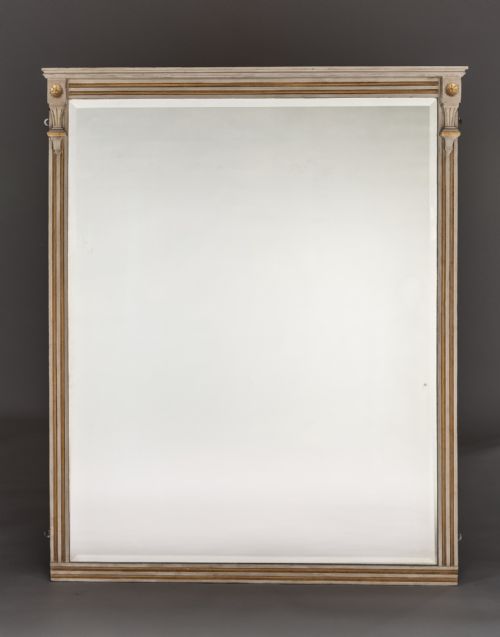


Painted Chimney Glass Mirror
These large painted chimney glass mirror pieces bring decorative presence to a room, offering grand scale and period character.
Painted Chimney Glass Mirror
A painted chimney glass mirror is primarily encountered as a large overmantel mirror designed to sit above a fireplace. The examples on this page span the Georgian period through the Victorian era, alongside Edwardian and later interpretations.
Stylistic influences range from French chateau and Louis XV designs to Aesthetic Movement ebonisation and Sheraton satinwood. The form remains anchored in domestic display, combining reflective glass with painted surfaces.
Materials and construction
Makers built these frames using carved wood and applied gesso to build up moulded decoration and arched tops. Gesso provided a smooth ground for subsequent layers of paint, gilder's gold leaf, or parcel-gilt highlights.
Surface finishes include white paint, light grey schemes, ebonised treatments, and distressed patinas. Mirror glass is set within these heavy wooden carcases, often accompanied by original or replacement backing boards.
The listings on this page span multiple periods, including Georgian, Victorian, Edwardian, and mid-century items.
Judging quality in painted chimney glass mirror pieces
Quality rests in the crispness of the wood carving and the depth of the gesso mouldings beneath the paint layers. Finer pieces retain clean architectural lines and well-executed relief work rather than flat, simplified mouldings.
The integrity of the surface finish dictates visual success, where original paint schemes or controlled distressing look intentional and harmonious. The weight of the timber carcase and the clarity of the mirror glass complete the assessment.
The Painted Chimney Glass Mirror Glossary
- Overmantel mirror
- A large mirror specifically proportioned to hang on the wall directly above a fireplace mantel. These pieces often dominate a chimney breast.
- Gesso
- A plaster-like mixture applied to wood frames to create a smooth surface for painting or gilding. It allows for intricate moulded details.
- Parcel-gilt
- A finish where portions of an object are gilded with gold leaf while the rest is painted or left plain. This technique accentuates specific carved elements.
- Trumeau mirror
- A decorative wall mirror incorporating a painted panel or artwork above the glass. Originating in France, these pieces served as architectural wall decorations.
Painted Chimney Glass Mirror: Frequently Asked Questions
How do I hang a heavy chimney glass mirror?
These large frames require secure fixing directly into wall studs or masonry using heavy-duty brackets. The substantial weight of the wood and gesso carcase demands professional installation.
Ensure the hanging wire or integrated mirror plates match the load capacity of the wall structure to prevent movement.
Where should I place a painted overmantel mirror?
Traditionally positioned above a fireplace in a reception room, a painted chimney glass mirror also functions effectively on any prominent blank wall. Its scale allows it to anchor furniture arrangements below it.
Placement opposite a window will maximise light reflection throughout the interior space.
How do I date a Victorian painted mirror?
Dating relies on stylistic clues such as Aesthetic Movement ebonisation or heavy Victorian classical revival moulding profiles. Examining the construction of the wooden frame and backing materials provides further chronological context.
Changes in paint chemistry and mirror glass manufacture also help narrow down the decade of production.
What is the difference between a wall mirror and an overmantel?
Overmantel mirrors are specifically proportioned to span the width of a fireplace surround, often featuring landscape rectangles or arched tops. Standard wall mirrors follow more balanced vertical or square dimensions.
An overmantel typically carries heavier architectural moulding to balance the hearth below.