

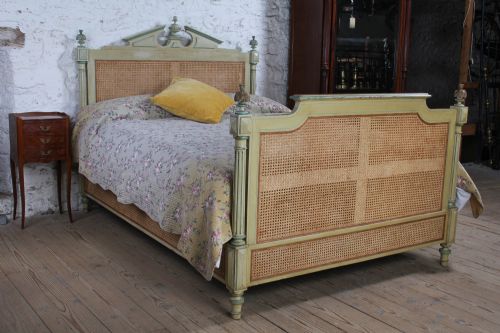
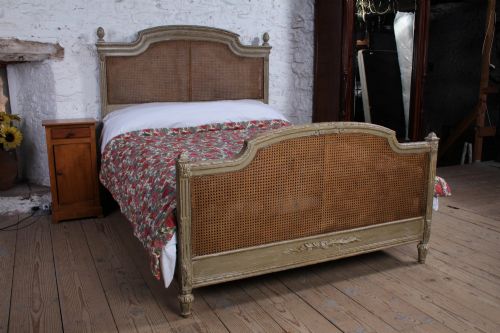


Painted Cane Bedstead
A painted cane bedstead brings architectural warmth to a bedroom through woven panels and decorated timber frames.
Painted Cane Bedstead
A painted cane bedstead combines a wooden framework with woven plant material to create a light yet sturdy sleeping frame. These items appear in various dimensions from single to king sizes, often following classical revival lines.
The selections on this page span from the late Victorian era through the 1920s, drawing heavily on French design vocabulary. Pieces reflect periods including the 1890s, 1900, 1910, and 1920, showing how cabinetmakers adapted historical aesthetics for modern bedrooms.
Common stylistic influences include Louis XVI style, Empire style, and French chateau aesthetics alongside later Art Deco platform formats. Makers utilised beech, satinwood, and general painted timber to construct these bedroom suites and single frames.
Construction and materials
Makers built these frames using carved wood and painted timber, frequently employing beech as a primary structural support. Artisans applied surface decoration through hand-painted polychrome panels, gold leaf accents, and satinwood finishes to elevate the visual weight of the wood.
The characteristic woven cane inserts required skilled hand-weaving techniques to create breathable headboards and footboards. This combination of supportive wooden framing and pliable woven plant material resulted in a bed that felt visually airy despite its physical size.
Painted Cane Bedstead Retail Price Guide 2026
Typical asking prices for painted cane bedstead among the pieces listed under this phrase on Sellingantiques today, from the lower quarter to the upper quarter. They describe what is for sale here now, not the wider market.
Listings feature painted cane bedsteads across multiple decades, spanning late Victorian designs to the 1920s using beech, satinwood, and gold leaf.
Assessing quality
Quality rests upon the crispness of the carved wood details and the precision of the hand-painted elements, such as portrait panels. Finer examples display meticulous brushwork and integrated decorative schemes that extend to matching bedroom furniture like bedsides and chairs.
The integrity of the woven cane panels dictates much of the physical standard, with tighter and more uniform weaving representing higher craftsmanship. Additionally, the selection of underlying woods like satinwood rather than basic painted timber marks a superior tier of production.
Maple and Co
The Painted Cane Bedstead Glossary
- Cane
- Woven plant material typically derived from the rattan palm, used to create flexible panels for headboards and footboards. This material provides breathable structure and a light texture.
- Louis XVI Style
- A neoclassical aesthetic characterised by straight tapered legs, classical motifs, and restrained symmetry. Pieces in this style often feature painted surfaces and carved wooden details.
- Polychrome
- Decoration executed in multiple colours, frequently seen on hand-painted portrait panels inset into the bed frames. This technique adds pictorial depth to the painted timber.
- Satinwood
- A durable hardwood with a natural golden sheen, favoured by makers for high-end cabinetwork. It provides a smooth surface that takes paint or polished finishes effectively.
- Empire Style
- A neoclassical design movement originating in France, defined by bold proportions and military-inspired or classical ornamentation. It lends a grander scale to bedstead architecture.
Painted Cane Bedstead: Frequently Asked Questions
What sizes do these beds come in?
These frames appear in single, double, king size, and super king dimensions to suit various room proportions.
Larger formats often form part of comprehensive bedroom suites that include matching bedside cabinets and chairs.
How do I care for cane panels?
Woven cane requires gentle dusting with a soft brush and occasional light moisture to keep the material from drying out.
Avoiding direct heat sources helps preserve the natural flexibility of the woven strands over time.
What periods are represented here?
The listings encompass late Victorian designs alongside pieces from the 1890s, 1900, 1910, and 1920.
Stylistic influences range from traditional French chateau aesthetics to early twentieth-century Art Deco platform builds.
Are mattresses easy to fit?
Many antique frames accommodate standard modern mattress sizes, though exact dimensions can vary by era.
Some configurations include dedicated platform bases or require standard wooden slats for proper support.