


Overlay Glass Urn
These overlay glass urn and vase pieces bring layered colour and tactile depth to a room, offering the rewarding hunt for cameo, cut-to-clear, and metal-mounted vessels.
Overlay Glass Urn
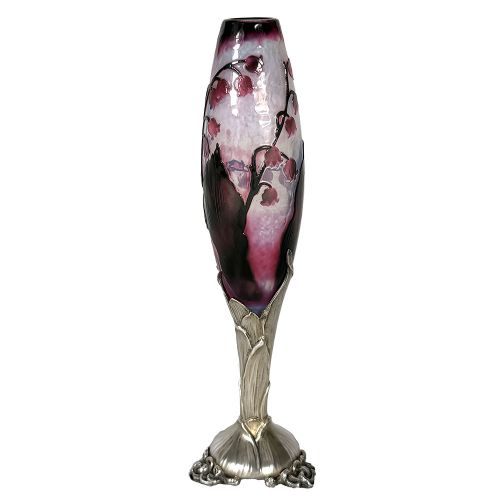
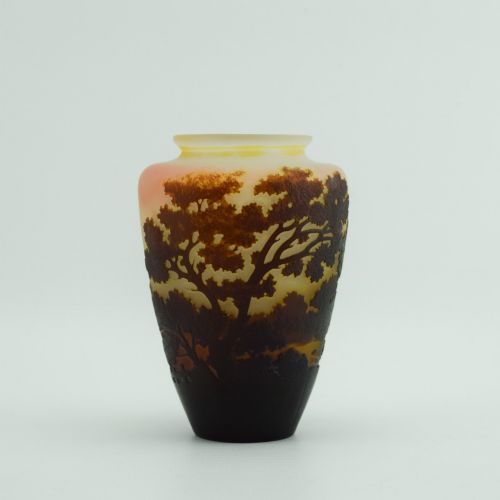
When you search for an overlay glass urn, you encounter vessels defined by contrasting layers of coloured and clear glass, or glass mounted in metal. The examples on this page span the nineteenth century, the Victorian era, and the early twentieth century, including Art Nouveau and Art Deco periods.
The forms range from ovoid and panelled vases to garniture sets and landscape scenes. You are most likely to meet pieces originating from Bohemian and British workshops, alongside French cameo works and Belgian productions.
The palette extends from deep cobalt blue and ruby red to iridescent surfaces and green over crystal. Each piece uses the overlay technique to create depth, pattern, and sculptural form.
How they were made
Makers formed these vessels by fusing a layer of coloured glass over a base of clear or contrasting glass while hot. Craftsmen then shaped the molten material into vases and urns using traditional blowing techniques.
Surface decoration relied on skilled cutting, acid-etching, or cameo carving to expose the underlying colour through the outer layer. Workshops also applied sterling silver or pewter mounts directly onto the glass body to finish the piece.
Materials recorded include cameo glass, sterling silver, acid-etched glass, iridescent glass, enamel, lead crystal, and cobalt glass.
What varies in quality
Quality depends upon the precision of the cutting and the depth achieved in cameo carving. Finer vessels display crisp borders where the overlay meets the base glass, alongside harmonious proportions in the overall form.
The artistry of the metalwork or the subtlety of acid-etched landscapes distinguishes standard production from exceptional studio output. Weight, clarity of the crystal, and richness of the coloured layers also dictate the standing of a piece.
Loetz Witwe·Thomas Webb and Sons·Charles Graffart for VSL·Galle
The Overlay Glass Urn Glossary
- Cameo glass
- A vessel formed of two or more distinct layers of fused glass, where the outer layer is carved away to leave a raised design. This technique requires considerable patience and steady hand control.
- Cut to clear
- A method where a heavy outer layer of coloured glass is cut away in geometric or floral patterns to reveal the clear glass beneath. It creates a striking contrast of light and shadow across the surface.
- Iridescent glass
- A finish achieved by treating the hot glass surface with metallic vapours to produce a shimmering, rainbow effect. This treatment gained immense popularity during the Art Nouveau period.
- Garniture set
- A matching group of three vases or urns designed to be displayed together on a mantelpiece or sideboard. They typically feature a central larger vessel flanked by two smaller matching pieces.
- Armorial
- A design incorporating a family crest or coat of arms, often etched or enamelled onto the glass surface. Such pieces frequently carry personal or historical significance.
Overlay Glass Urn: Frequently Asked Questions
What is an overlay glass urn?
An overlay glass urn is a decorative vessel made with multiple fused layers of glass where the outer layer is cut, carved, or etched away to reveal a contrasting colour underneath. These pieces often feature floral, geometric, or landscape motifs.
Craftsmen produced them across Europe and Britain during the nineteenth and early twentieth centuries, incorporating styles from Victorian ornamentation to Art Nouveau fluidity.
How do I clean and care for overlay glass?
Clean your glass vessels gently using lukewarm water and a mild, non-abrasive soap, taking care around any applied metal mounts or sterling silver overlays. Dry them immediately with a soft, lint-free cloth to prevent water spots.
Avoid immersing pieces with metal mounts in water for extended periods, and keep them out of direct sunlight to preserve the richness of the coloured layers.
How can I tell Victorian pieces apart from later ones?
Victorian pieces often display heavier cobalt blue or ruby red cut-to-clear patterns with ornate, traditional silhouettes. They reflect the formal design sensibilities of the nineteenth century.
Later pieces from the early twentieth century tend to embrace organic Art Nouveau forms, iridescent finishes, or acid-etched naturalistic scenes associated with makers like Galle and Loetz.
Were these urns used for flowers or display?
Most of these vessels served primarily as decorative mantel ornaments or centrepieces rather than functional flower vases. Their intricate cameo carving and delicate metal mounts made them prized objects for display in period interiors.
Matching garniture sets were specifically arranged on parlour sideboards or mantels to create a balanced decorative scheme.