

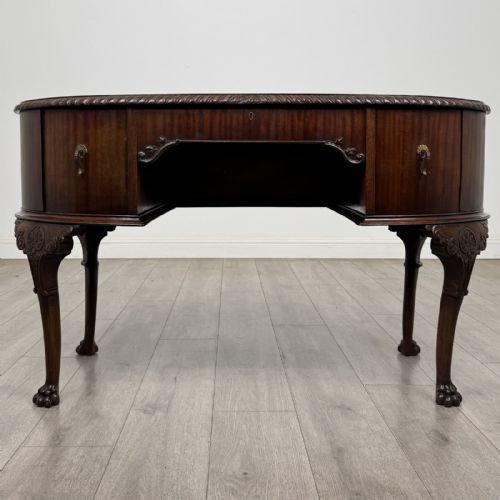
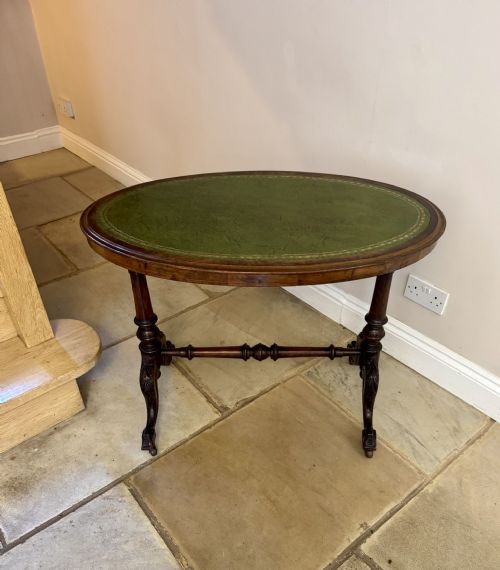


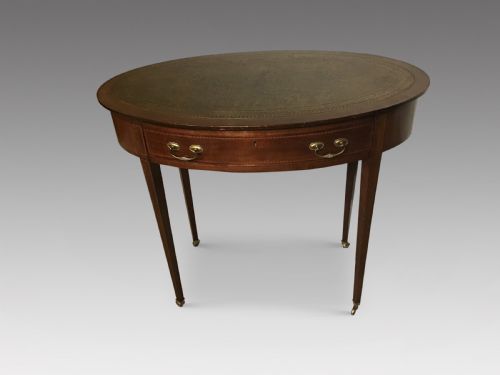


Oval Writing Table
An oval writing table offers a graceful alternative to the rigid corners of a traditional desk, combining refined domestic workspace with a commanding centre-room presence.
Oval Writing Table
An oval writing table is a dedicated surface designed for correspondence and study, distinguished by its curved perimeter rather than standard rectangular proportions. The pieces gathered here emerge from distinct eras, spanning Georgian restraint, Victorian ornamentation, and Edwardian refinement.
The version most commonly encountered on this page is the Victorian iteration in burr walnut or mahogany, often fitted with a leather writing inset. Alongside these, Edwardian inlaid mahogany examples and earlier Georgian drum tables frequently appear, offering diverse scales for domestic interiors.
These forms cross over into library tables and freestanding centre tables, demonstrating the versatile nature of curved timber furniture. Whether standing centrally in a room or positioned against a wall, each piece balances utility with decorative grace.
How they were made
Cabinet makers constructed the foundational carcase using dense timbers such as mahogany, walnut, and oak, often selecting burr walnut or satinwood veneers for decorative impact. Marquetry inlay, brass mounts, and gilt bronze details were applied to elevate the aesthetic of formal pieces.
Writing surfaces typically received a panel of tooled leather inset into the timber top, bordered by banding or stringing. Structural support ranged from central pillar pedestals to four-leg stretcher bases, accommodating both stationery use and free-standing placement.
Oval Writing Table Retail Price Guide 2026
Typical asking prices for oval writing table among the pieces listed under this phrase on Sellingantiques today, from the lower quarter to the upper quarter. They describe what is for sale here now, not the wider market.
The listings here feature walnut, mahogany, satinwood, and rosewood, spanning periods from the eighteenth century through the Edwardian era.
What varies in quality
Quality reveals itself in the selection of timber veneers and the precision of the marquetry or inlay work. Grain matching across a curved top requires considerable skill, distinguishing ambitious pieces from standard workshop output.
Construction details such as secret rising compartments, finely cast brass or gilt bronze mounts, and secondary timbers used in drawer linings mark the upper tiers of craftsmanship. The fluidity of the curved edge and the stability of the central pedestal further separate ordinary examples from exceptional ones.
A. Beurdeley
The Oval Writing Table Glossary
- Drum table
- A circular or oval library table with a deep top containing drawers, usually supported by a central pillar and tripod base.
- Marquetry
- Decorative patterns formed by fitting together thin veneers of various coloured woods, displayed across the top surfaces of finer tables.
- Satinwood
- A pale, lustrous timber native to the tropics, prized during the Georgian and Edwardian periods for bright inlaid decoration.
- Inlaid
- Ornamented by embedding pieces of contrasting wood, brass, or other materials flush with the surrounding surface.
- Freestanding
- Finished on all sides so the piece can stand in the centre of a room rather than against a wall.
Oval Writing Table: Frequently Asked Questions
Where should I place an oval writing table?
An oval writing table is ideally positioned in the middle of a room as a freestanding centre piece, showing off finished back panels and curved timber grains.
Alternatively, placing one in a study or drawing room allows the curved perimeter to soften the angular lines of surrounding architecture.
How do I care for the leather top?
Leather writing surfaces require gentle dusting and occasional treatment with specialist leather balms to prevent drying and cracking.
Keep these tables away from direct sunlight and strong heat sources to preserve both the leather inset and the underlying timber.
What is the difference between a writing table and a library table?
Writing tables are traditionally built with a primary focus on correspondence, often featuring fitted drawers and dedicated leather writing surfaces.
Library tables are typically larger, heavier pieces designed for heavy volumes and central room placement, though the forms frequently overlap.
How do I identify a Georgian piece?
Georgian tables rely on solid mahogany construction, restrained proportions, and classic design elements like dropleaf mechanisms or simpler drum formations.
They lack the heavier ornamentation and complex marquetry often found on later Victorian and Edwardian revivals.