


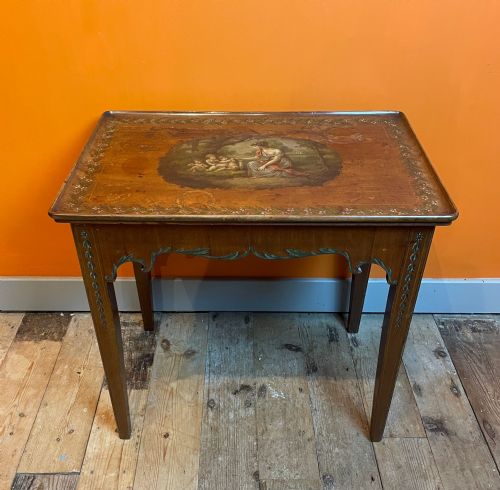
Oval Painted Side Table
These oval painted side table pieces bring decorative colour and practical surface space to a room, drawing on Georgian, Regency and Edwardian craftsmanship.
Oval Painted Side Table
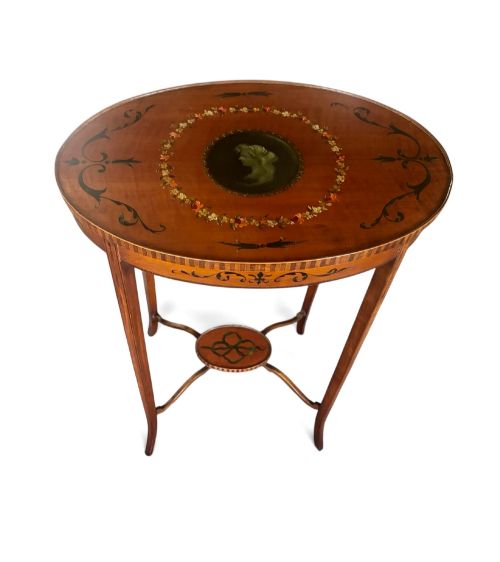
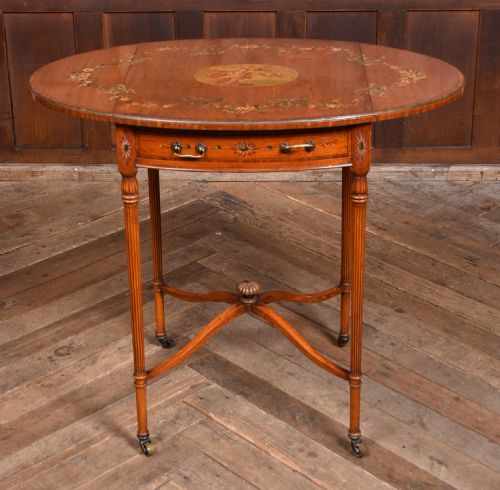
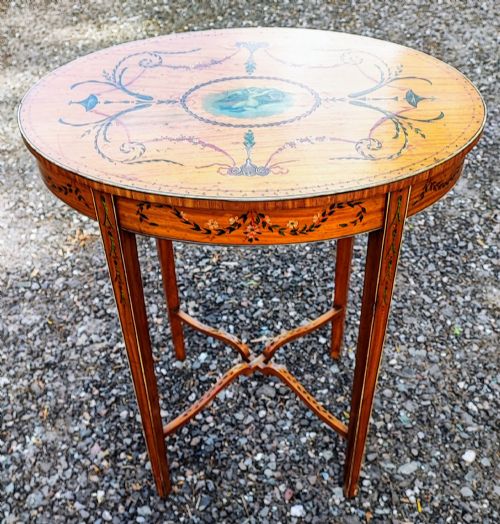
When you search for an oval painted side table, you encounter a selection of occasional furniture spanning the Georgian period, the Regency era, and the Edwardian epoch. These pieces frequently appear in satinwood or mahogany, decorated with hand-painted floral motifs and neoclassical scenes.
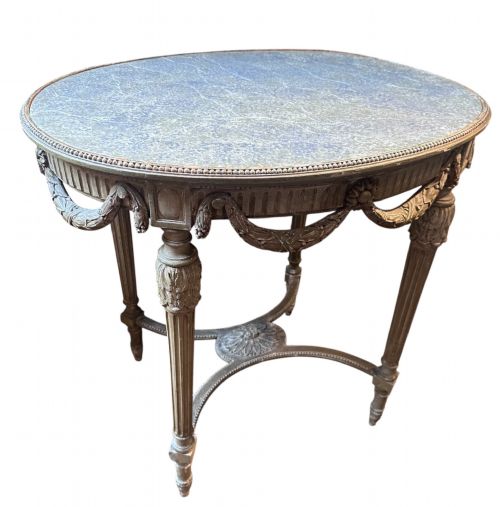
The most common form on this page is the Edwardian satinwood occasional table, often featuring delicate painted decoration and slender legs. Alongside these, French Louis XVI style designs and French painted bedside tables provide alternative variations with marble tops or night table formats.
Materials and construction
Cabinet makers utilised satinwood and mahogany as the primary timber foundations, shaping the wooden tops into oval forms supported by slender legs. Brass mounts and marble inserts occasionally supplement the wooden construction, particularly in French provincial and Louis XVI style examples.
The decorative surfaces rely on hand-applied paint, showcasing floral details, trompe l'oeil work, and neoclassical scenes. Artisans of the Georgian, Regency and Edwardian periods applied these painted finishes directly onto the wood, often pairing the brushwork with fine satinwood grain.
Listings span multiple eras, encompassing Georgian, Regency, 19th Century, and Edwardian periods.
Assessing quality in painted tables
The distinction between tiers rests upon the execution of the painted decoration and the selection of timber. Hand-painted neo-classical scenes and floral motifs executed with fine detail elevate a piece above standard decorative output.
Structural integrity of the timber and the retention of original painted surfaces dictate the standing of an item. Tables retaining their untouched brushwork and balanced satinwood or mahogany construction command greater interest than those with altered finishes.
The Oval Painted Side Table Glossary
- Satinwood
- A durable hardwood with a lustrous, golden-yellow sheen frequently utilised in fine cabinet making during the Georgian and Edwardian periods.
- Occasional table
- A small, movable table designed for specific, intermittent use within a room rather than primary dining or writing.
- Sheraton Revival
- A late nineteenth and early twentieth century design movement that reinterpreted the lighter, neoclassical furniture forms of the eighteenth century.
- Trompe l'oeil
- An artistic technique that uses realistic imagery to create the optical illusion that the depicted objects exist in three dimensions.
- Pembroke table
- A form of small table featuring two hinged drop leaves on opposing sides, supported by folding brackets or swing legs.
Oval Painted Side Table: Frequently Asked Questions
Where should I place an oval painted side table?
These tables function effectively beside seating in a drawing room or as a compact surface in a hallway. Their painted decoration allows them to serve as focal points in smaller spaces.
Because many examples feature delicate satinwood or painted tops, positioning them away from direct sunlight preserves the pigments and timber finish over time.
How do I care for a painted wooden surface?
Dusting with a dry, soft cloth prevents the accumulation of particles without disturbing the historic paint layers. Avoid moisture and commercial cleaning sprays, which can lift or cloud aged finishes.
Using coasters or protective mats safeguards the hand-painted floral decorations and neo-classical scenes from accidental liquid damage or scratches.
What is the difference between Georgian and Edwardian tables?
Georgian tables originate from the eighteenth and early nineteenth centuries, often featuring robust proportions alongside sophisticated hand-painted neoclassical scenes or trompe l'oeil details.
Edwardian interpretations date from the early twentieth century and typically display lighter satinwood frames, delicate floral brushwork, and influences from the Sheraton Revival style.
Are these tables suitable for daily use?
Most pieces function well for holding small lamps, books, or decorative objects. Their lighter construction means they are intended for gentle placement rather than heavy loads.
Careful handling ensures that antique joints and hand-painted surfaces remain intact during everyday placement and relocation around the home.