
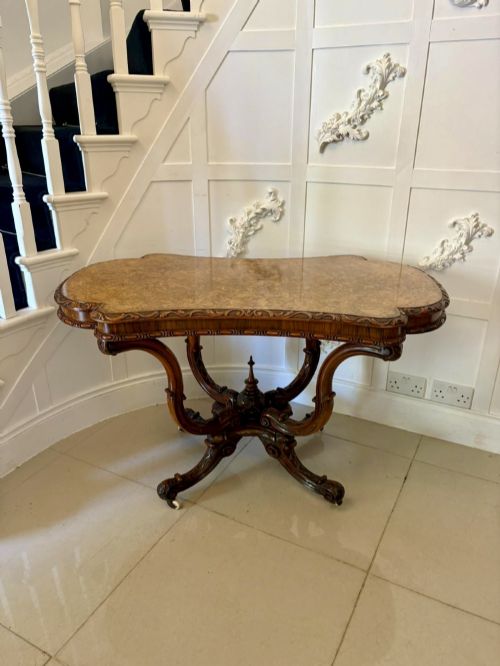
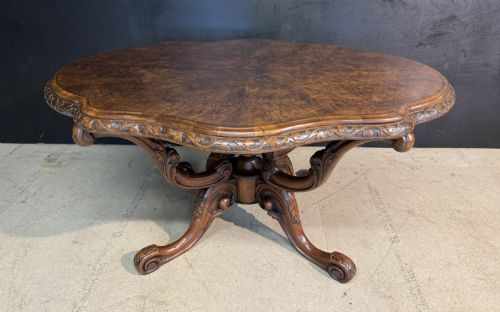
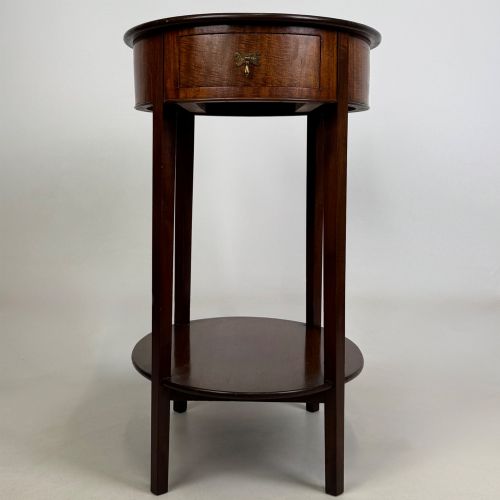


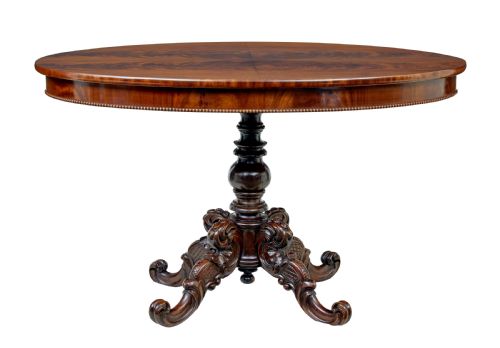


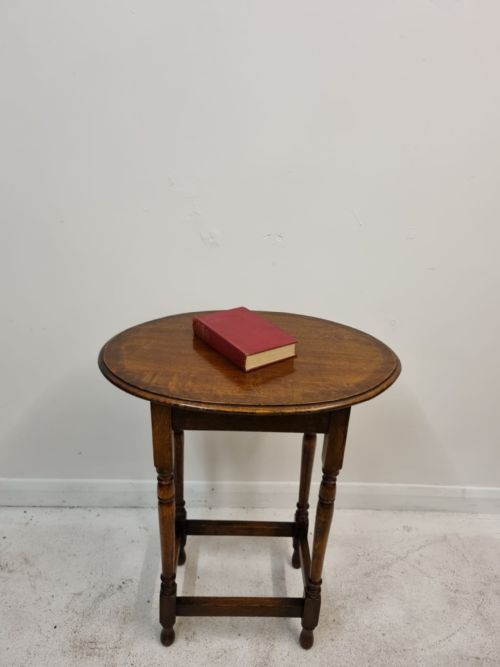


Oval Hall Table
An oval hall table brings a curvaceous silhouette and practical surface to an entranceway, drawing on nineteenth-century and Edwardian forms.
Oval Hall Table
An oval hall table is typically encountered as a Victorian or Edwardian piece, spanning centuries from the mid-nineteenth period onwards. These items often double as centre tables, side tables, or occasional tables depending on their proportions and placement.
Makers produced these designs in varied stylistic veins, ranging from Sheraton Revival and Aesthetic Movement to French Empire and English Country House aesthetics. Walnut, mahogany, and oak dominate the forms, frequently shaped with turned legs or pedestal bases.
Earlier examples arrive from the Victorian era with burr walnut and marquetry detailing, while later Edwardian versions utilise satinwood and simpler mahogany constructions.
Materials and Construction
Cabinet makers utilised dense hardwoods such as mahogany, walnut, and oak to build the foundational frames, frequently incorporating burr walnut veneers for rich grain patterns. Satinwood and boxwood provided contrasting stringing and inlay work.
Structural support took several distinct forms, including carved central pedestals, tripod legs, and barley twist supports, sometimes supplemented by brass fittings or ceramic elements.
Surface decoration relied on hand-carving, marquetry, and painted finishes applied to the timber bodies, alongside occasional leather inset tops for writing and library use.
Listings demonstrate a strong prevalence of Victorian and Edwardian pieces, utilising mahogany, walnut, and oak.
Craftsmanship and Material Depth
The distinction between tiers rests upon the choice of timber and the precision of the cabinet work, particularly in the selection of figured burr walnut and satinwood veneers. Finer pieces demonstrate meticulous inlay and crisp hand-carving rather than mechanical ornamentation.
Structural integrity separates standard utilitarian items from exceptional examples, observed in the stability of pedestal bases and the seamless joining of oval tops. The integration of secondary woods and the finesse of turned legs further signal higher workshop standards.
The Oval Hall Table Glossary
- Burr walnut
- A prized timber harvested from the wart-like growths on walnut trees, yielding intricate and swirling grain patterns. Cabinet makers prized this material for veneering prominent table tops.
- Marquetry
- The art of applying decorative pieces of veneer to a structure to form intricate patterns and pictures. Craftsmen utilised contrasting woods like satinwood and boxwood within these designs.
- Barley twist
- A spiral turning technique resembling a twisted rope, carved into furniture legs and supports. This decorative turn appears frequently on oak occasional tables from the Edwardian period.
- Sheraton Revival
- A late nineteenth-century design movement inspired by the neoclassical furniture of George Sheraton. Pieces from this style often feature delicate inlay and lighter mahogany frames.
- Aesthetic Movement
- A late Victorian design philosophy that prioritised visual beauty over narrative meaning. Furniture in this style displays simpler lines and refined proportions.
Oval Hall Table: Frequently Asked Questions
Where should an oval hall table be placed?
These tables suit entrance halls and narrow corridors where a curved edge softens traffic flow. Their compact footprint also allows them to function as side or occasional tables in living spaces.
Positioning one against a wall or freestanding in a larger reception area highlights the grain of the mahogany or walnut top.
How do I date an antique oval table?
Dating relies on identifying timber choices, construction methods, and stylistic markers recorded across Victorian and Edwardian examples. Mid-nineteenth-century pieces often feature heavy burr walnut and elaborate carving.
Later Edwardian versions tend towards lighter satinwood inlays, simpler mahogany frames, and specific leg turnings like the barley twist.
Were these tables always used in hallways?
Historical records show these pieces serving multiple domestic functions as centre tables, writing desks, and occasional furniture. The oval shape was adapted for various rooms depending on the household needs.
Many examples listed as hall tables also appear as library, breakfast, or lamp tables within domestic settings.
What is the difference between an occasional table and a hall table?
The primary distinction lies in proportion and intended placement within a home, though the forms often overlap. Occasional tables were designed to be moved easily for specific tasks.
Hall tables generally anchor a transitional space, providing a surface for correspondence or decorative objects near an entrance.