


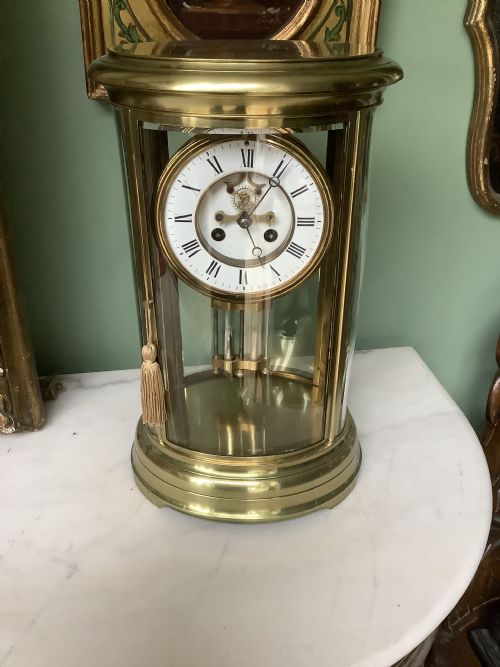

Oval Brass Timepiece
An oval brass timepiece brings French craftsmanship and Victorian weight to a mantel or desk.
Oval Brass Timepiece
When you search for an oval brass timepiece, you are looking at carriage clocks, mantel clocks, and strut clocks framed in metal and glass. The selections here span the Victorian and Edwardian eras, reaching from eighteen-sixty into the nineteen-twenties.
The most common forms on this page are carriage clocks with bevelled glass panels and mantel clocks such as the four-glass bracket style. Many originate from French workshops of the late nineteenth century, alongside English retail examples.
Makers and retailers like Howell and James, Drocourt, and Ad Mougin appear across these listings. They take various shapes, from miniature alarm designs to giant four-glass models and elliptical dials.
What varies in quality
The standard of execution in the brass casting and the complexity of the movement separate the finest pieces from simpler iterations. Four-glass mantel clocks with striking mechanisms represent a higher level of horological ambition than basic strut clocks.
Details such as cloisonne enamel work and the presence of an original leather travelling case elevate an example. The crispness of the enamel dial lettering and the weight of the brass casing also indicate superior production.
Howell And James London·Drocourt·Ad Mougin
The Oval Brass Timepiece Glossary
- Carriage clock
- A portable spring-driven timepiece designed for travel during the nineteenth century. These clocks usually feature a brass frame with glass panels and a swing handle on top.
- Four-glass clock
- A mantel clock housed within four glass panels that expose the mechanical movement from all sides. They often incorporate striking mechanisms.
- Strut clock
- A desk timepiece supported by a hinged prop or strut at the back. They are frequently housed in leather cases or metal frames.
- Cloisonne enamel
- A decorative technique where enamel paste is applied within compartments created by soldered brass wires on the metal surface. It adds rich colour and pattern.
- Striking mechanism
- A mechanical train within the clock that sounds the hours or half-hours on a bell or gong. More complex than simple time-only movements.
Oval Brass Timepiece: Frequently Asked Questions
What is an oval brass timepiece?
An oval brass timepiece is a mechanical clock housed in a curved brass case, typically dating from the nineteenth or early twentieth century. These items include portable carriage clocks and mantel clocks with glass panels.
Many examples reflect French design styles of the period, while others bear the names of prominent London retailers. They combine functional timekeeping with decorative metalwork.
How do I wind a carriage clock?
Winding requires a dedicated key inserted into the arbours found on the backplate of the movement. Care must be taken not to overwind the mainspring.
Most nineteenth-century movements run for a specific duration, such as eight days, before needing attention. Keeping the clock upright ensures the balance wheel operates correctly.
Are these clocks French or English?
The evidence shows a strong French influence in these listings, with makers like Drocourt and Ad Mougin producing carriage and mantel clocks in the late nineteenth century. At the same time, English retailers such as Howell and James also retailed them.
Stylistic cues and movement stamps often help identify the workshop origin. French examples frequently feature specific escapement types common to Paris makers.
What is a four-glass clock?
A four-glass clock is a mantel timepiece enclosed by glass panels on the front, back, and sides. This design allows light to pass through and reveals the brass mechanism clearly.
They are heavier and more substantial than travel clocks, intended for static placement on a mantelpiece. Some incorporate striking trains to mark the hours.