



Oval Back Desk Chair
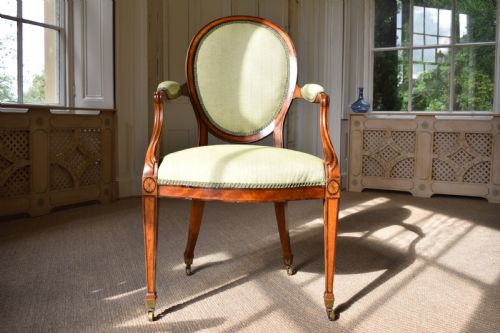
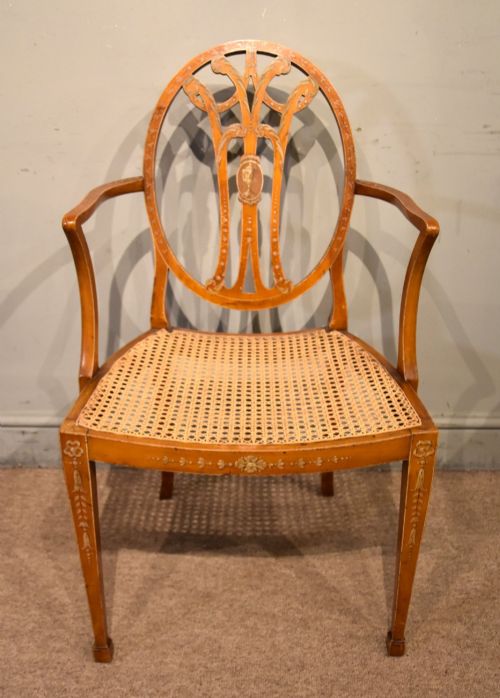
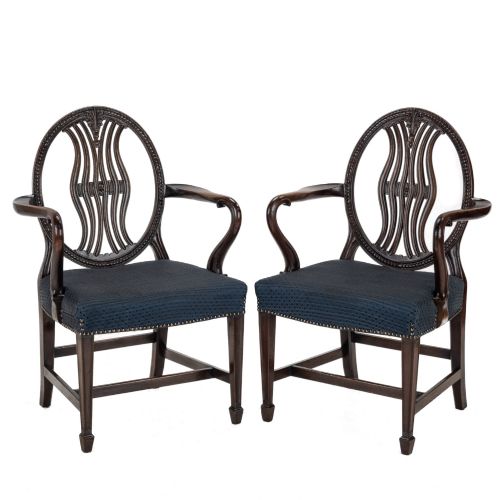
An oval back desk chair brings a refined silhouette to a study, uniting curved timber frames with supportive seating.
Oval Back Desk Chair
When searching for an oval back desk chair, you are examining seating designed with a rounded or elliptical backrest, frequently appearing as armchairs, carvers, and library chairs. These forms draw from Georgian, Victorian, and Edwardian periods, reflecting Revival styles such as Sheraton and Hepplewhite.
The versions most commonly met on this page span the eighteenth, nineteenth, and early twentieth centuries, constructed in mahogany, satinwood, and walnut. They often incorporate painted details, split cane panels, or fabric and leather upholstery suited to writing tables and desks.
Construction and materials
Makers shaped solid timbers like mahogany, walnut, and satinwood into curved frames, frequently employing intricate wood inlay to ornament the backrests and rails. Brass accents and carved details sometimes supplement the woodwork.
Support and comfort rely on traditional upholstery, split cane work, and fitted leather pads. Frames are joined to withstand regular sitting while maintaining slender, graceful proportions.
Oval Back Desk Chair Retail Price Guide 2026
Typical asking prices for oval back desk chair among the pieces listed under this phrase on Sellingantiques today, from the lower quarter to the upper quarter. They describe what is for sale here now, not the wider market.
Several pieces arrive as matched pairs, hinting at past conversations held across double desks.
Judging the quality
Quality rests upon the crispness of the carving, the precision of the wood inlay, and the integrity of the timber frame. Superior examples display balanced proportions and seamless joinery in the curved backrest.
The refinement of secondary materials, such as finely woven split cane or neatly fitted upholstery, separates standard seating from more ambitious library chairs and salon pieces.
The Oval Back Desk Chair Glossary
- Carver
- An armchair, often matching a set of dining or side chairs, featuring arms to accommodate the sitter more comfortably at a desk or table.
- Bergere
- An enclosed armchair with upholstered sides and a back panel typically filled with cane work.
- Sheraton Revival
- A late nineteenth and early twentieth century style drawing inspiration from the light, neoclassical furniture designs of the eighteenth century.
- Inlay
- A decorative technique where contrasting woods or materials are fitted flush into the surface of the primary timber to create patterns.
- Open armchair
- A seat without upholstered panels on the sides, leaving the wooden framework visible.
Oval Back Desk Chair: Frequently Asked Questions
What periods do these chairs come from?
The pieces span from the eighteenth century through the Georgian and Victorian eras into the Edwardian period and the early twentieth century.
Revival movements from the nineteenth century also heavily influence the designs available here.
How were these chairs originally used?
They served as functional seating in libraries, studies, and bedrooms, often positioned at writing desks or dressing tables.
Armchairs provided additional comfort for reading and correspondence compared to standard side chairs.
Are these chairs suitable for daily desk work?
Most of these pieces were built for domestic studies and libraries, offering sturdy timber frames and supportive curved backs.
Upholstered and cane variations provide varying degrees of cushion, though modern desk habits may benefit from careful height consideration.
How do I distinguish between styles?
Georgian and George III pieces generally showcase classic proportions and solid mahogany construction with restrained ornament.
Edwardian and Sheraton Revival examples often feature lighter satinwood, painted details, and delicate stringing.