


Ornate Gilt Timepiece
An ornate gilt timepiece brings together gilded metalwork and precision movement, capturing the elaborate decorative spirit of the nineteenth century.
Ornate Gilt Timepiece
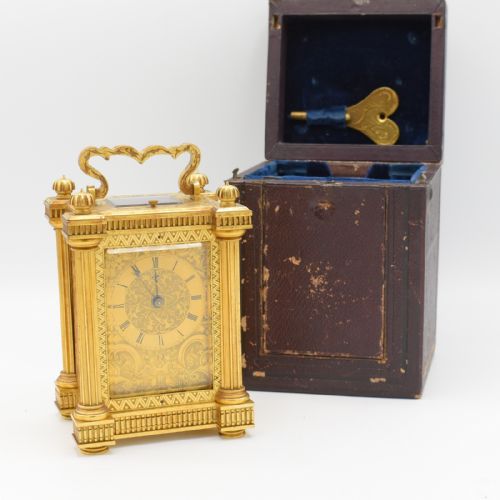
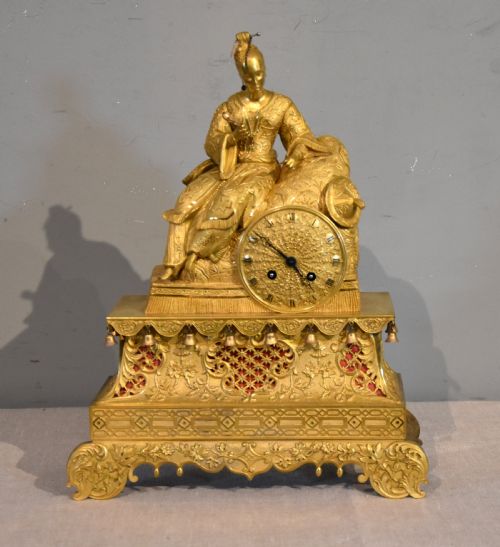
An ornate gilt timepiece usually takes the form of a mantel clock, carriage clock, or desk clock, drawing on nineteenth-century French and Victorian design traditions. Buyers encountering these pieces will find heavy metal cases finished with gilding, often paired with contrasting materials like marble or porcelain.
The selection ranges from architectural portico models and rococo revival pieces with scrolling foliage to portable brass carriage clocks and crystal regulators enclosed in glass. Most examples date from the Victorian era and the latter half of the nineteenth century, reflecting robust manufacturing centres in Britain and France.
How they were made
Makers formed the primary housings from brass, bronze, and ormolu, applying mercury gilding or electroplating to achieve a brilliant metallic sheen. Cases often incorporated decorative inserts of enamel, hand-painted porcelain panels, or polished red and white marble.
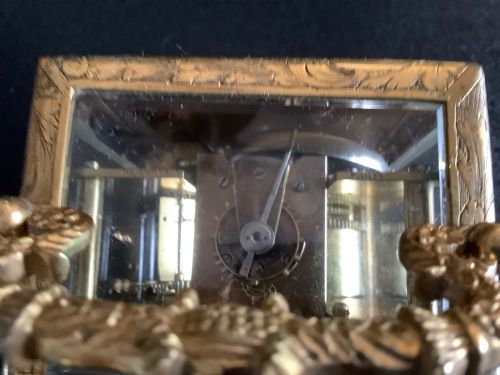
Movements relied on brass gear trains, escapements, and sometimes striking mechanisms like the grand sonnerie, housed securely within heavy cast metal frames. Enamel dials featuring delicate numerical markers were fitted behind protective glass bezels to complete the construction.
Some travel timepieces arrived with giant dimensions, proving that nineteenth-century travellers took their heavy brass comforts seriously.
What varies in quality
The sophistication of the casting and chasing distinguishes standard production from finer output, visible in the crispness of acanthus leaves and figural details on gilt bronze. Heavier metal gauge and substantial marble bases indicate superior structural integrity.
Movement complexity also sets pieces apart, with repeater mechanisms, platform escapements, and signed brass backplates representing higher tiers of horological work compared to simple time-only setups.
Howell & James London·Gontard & Bolviller Paris·Samuel Marti·Thomas Cole and James Cole·Henri Jacot
The Ornate Gilt Timepiece Glossary
- Ormolu
- Gilded bronze, produced by applying a mixture of gold and mercury to a bronze base before heating. This technique creates a rich, durable surface finish found on many French mantel clocks.
- Carriage clock
- A small, portable spring-driven timepiece equipped with a carrying handle and glass panels. These were originally designed for travel during the nineteenth century.
- Escapement
- The mechanism within a clock that controls the release of power from the mainspring or weights to the gear train. Precision platforms here dictate timekeeping accuracy.
- Champleve
- An enamelling technique where troughs are dug into a metal surface and filled with vitreous enamel powder before firing. It appears on decorative dials and clock panels.
- Crystal regulator
- A mantel clock housed in a glass-panelled brass frame that reveals the mechanical movement from multiple angles. These gained popularity in the late nineteenth century.
Ornate Gilt Timepiece: Frequently Asked Questions
Where do I put a heavy mantel clock?
These clocks require a sturdy surface such as a mantelpiece, heavy sideboard, or dedicated console table capable of supporting substantial bronze and marble weight.
Ensure the placement is level to allow the pendulum or escapement to beat evenly without stopping.
How do I tell French and Victorian pieces apart?
French pieces often display distinct regional styling such as rococo scrolls, Sevres porcelain panels, or signatures from makers like Samuel Marti and Henri Jacot. Victorian examples made in Britain frequently incorporate robust fusee movements or retail through notable London establishments.
Stylistic overlaps occur because British makers drew heavily on French design vocabulary during the nineteenth century.
Are these clocks suitable for daily use?
Many mechanical clocks from the nineteenth century remain fully functional and keep reliable time when serviced properly. Regular cleaning of the brass gear trains helps preserve the historical movement.
Gentle handling during winding ensures the delicate escapements and glass panels stay intact over years of display.