
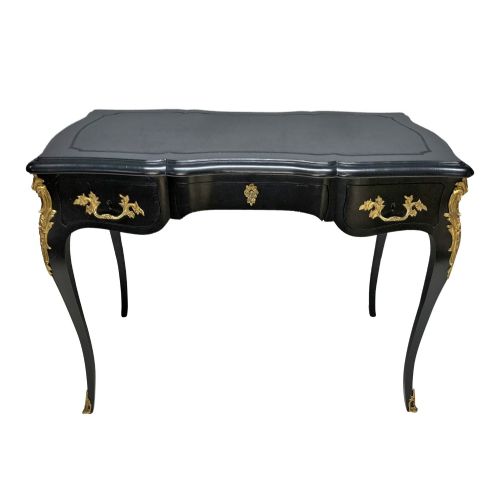
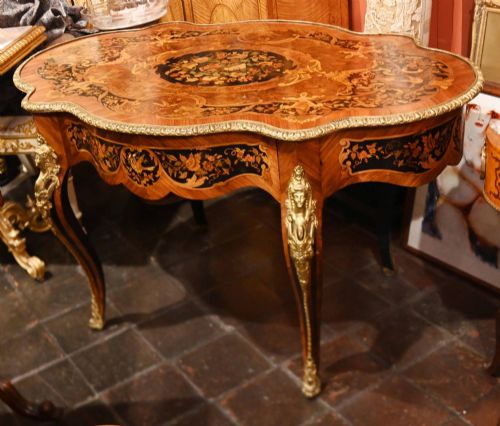
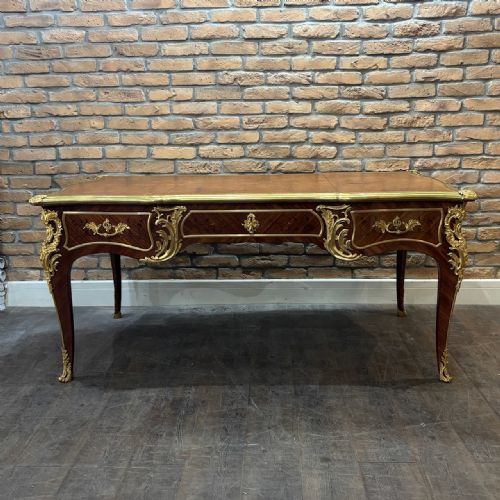
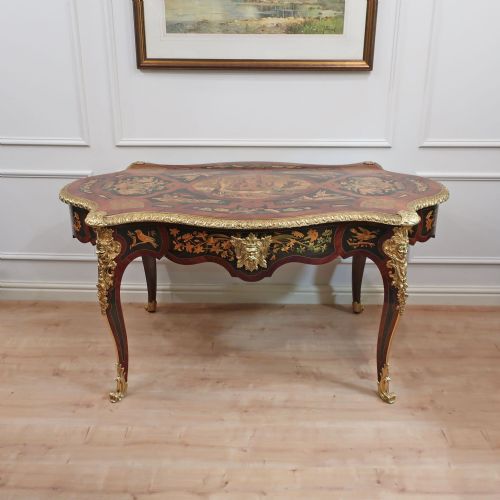


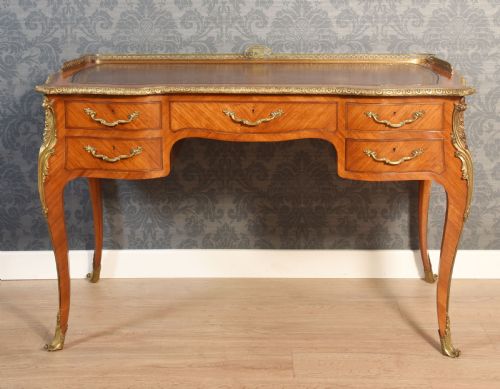

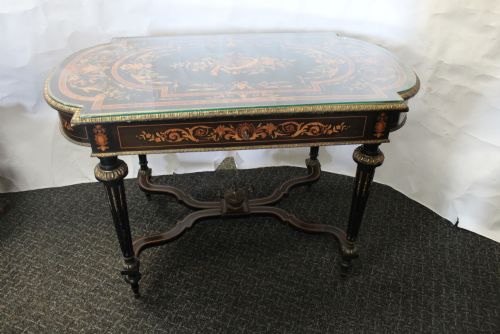


Ornate French Writing Table
An ornate french writing table brings continental flair to a room, offering a surface for correspondence finished with meticulous decorative detailing.
Ornate French Writing Table
When you search for an ornate french writing table, you encounter pieces spanning the nineteenth century alongside early twentieth-century revivals. These items primarily take the form of desks, bureau plat tables, and centre tables designed for domestic studies and reception rooms.
The pieces on this page lean heavily into revival aesthetics, particularly Louis XV and Napoleon III styles. They provide functional writing surfaces combined with elaborate decorative schemes suited to prominent placement in a home.
How They Were Made
Cabinet makers utilised fine timbers such as kingwood, walnut, rosewood, and satinwood as the foundation for intricate marquetry and parquetry inlay. These wooden surfaces are frequently accented with cast ormolu and gilt bronze mounts that frame the edges and corners.
Many examples incorporate leather writing inserts and detailed porcelain plaques, such as Sevres inserts, integrated directly into the woodwork. Ebonised finishes and black lacquer also appear, providing a contrasting dark ground for the metallic mounts.
Materials appearing across these items include ebonised wood, burr walnut, kingwood, brass, and gilt bronze mounts.
What Varies in Quality
The distinction between standard and exceptional pieces rests upon the precision of the marquetry and the crispness of the bronze casting. Finer tables display tightly fitted parquetry and sharply chased ormolu mounts rather than simpler cast decoration.
Selection of timber grain and the integration of decorative plaques dictate the overall refinement of the desk. Higher quality examples demonstrate seamless joining between the timber structure and the applied metalwork.
The Ornate French Writing Table Glossary
- Bureau Plat
- A kneehole writing desk, usually freestanding with drawers across the frieze. This form developed in France during the eighteenth century and remained popular in later revivals.
- Ormolu
- Gilded bronze applied as mounts, handles, and feet on furniture. The technique involves coating bronze with a finely ground mercury and gold amalgam before heating.
- Marquetry
- Decorative patterns formed by fitting together thin veneers of various woods. Artisans cut these veneers meticulously to create pictorial or geometric designs across tabletops.
- Parquetry
- Geometric mosaic woodwork arranged in repeating patterns such as cubes or chevrons. This technique decorates the primary surfaces of many nineteenth-century writing tables.
- Bureau De Dame
- A small ladies writing desk, often featuring a fitted superstructure with small drawers and compartments. These delicate pieces were designed for personal correspondence.
Ornate French Writing Table: Frequently Asked Questions
Where should I place a writing table?
These tables function well as freestanding pieces in the centre of a room rather than pushed directly against a wall. Their finished backs and ornate mounts allow them to be viewed from all angles.
They serve effectively as functional desks or as decorative display surfaces in studies, drawing rooms, and large hallways.
How do I care for leather inserts?
The leather surfaces on these writing desks require gentle cleaning with a dry or barely damp cloth, avoiding harsh chemical cleaners. Conditioning leather periodically helps preserve suppleness and prevents cracking over time.
Keep these tables away from direct heat sources and strong sunlight to protect both the leather and the underlying timber finish.
What is a bureau plat?
A bureau plat is a flat-topped writing table fitted with one or more rows of drawers beneath the writing surface. These desks were traditionally designed to sit in the middle of a room.
They offer an expansive surface area and typically feature decorative bronze mounts along the apron and legs.
How do I identify Louis XV style?
Louis XV style furniture is characterised by serpentine curves, cabriole legs, and asymmetrical floral motifs. The lines flow organically without rigid symmetry.
This aesthetic experienced a major revival during the nineteenth century, which accounts for many of the pieces found in this category.