



Ornate French Clock
An ornate French clock brings heavy cast bronze, polished marble and precise escapements into a room, offering both reliable timekeeping and undeniable decorative presence.
Ornate French Clock
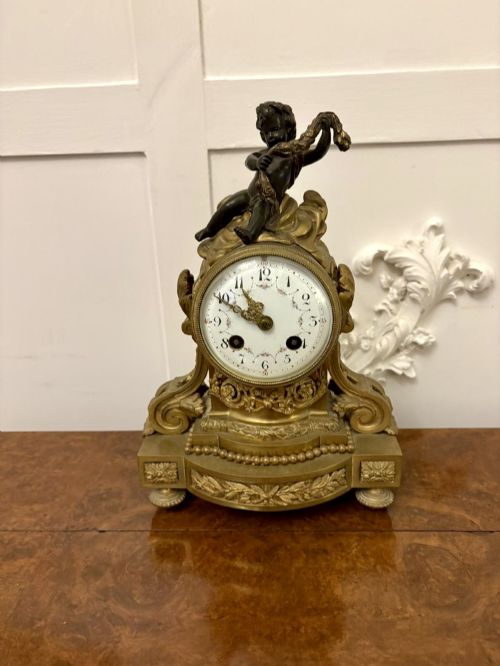
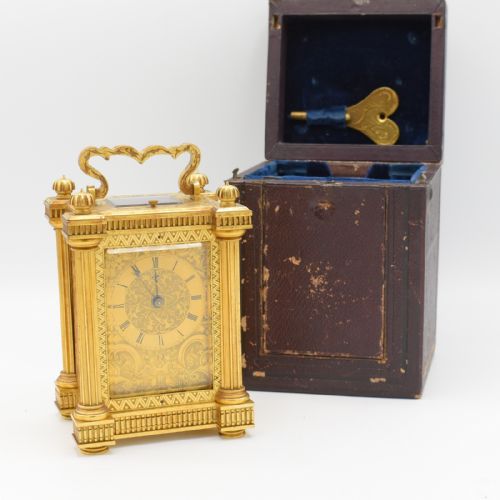
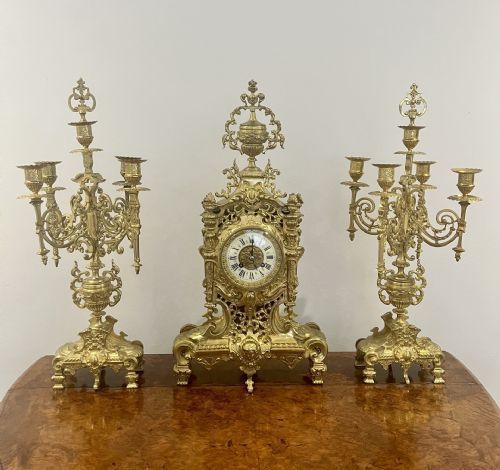
When you search for an ornate French clock, you encounter domestic timepieces built primarily during the nineteenth century, spanning periods from the 1850s through to 1900. These objects take several distinct architectural forms, from substantial mantel clocks and garniture sets flanked by matching urns to glass-panelled carriage clocks designed for travel.
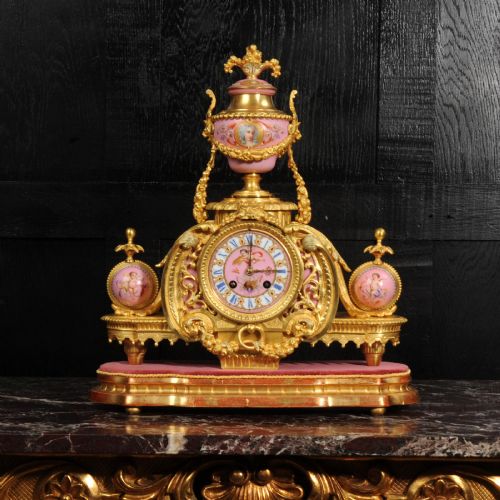
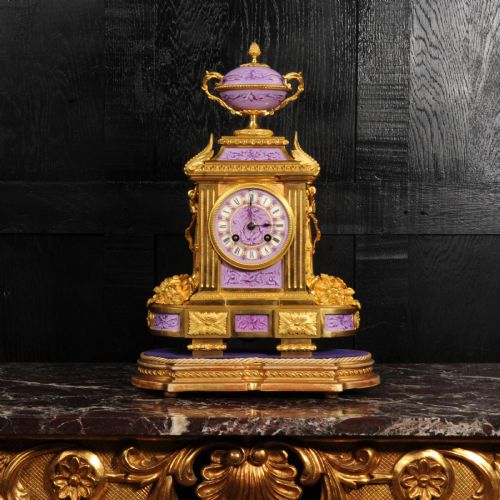
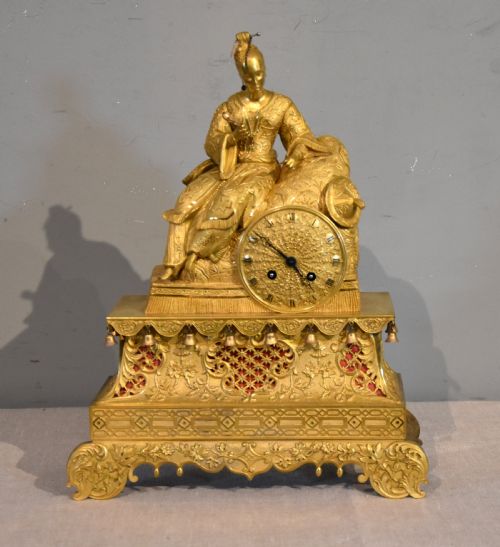
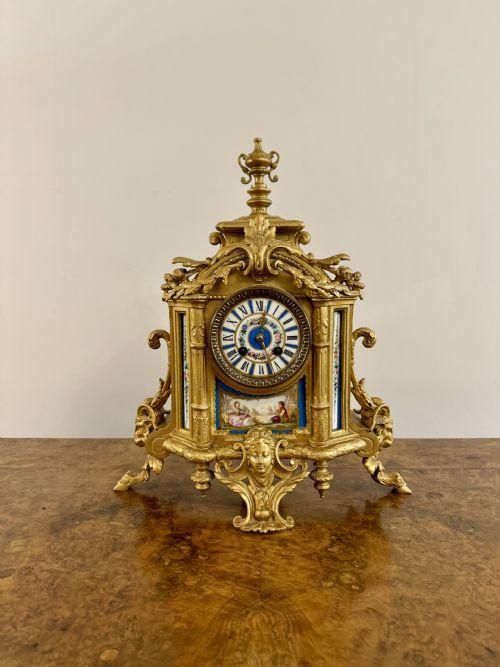
The most common versions met on this page are mantel clocks styled in the French Rococo Revival or Second Empire taste, featuring rich gilding, figurative castings and visible porcelain panels. Alongside these sit smaller brass carriage clocks housed in bevelled glass cases, often retaining their original leather travelling outer boxes.
Makers and horologists based in Paris and provincial French workshops produced these pieces for an international clientele, combining heavy brass movements with elaborate cast housings. The resulting objects served as both functional household utilities and central decorative focal points for Victorian and Edwardian interiors.
How they were made
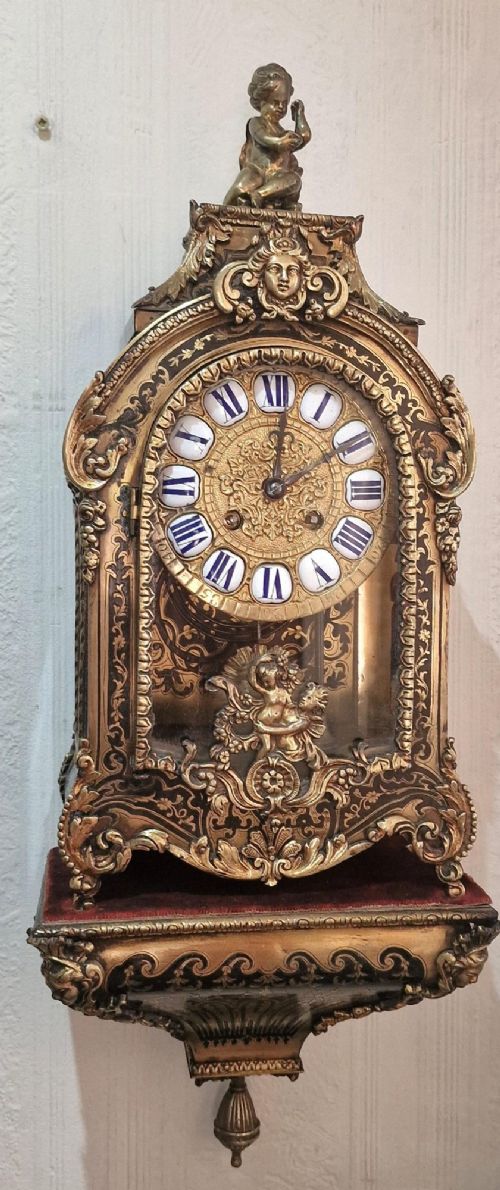
The construction of these pieces relies heavily on cast ormolu, gilt bronze, and brass, shaped into elaborate scrolls, foliage and figural motifs using traditional foundry techniques. Dial faces frequently incorporate hand-painted enamel numerals or individual porcelain plaques decorated with floral scenes and blue cartouche markers.
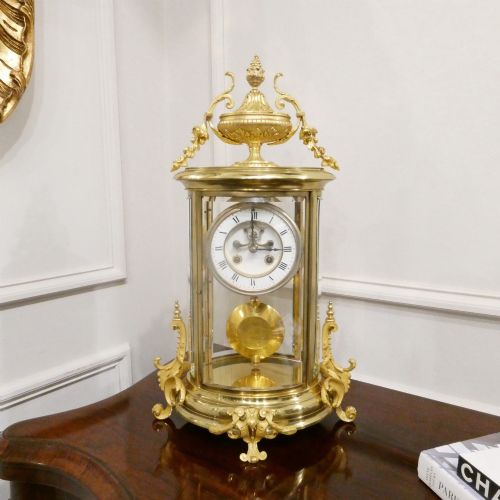
Many housings combine multiple contrasting materials within a single frame, pairing black or red marble, slate, alabaster and tortoise shell with polished metal mounts. Glass components appear extensively in four-glass mantel clocks and carriage clocks, allowing an unobstructed view of the oscillating escapement and gear trains within.
Listings span the nineteenth century, incorporating materials from Sèvres porcelain and red marble to heavy cast ormolu and brass.
What varies in quality
Quality in these horological pieces rests upon the crispness of the bronze casting and the depth of the subsequent gilding or ormolu finish. Finer examples display sharp, hand-chased detailing in the metalwork rather than the soft edges characteristic of mass production.
The mechanical movement dictates the upper tier of value, particularly when signed by renowned makers or horologists such as Achille Brocot, Samuel Marti, Japy Freres or A.D. Mougin. The inclusion of complex complications like repeater mechanisms, grand sonnerie striking trains or platform escapements further elevates the standing of an individual clock.
Achille Brocot·Samuel Marti·Howell And James·Japy Freres·Brunelot·Gontard And Bolviller·A D Mougin
The Ornate French Clock Glossary
- Ormolu
- A golden-coloured metallic alloy used to simulate genuine gold on furniture and clock mounts. It is applied to bronze or brass castings to provide a bright, reflective surface.
- Garniture
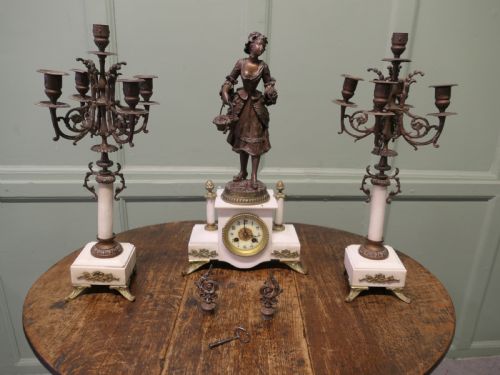
- A decorative set consisting of a central clock flanked by matching side ornaments such as urns or vases. These matched suites were designed to sit harmoniously upon a mantelpiece.
- Carriage clock
- A small, portable spring-driven timepiece equipped with a carrying handle and glass panels. They were originally made for travellers during the nineteenth century.
- Champlevé
- An enamelling technique where troughs or cells are hollowed out of a metal surface and filled with vitreous enamel paste. The piece is then fired and polished flat.
- Escapement
- The internal mechanism that converts rotational energy into impulsive swings, regulating the speed at which the clock runs. Fine examples feature visible platforms.
Ornate French Clock: Frequently Asked Questions
What is a clock garniture set?
A clock garniture set comprises a central mantel clock accompanied by two matching side pieces, typically designed as decorative urns or vases. These matching items were manufactured as a cohesive suite to create a balanced display across a fireplace mantel.
In period interiors, placing these three matching objects together established a formal focal point within the principal reception rooms. The materials of the side pieces invariably mirror the central clock, combining ormolu, porcelain, or marble.
How do carriage clocks work?
Carriage clocks operate using a spring-driven movement rather than hanging weights, allowing them to function reliably while portable. A folding handle on top permits safe transport between rooms or during travel.
Inside, a platform escapement regulates the gear train regardless of the clock's exact orientation. Glass panels on the top and sides expose these moving internal components to view.
What is French Boulle work?
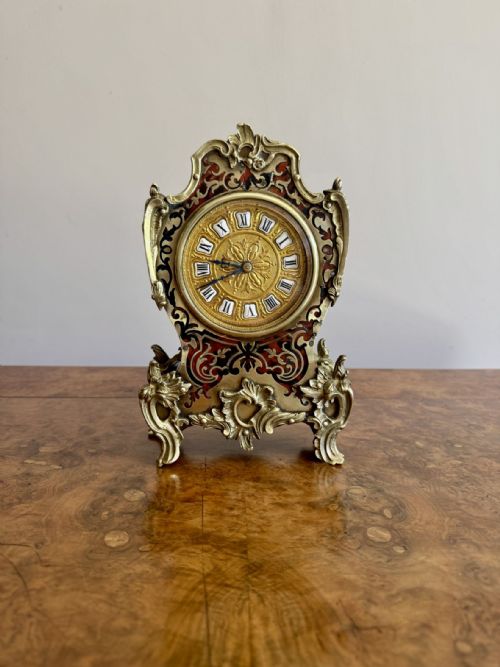
Boulle work is an intricate marquetry technique involving inlaid tortoise shell and brass, popularised by French cabinetmakers. Thin sheets of metal and shell are cut together to create contrasting patterns across the wooden carcass.
Clocks featuring this technique display distinctive golden scrolls against a dark, mottled background. The method requires considerable skill to fit the delicate materials flush across curved clock cases and wall brackets.
How do I wind an antique clock?
Winding requires a matching key inserted into specific holes on the enamel dial or backplate, turned gently until resistance is felt. Care must be taken not to overwind the mainsprings, which can cause internal damage.
Many nineteenth-century movements feature separate arbours for the timekeeping train and the striking train. Maintaining a regular winding schedule helps keep the mechanical gear train functioning smoothly.
What is a four glass clock?
A four-glass clock is a mantel timepiece housed in a brass or gilt frame inset with bevelled glass panes on the front, back, and both sides. This construction exposes the entire movement and pendulum to light from all angles.
These clocks frequently utilise mercury pendulums designed to compensate for temperature changes. Their transparent cases reflect the architectural tastes of the later nineteenth century.