
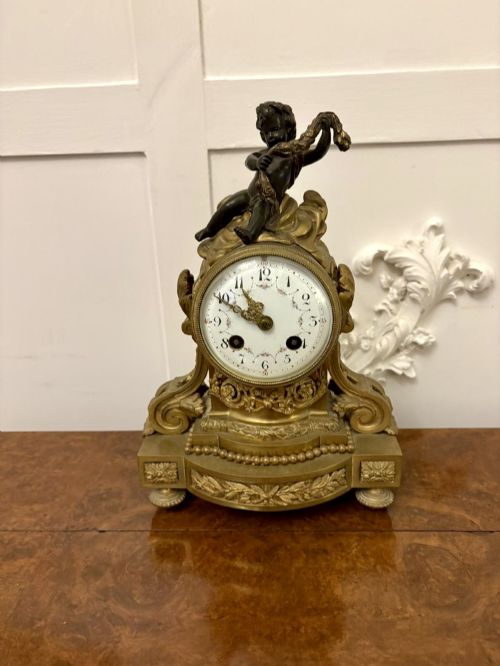
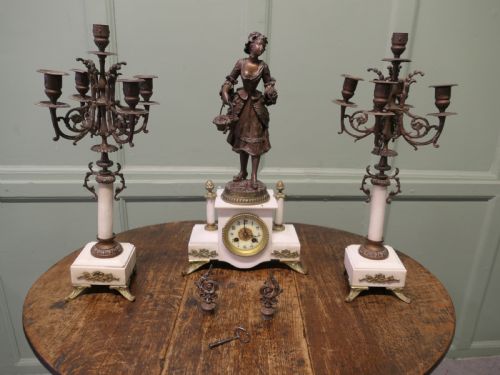
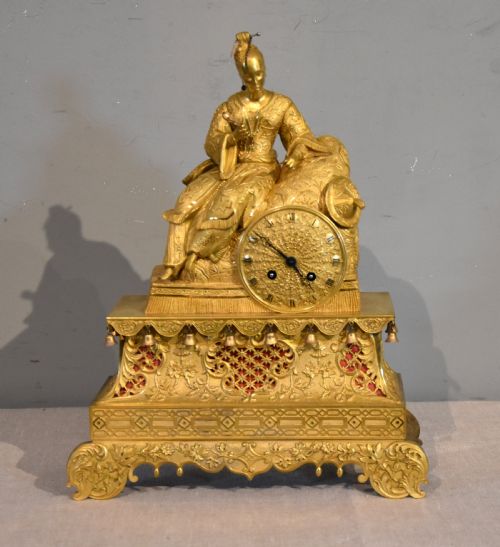
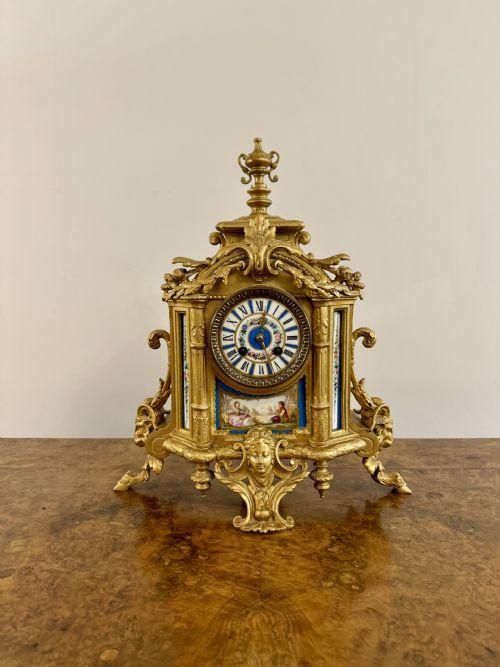


Ornate Bronze Mantle Clock
An ornate bronze mantle clock brings nineteenth-century French weight and gilt metalwork directly to the fireplace, combining heavy cast cases with striking movements.
Ornate Bronze Mantle Clock
An ornate bronze mantle clock on this page typically originates from nineteenth-century French workshops, spanning periods from the 1850s to the early 1900s. These pieces take the form of mantel clocks, clock garniture sets with side urns or candelabra, and crystal regulators housing visible mechanical movements.
Makers and designers drew heavily upon historical idioms, producing Rococo revival scrolls, Louis XVI neoclassical symmetry, and occasional Chinoiserie or Art Nouveau flourishes. The resulting objects function simultaneously as reliable timekeepers and heavy decorative centerpieces built to command a room.
How they were made
Foundries cast these heavy cases in bronze, brass, or spelter before applying thick layers of gold through mercury gilding to produce ormolu, or leaving the surfaces in dark patinated bronze. Workshops then integrated hand-painted porcelain plaques, enamel dial chapters with Arabic or Roman numerals, and bevelled glass panels into crystal regulator cases.
Movements were engineered to run for eight days, frequently striking hours and half-hours on bells or gongs. Skilled artisans finished the metalwork with fine chiselling and chased details, ensuring that cast motifs like lion masks, cherubs, and scrolling foliage remained sharp and distinct.
What varies in quality
The division between standard production and exceptional manufacture rests upon the crispness of the bronze chasing and the depth of the original gilding. Master bronze-founders reworked cast surfaces by hand with gravers to sharpen every acanthus leaf and scroll, whereas lesser pieces left cast details soft and uniform.
The integration of materials also defines the tier of a piece, separating clocks with hand-painted Sevres-style porcelain panels and finely detailed champleve enamelling from those with plain brass dials and simpler cast metal bodies.
Japy Freres·Leroy and Fils·Auguste Moreau
The Ornate Bronze Mantle Clock Glossary
- Ormolu
- Gilt bronze produced by applying a mercury and gold amalgam to a bronze base and heating it until the mercury vaporised, leaving a rich golden coating.
- Garniture
- A set consisting of a central clock flanked by matching ornamental objects such as vases, urns, or candelabra designed to sit together on a mantle.
- Crystal regulator
- A mantle clock constructed with heavy bevelled glass panels on all four sides, allowing an unobstructed view of the pendulum and mechanical movement within.
- Champleve
- An enamelling technique where troughs are dug into the metal surface, filled with vitreous enamel powder, and fired before being polished flush.
- Spelter
- A zinc alloy commonly utilised as a less expensive alternative to bronze for casting sculptural clock cases during the nineteenth century.
Ornate Bronze Mantle Clock: Frequently Asked Questions
How do I wind an ornate bronze mantle clock?
Most of these movements require a matching winding key inserted into the dial holes to tension the mainsprings every eight days.
Care must be taken not to overwind the springs, stopping as soon as resistance is felt.
Why does my clock run fast or slow?
Temperature changes and the settling of the heavy bronze case can alter the beat of the pendulum over time.
Adjustment is typically made by turning a small nut on the pendulum rod to raise or lower the bob.
Where should I place a mantle shelf clock?
These heavy cast cases require a stable, level surface capable of supporting considerable weight without shifting.
Placing them away from damp exterior walls helps protect the delicate gilt surfaces and enamel dials.
How do I identify a Victorian French movement?
French movement makers stamped their backplates with workshop medals, serial numbers, and retailer signatures.
These mechanical signatures frequently indicate production centres in Paris or the Saint-Nicolas-d'Aliermont region.