

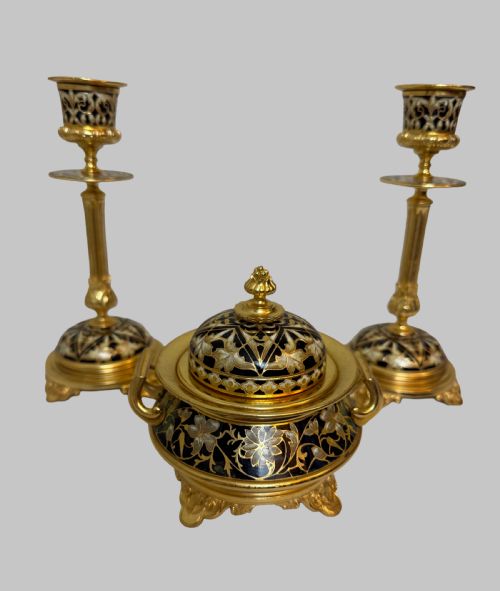


Ornate Inkstand Set
These ornate antique inkstand sets are heavy desktop showpieces in brass, bronze and porcelain, built to organise correspondence with elaborate Victorian flair.
Ornate Inkstand Set
An ornate antique inkstand set brings together inkwells, pen trays and sometimes letter holders or candlesticks onto a single fitted base. You will most frequently encounter brass and cast-brass desk sets from the Victorian and Edwardian periods, often dating between eighteen-sixty and nineteen-hundred.
Beyond standard brass configurations, these desk accessories appear with champleve enamel, cut glass inserts and Sèvres-style Minton porcelain. French Rococo revival and Napoleon III influences dominate the decorative vocabulary, alongside occasional Anglo-Indian brasswork and blue and white ceramic inkwells.
The objects function as complete desk suites designed to hold the tools of nineteenth-century correspondence in one cohesive display. Makers such as James Cartland and Sons and Elkington contributed specialised desk hardware to this tradition.
Materials and construction
Foundries produced these pieces primarily through brass casting, fabricating heavy stands, hinged lids and decorative mounts with substantial metal weight. Gilt bronze and ormolu finishes provided a rich surface sheen, while champleve enamel introduced vibrant colour fields into the metalwork.
Glassmakers supplied heavy cut-glass inkwell inserts designed to fit securely into metal collars, preventing ink from spilling onto the desk surface. Porcelain elements, including Minton ceramic bodies, were painted and glazed before mounting into brass frames.
Ornate Inkstand Set Retail Price Guide 2026
Typical asking prices for ornate inkstand set among the pieces listed under this phrase on Sellingantiques today, from the lower quarter to the upper quarter. They describe what is for sale here now, not the wider market.
Desk accessories on this page range from simple ceramic inkwells on brass stands to elaborate French champleve enamel and cast-brass ensembles.
Assessing quality and manufacture
The distinction between standard desk pieces and superior examples lies in the crispness of the casting and the depth of the chasing. Finer sets display sharply defined scrollwork, substantial gauge metal and tightly fitting hinges on the inkwell lids.
Material combination also elevates a piece, particularly the integration of hand-applied champleve enamel or fine porcelain panels alongside cast brass. Signed work from established makers like Elkington or James Cartland indicates a higher standard of workshop production.
James Cartland and Sons·Elkington·Moser
The Ornate Inkstand Set Glossary
- Champleve enamel
- A technique where troughs are gouged into the surface of a metal object and filled with vitreous enamel before firing. This colourful decoration appears frequently on French nineteenth-century desk stands.
- Ormolu
- A metallic coating of finely ground gold-mercury amalgam applied to a bronze object. It gives the metal a brilliant golden appearance without solid gold construction.
- Chaff-cutter escapement
- A specific mechanical movement found in desk clocks integrated into inkstand sets. It regulates the timekeeping using a distinctive escapement wheel design.
- Sèvres style
- A decorative manner imitating the famous French porcelain manufactory, featuring hand-painted pastoral scenes or rich coloured grounds. Minton produced porcelain in this manner for Victorian inkstands.
Ornate Inkstand Set: Frequently Asked Questions
What is an ornate antique inkstand set?
It is a desk accessory housing inkwells, pen rests and sometimes candlesticks or letter holders on a shared tray. These pieces served as centrepieces for nineteenth-century writing desks.
They combine utilitarian function with ornamental metalwork, ceramics or glass to reflect the formal writing habits of the Victorian and Edwardian eras.
How were these inkstands used?
Owners placed them on library desks or writing tables to keep writing materials organised and ready for use. The inkwells held liquid ink for dip pens, while the trays caught stray nibs and prevented spills.
Many sets included integrated letter racks or candlesticks to provide illumination and correspondence sorting during evening writing sessions.
How do I date a brass desk set?
Dating relies on stylistic clues, manufacturing techniques and maker marks stamped into the brass or bronze. Victorian pieces often display heavy Rococo revival scrolls, while nineteen-hundred Edwardian versions show slightly cleaner lines.
Comparing the hinge construction, glass insert thickness and enamel work against known nineteenth-century examples helps narrow the period of manufacture.
Can I still use an antique inkstand?
You can use them for display, stationery organisation or modern fountain pen storage on a desk. Many collectors prefer to keep glass inserts clean and dry rather than filled with modern ink.
Using them as intended is possible if the glass inkwell liners are intact and free of cracks, though most owners treat them primarily as historical desk art.