









French Bronze Desk Accessories
French bronze desk accessories bring tactile weight and classical design to a working surface, combining utility with decorative sculpture.
French Bronze Desk Accessories
When you search for french bronze desk accessories, you encounter functional objects designed for the writing table, primarily inkstands, inkwells, candlesticks, bookends, letter openers, and decorative boxes. These pieces range from the strict symmetry of the French Empire and Neoclassical styles to the organic fluidity of Art Nouveau and the geometric lines of Art Deco.
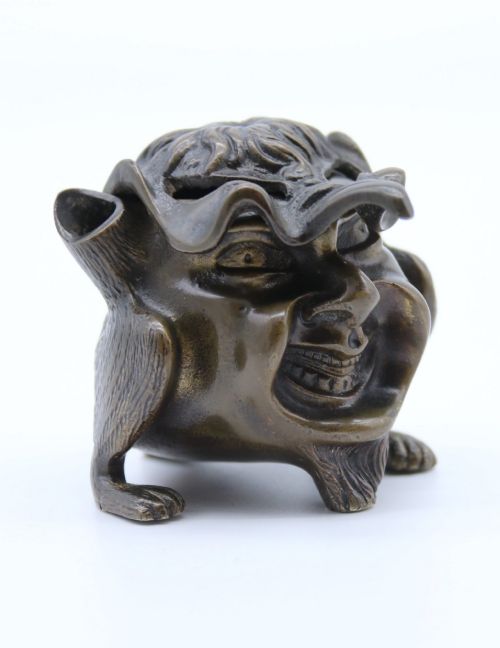
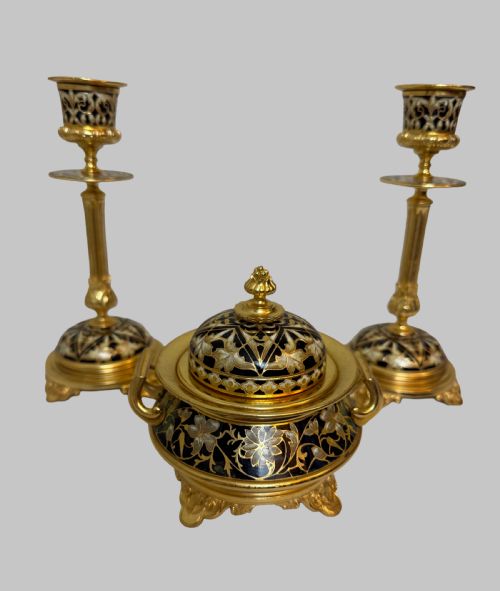
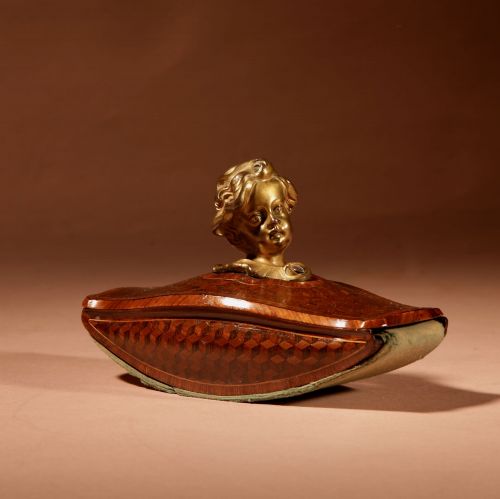
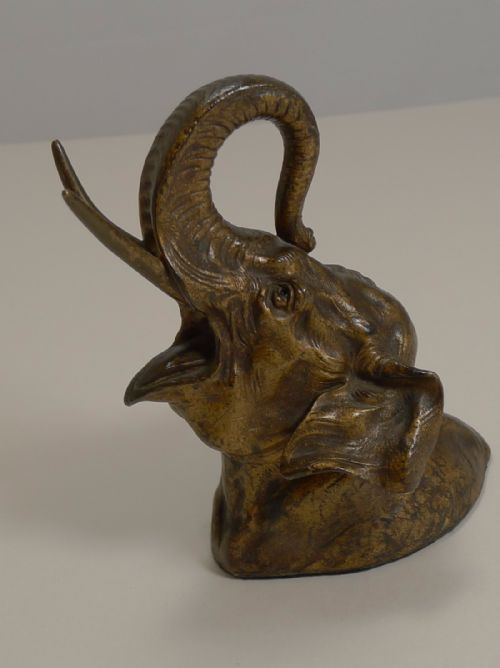
The version you are most likely to meet on this page is the 19th-century inkstand or inkwell, frequently paired with a heavy marble base. Materials span gilt bronze, patinated bronze, ormolu, and brass, occasionally accompanied by champleve enamel or mahogany. The inventory also includes figural subjects, from animals such as lions, elephants, and dogs to classical figures and whimsical characters.
Makers and designers working across these periods utilised cast metal and stone to create substantial pieces intended for prominent display. Whether an early nineteenth-century ormolu mount or a later Art Deco spelter pair of bookends, each item reflects the prevailing aesthetic of its decade.
Materials and construction
The primary construction method relies on bronze casting, utilising both lost-wax and sand-casting techniques to achieve sharp detail in figures, foliage, and architectural mounts. Artisans then finished these casts through chasing, which involves hand-tooling the metal surface to refine textures and contours before applying patination or gilding.
Many desk pieces integrate stone bases, notably Sienna, vert, and onyx marble, which provide stability and contrast against the warm tones of gilt bronze and ormolu. Components such as inkwells, lids, and mounts were secured with threaded pins and screws, combining heavy metalwork with durable mineral foundations.
French Bronze Desk Accessories Retail Price Guide 2026
Typical asking prices for french bronze desk accessories among the pieces listed under this phrase on Sellingantiques today, from the lower quarter to the upper quarter. They describe what is for sale here now, not the wider market.
Writers of the past kept their ink secure inside grotesques, emus, and even playing kittens cast in bronze.
Assessing quality and execution
The application of gilding and patination also distinguishes the range. Heavy fire-gilding or ormolu retains a deep, warm lustre over centuries, whereas inferior finishes appear flat or uneven. The integration of materials, such as the precise fit of glass or ceramic liners within bronze inkwells, marks the difference between standard production and fine craftsmanship.
Lefebvre of Belgium·Albert Marionnet·Asprey Of London·Maurice Dufrene·Ernest Louis ADNIN
The French Bronze Desk Accessories Glossary
- Ormolu
- Gilded bronze, produced by applying a mercury-gold amalgam to a bronze base and heating it to vaporise the mercury. This technique creates a durable, luminous golden finish characteristic of French decorative arts.
- Champleve
- An enamelling technique where troughs or cells are hollowed out of the metal surface and filled with vitreous enamel before firing. It frequently appears on nineteenth-century desk sets and candlesticks.
- Patinated bronze
- Bronze treated with chemical solutions to produce a specific surface colour, ranging from deep brown to green. This treatment protects the metal and accentuates sculptural details.
- Encrier
- A French term for an inkstand or inkwell, often incorporating multiple glass or ceramic ink pots, pen trays, and tapersticks on a shared tray.
- Spelter
- A zinc-based alloy used as a less expensive alternative to bronze, particularly in Art Deco bookends and figures. It was often given a bronze-coloured surface finish.
French Bronze Desk Accessories: Frequently Asked Questions
How do I distinguish Empire style from Art Deco?
Empire style pieces, dating from the early nineteenth century, feature strict classical motifs, symmetry, military trophies, and rich ormolu mounts on dark marble. They emphasise grandeur and historical precedent.
Art Deco pieces, from the 1920s and 1930s, utilise streamlined geometries, stylised animal figures in bronze or spelter, and modern industrial forms that reject classical revivalism.
Were these items meant to travel?
Some desk accessories, described as campaign pieces, were built for portability with fitted compartments and secure lids to prevent ink spills during transit. Most stationary inkstands and desk sets, however, remained anchored to heavy marble bases for use in a permanent study or office.
The inclusion of heavy stone bases made daily relocation impractical, so they functioned primarily as permanent desk furniture.
What is the difference between bronze and spelter?
Bronze is a durable alloy of copper and tin that accepts fine chasing and holds crisp sculptural detail. It possesses significant weight and develops a rich patina over time.
Spelter is a softer, zinc-based alloy utilised as an economical substitute in later periods, particularly for Art Deco bookends. It is lighter and requires surface plating to mimic the appearance of bronze.