




Ormolu Three Light Candelabra
These ormolu three light candelabra bring French styling and gilded warmth to any interior.
Ormolu Three Light Candelabra
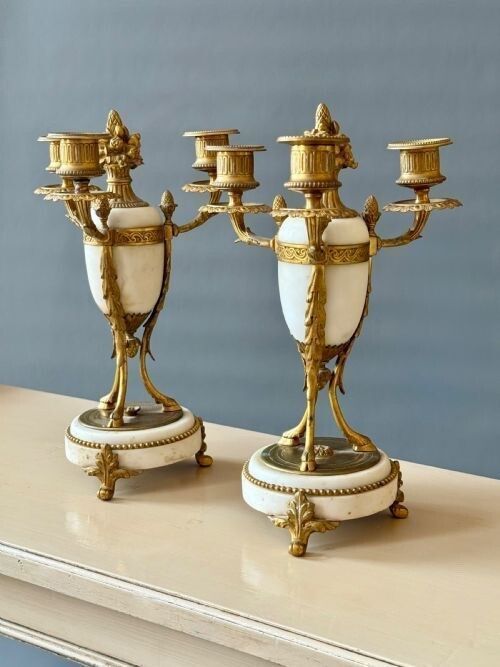
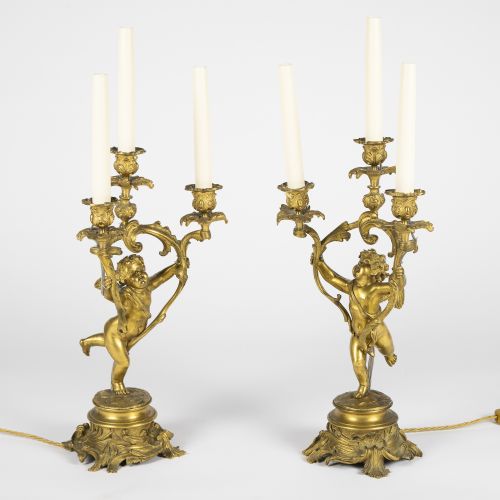
When you search for ormolu three light candelabra, you encounter decorative lighting primarily from the nineteenth century, including the Regency period and various revival styles. These objects generally take the form of paired branches designed to hold three candles, though table lamps and wall lights also appear in the selection.
The aesthetic leans heavily toward French design traditions, encompassing French Empire, Rococo Revival, Louis XVI Revival, and Charles X models. Buyers meeting these pieces on this page will find them rendered in symmetrical or figural arrangements featuring cherubs, putti, and classical motifs.
Distinctions in Quality
The integration of contrasting materials, such as veined marble plinths or slate bases paired with gilt metal, marks the differentiation between standard production and exceptional examples. Signed pieces or those demonstrating complex adjustable arm mechanisms command attention for their workshop provenance.
Listings for ormolu three light candelabra span the nineteenth century, featuring materials such as gilt bronze, patinated bronze, marble, and slate.
Rabiat·Clodion
The Ormolu Three Light Candelabra Glossary
- Ormolu
- A technique of applying finely ground high-carat gold to a bronze object, also used to describe the gilded bronze material itself. This finish provides a warm, rich lustre that defines much nineteenth-century decorative metalwork.
- Regency
- An English design period spanning the early nineteenth century characterised by classical restraint and Greco-Roman motifs. Pieces from this era often combine dark patinated bronze with bright gilt elements.
- Patinated Bronze
- Bronze that has been chemically treated to produce a darkened, weathered surface. This technique highlights the bright details of adjacent ormolu components.
- Rococo Revival
- A nineteenth-century design movement mimicking the asymmetrical scrolls, naturalistic foliage, and shell motifs of the eighteenth-century French style. It appears frequently in elaborate candelabra branches and bases.
Ormolu Three Light Candelabra: Frequently Asked Questions
How do I clean ormolu and bronze?
Dust gently with a soft, dry brush to prevent accumulation in the intricate recesses of the cast ornamentation. Avoid abrasive cloths, chemical dips, or metal polishes that can strip the historic gilding.
Maintain a stable indoor environment away from direct moisture and humidity to protect the underlying metal and any integrated marble or slate components.
Were these originally wired for electricity?
These pieces were originally manufactured to hold wax candles for interior illumination during the nineteenth century. Many have subsequently been adapted as table lamps or wall lights while retaining their original candelabra branches.
When evaluating electrified examples, check whether the conversion preserves the structural integrity of the original metal components without causing permanent damage.
How do I distinguish French Empire from Rococo Revival?
French Empire pieces display classical symmetry, military motifs, and austere architectural lines influenced by antiquity. The materials frequently contrast dark patinated bronze with bright ormolu highlights.
In contrast, Rococo Revival pieces embrace asymmetry, flowing scrollwork, naturalistic foliage, and figural elements such as cherubs or putti. The overall movement is softer and more ornate than the disciplined geometry of the Empire style.