



Ormolu Mounted End Tables
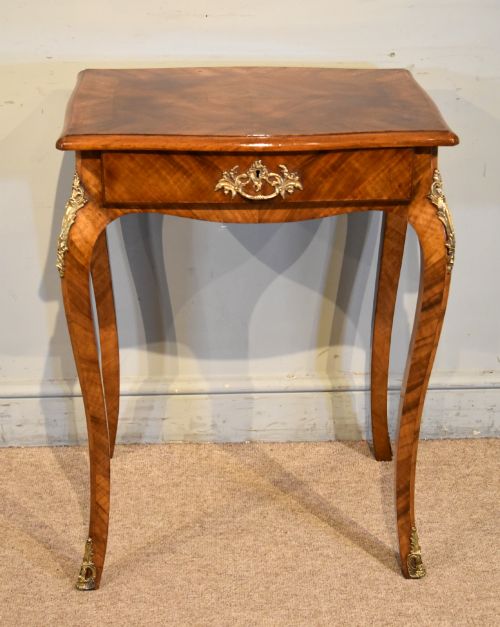
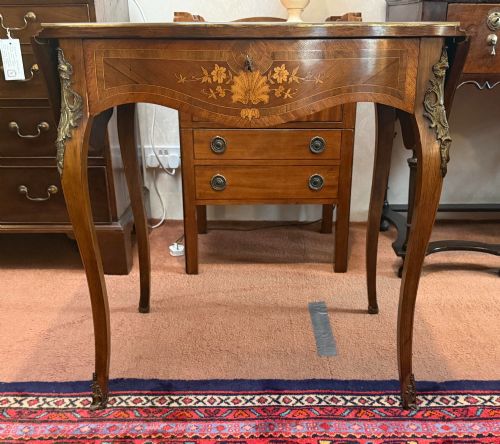
These ormolu mounted end tables bring French revival elegance and gilt bronze enrichment to a room.
Ormolu Mounted End Tables
When you search for ormolu mounted end tables, you encounter compact occasional furniture designed for French interiors, spanning the nineteenth century and into the early twentieth century. These pieces function as side tables, lamp tables, bedside cabinets, and gueridons, providing surface space alongside seating or beds.
The selections on this page lean heavily towards French styling, particularly Louis XV and Louis XVI revivals alongside Napoleon III and Empire pieces. Walnut, kingwood, rosewood, and mahogany form the primary carcases, frequently decorated with intricate marquetry and parquetry veneers.
You will notice distinct forms including kidney-shaped occasional tables and marble-topped gueridons. Many incorporate porcelain plaques or satinwood inlay, demonstrating the decorative ambition of these smaller scale furnishings.
How they were made
Cabinetmakers constructed the carcases from dense hardwoods such as mahogany and walnut, applying decorative veneers of kingwood, rosewood, and satinwood in geometric parquetry or floral marquetry patterns. Marble tops frequently insert into moulded wooden or gilt bronze surrounds.
Cast gilt bronze and brass mounts, known as ormolu, decorate the corners, aprons, and legs. These metal fittings were chased by hand to sharpen the detail before being fire-gilded or polished.
Ormolu Mounted End Tables Retail Price Guide 2026
Typical asking prices for ormolu mounted end tables among the pieces listed under this phrase on Sellingantiques today, from the lower quarter to the upper quarter. They describe what is for sale here now, not the wider market.
Materials recorded across the selection include ormolu, brass, kingwood, marble, mahogany, walnut, gilt bronze, and rosewood.
What varies in quality
The refinement of the cast bronze mounts separates standard production from exceptional work. Crisp chiselling and heavy gilding indicate superior craftsmanship compared to softer, shallower metal casting.
Veneer selection and the precision of the marquetry inlay determine the visual depth of the timber surfaces. Finer pieces demonstrate seamless alignment of complex wood grains and delicate parquetry patterns.
F. Linke·Henry Dasson·Weisweller
The Ormolu Mounted End Tables Glossary
- Ormolu
- Gilded bronze mounts applied to furniture. The technique involves applying a gold amalgam to bronze and heating it to drive off the mercury.
- Gueridon
- A small round table, typically supported by a central pillar or three legs. These often feature marble tops and decorative mounts.
- Parquetry
- Geometric wood inlay patterns resembling mosaics. Makers used contrasting timbers to create diagonal or chequered designs across the table top.
- Marquetry
- Pictorial wood veneer work using various tinted and textured woods. This technique creates floral or scroll motifs across the surfaces of the table.
Ormolu Mounted End Tables: Frequently Asked Questions
How were ormolu mounted end tables used originally?
These compact tables served functional roles in grand reception rooms and private chambers alike. They provided convenient surfaces for holding lighting, books, or decorative objects beside seating furniture.
In bedchambers, smaller cabinet versions functioned as nightstands or bedside storage. Their decorative presence matched the formal aesthetic of nineteenth-century French interiors.
How do I distinguish Louis XV revival from Louis XVI style?
Louis XV revival pieces, often termed Rococo style, exhibit asymmetrical curves, undulating cabriole legs, and flowing naturalistic ormolu mounts. The overall silhouette feels organic and sinuous.
Louis XVI style tables introduce straight tapered legs, neoclassical symmetry, and geometric framing. The decorative mounts lean towards classical urns, ribbons, and restrained floral patinas.
What timber types should I expect to find?
Makers relied on both native and exotic hardwoods for these tables. Walnut and mahogany provide sturdy structural carcases for both plain and veneered surfaces.
Exotic veneers such as kingwood and rosewood appear across the top surfaces and drawer fronts. Satinwood is occasionally utilised for lighter contrasting inlay work.