
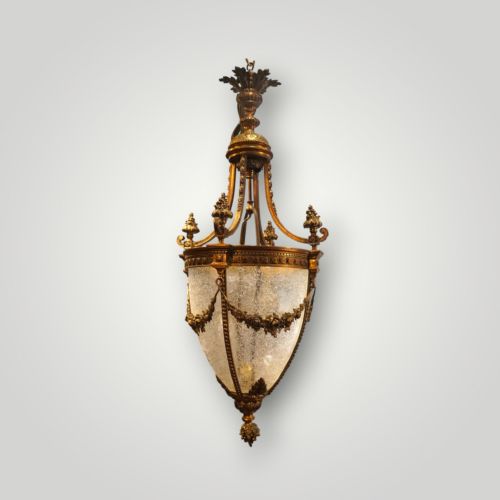
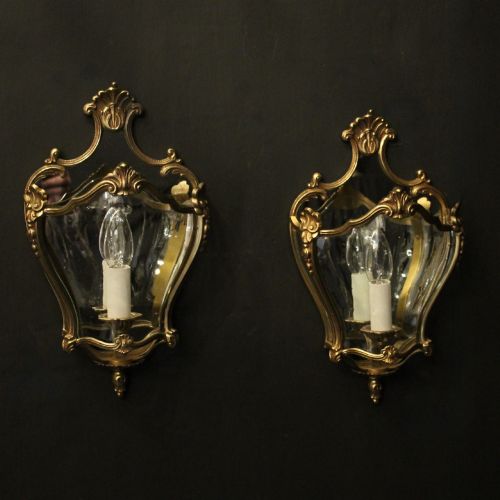
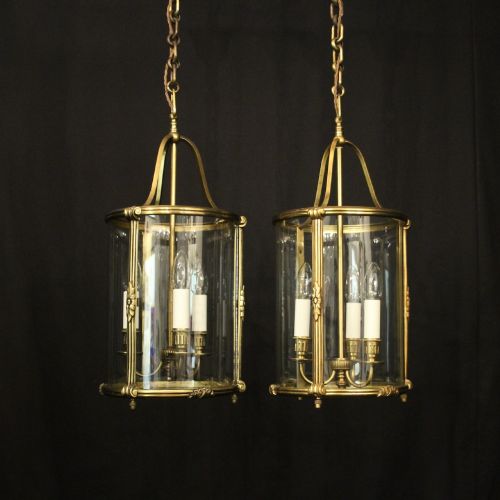
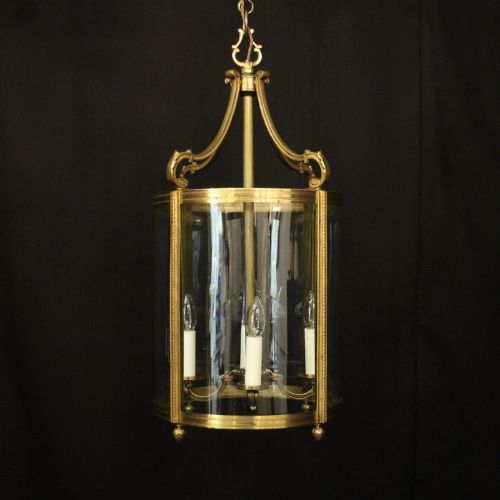


Ormolu Glass Lantern
These ormolu glass lantern pieces bring period grandeur and warm illumination to entrance halls, combining cast metal frames with clear glass panels.
Ormolu Glass Lantern
When you search for an ormolu glass lantern, you are looking at decorative hanging lights designed to illuminate hallways, stairwells, and vestibules. These fixtures use cast metal frames, often described as gilt bronze or ormolu, fitted with glass panels to protect the internal candle or electric light source from drafts.
The versions you are most likely to meet on this page hail primarily from the nineteenth century and the early decades of the twentieth century. French provincial and Parisian workshops dominate the selection, producing pieces influenced by classical Louis styles as well as Rococo and Neoclassical design principles.
Forms vary from single-bulb hall pendants and half lanterns to larger convex and multi-light ceiling configurations. English interpretations also appear alongside the dominant French output, offering hexagonal shapes and robust brass construction suited to period interiors.
Materials and construction
The primary structure relies on cast bronze or brass, which received a gold-coloured finish through fire gilding or chemical gilding techniques. This gilded metal provides a resilient and ornate skeleton designed to catch and reflect light within a hallway.
Panels of glass are fitted securely into the metal frames, utilising clear, bevelled, frosted, etched, or cut varieties to diffuse the internal illumination. These glass sections range from flat panes to curved convex plates that soften the light output.
The listings span the late nineteenth century through to the 1930s, featuring glass, gilt bronze, brass, and bevelled panels.
What separates the best pieces
Quality in these lanterns rests upon the crispness of the metal casting and the depth of the gilding. Finer examples display sharp, hand-chased detail in the acanthus leaves, scrollwork, and classical urn motifs, whereas lesser pieces show softer, shallower casting lines.
The glass selection also dictates overall merit. Heavy, bevelled, or deeply cut glass panels require superior craftsmanship and add substantial weight to the fixture compared to plain, thin panes.
The Ormolu Glass Lantern Glossary
- Ormolu
- A term traditionally used to describe gilded bronze, mimicking the appearance of gold. It forms the decorative metal framework of these hanging lights.
- Bevelled glass
- Glass panes featuring an angled edge ground down towards the perimeter. This treatment refracts light and adds decorative dimension to the lantern sides.
- Convex glass
- Curved glass panels that project outward from the lantern frame. This shape disperses light across a wider angle in a hallway.
- Hall lantern
- A ceiling-hung lighting fixture specifically scaled for corridors, vestibules, and entrance spaces. They serve both a practical and decorative purpose.
- Louis XVI style
- A neoclassical design aesthetic popular in French decorative arts, characterised by symmetry, straight lines, and classical architectural motifs.
Ormolu Glass Lantern: Frequently Asked Questions
How do I hang a heavy bronze lantern safely?
Hanging a heavy gilded bronze fixture requires anchoring directly into ceiling joists or installing a heavy-duty electrical box rated for substantial weight. Professional installation ensures the supporting chain and canopy bear the load securely without straining the plaster.
Electrical wiring should also be inspected and updated to meet current safety standards before mounting the lantern in an entrance hall or stairwell.
What is the difference between ormolu and gilt bronze?
Ormolu and gilt bronze refer to essentially the same material composition of a bronze or brass base coated with a layer of gold. The term ormolu derives from the French for ground gold, traditionally applied via a mercury amalgamation process in historical pieces.
Modern descriptions often use gilt bronze interchangeably, though both denote the same luxurious metallic finish found on period lighting.
Can these antique lanterns be wired for modern electricity?
Most antique hanging lanterns on the market have already been converted to accept modern electrical candelabra bulbs during the twentieth century. Rewiring is straightforward for a qualified electrician who can run internal cables safely through the existing central brass or bronze stem.
Using low-heat LED bulbs helps protect the internal wiring and fragile nineteenth-century components from thermal damage.