


Original Whitby Landscape
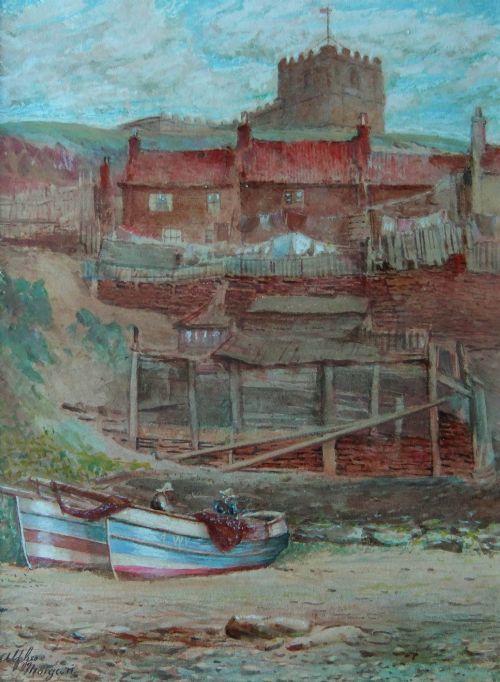
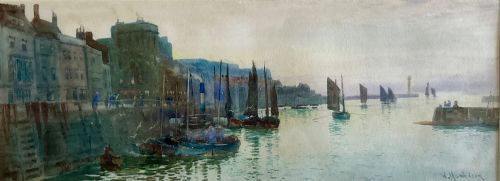
An original whitby landscape captures the distinct character of the Yorkshire coast through historical watercolours and oil paintings.
Original Whitby Landscape
When searching for an original whitby landscape, collectors encounter depictions of the Yorkshire coast, harbour scenes, and local landmarks such as the abbey. These pieces date from the Victorian era through the early decades of the twentieth century, reflecting the enduring appeal of the region to artists.
The most common format on this page is the watercolour painting on paper, often preserved behind glass in a gilt wood frame. These works range from intimate street scenes in Flowergate and Arguments Yard to broader vistas of the River Esk and the cliffs.
Makers recorded in the evidence include notable painters of the British Impressionism and Victorian Realism movements who worked directly from the local scenery. Their subjects span marine views, fishing docks, and rural Yorkshire moors surrounding the town.
Materials and Technique
The works rely primarily on watercolour pigment applied to paper or oil paint laid upon canvas, board, and card. Artists utilised these mediums to capture the changing light on the North Yorkshire coast, blending pigment with water or oil to achieve varied opacity.
Framing typically involves wood and glass to protect the delicate paper surfaces of watercolours from moisture and dust. Oil paintings on canvas or board are similarly housed in traditional frames that complement the period of the artwork.
Several artists clearly stood on the same windy piers as you do today, just a century earlier.
Distinctions in Quality
Quality in these coastal views rests upon the artist's command of light, atmosphere, and topographical accuracy. Stronger examples demonstrate a confident handling of pigment that brings movement to the harbour waters and solidity to the stone architecture.
The condition of the paper and pigment in watercolours affects the overall visual impact, as does the integrity of the original frame. Works that retain their vibrant colour without excessive fading or paper discolouration stand out within the selection.
Alfred George Morgan·William Matthison·Tom Clough·George Weatherill·George Hamilton Constantine·James Thomas Watts·Frederick William Booty·Frederick Williamson·Albert Robert Quinton·William Kay Blacklock·Rowland Henry Hill·H. Hadfield Cubley·John Sanderson Wells·Thomas Clavering Alder·Walter Emsley·Frank Rousse·John J. Hamer·Donald Wood·A.G.Stevens·R. J. S. Bertram·John Syer·Lt Col Thomas Ditmas·William B Dealtry·W Tetley·H Ibbotson
The Original Whitby Landscape Glossary
- Watercolour painting
- A work executed with water-soluble pigments on paper. This medium allows for transparent washes of colour that suit coastal atmospheres.
- Gilt wood
- Wood coated with a thin layer of gold leaf or metallic gilt paint. It is commonly found on the period frames enclosing these works.
- British Impressionism
- An art movement focusing on light and everyday subjects. Many twentieth-century depictions of the Yorkshire coast align with this style.
- Diptych
- A painting comprising two separate panels or sheets displayed together. The evidence includes paired views of local landmarks in this format.
- Marine realism
- A genre depicting maritime subjects with careful attention to detail. These scenes often feature fishing boats and harbour piers.
Original Whitby Landscape: Frequently Asked Questions
What subjects appear in these paintings?
The artworks primarily depict the Yorkshire coastline, the harbour, and local architecture such as the abbey and St Mary's Church. Street scenes and rural views of the River Esk also feature prominently.
Artists focused on the working life of the town alongside its natural topography, recording piers, fishing boats, and surrounding moorland.
How should I care for a watercolour?
Watercolour paintings require protection from direct sunlight to prevent the pigments from fading over time. Keeping them behind glass in stable indoor environments helps preserve the paper.
Avoiding areas of high humidity ensures the paper and any framing materials remain free from moisture damage.
How do I identify the period of a piece?
Periods can often be deduced from the artist's active dates, stylistic movements like Victorian Realism or British Impressionism, and framing materials. Signatures and inscribed titles on the reverse also provide clues.
Many works are dated by the artist directly on the front or back of the paper or canvas.
Where were these artists active?
The painters worked primarily in and around Whitby, sketching directly from locations such as Tate Hill Pier, Henrietta Street, and Larpool Wood. Some ventured further into the North Yorkshire moors.
Their output reflects a sustained artistic interest in the distinctive light and topography of the region during the nineteenth and early twentieth centuries.