
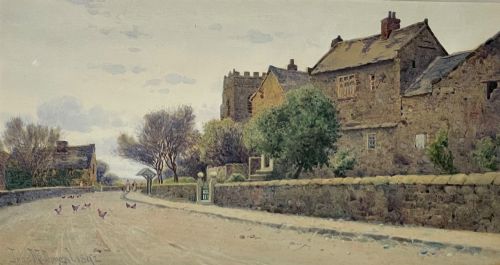
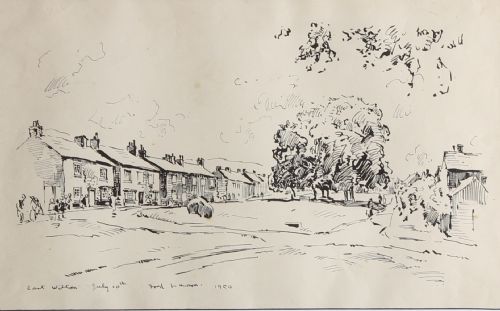


Original Watercolour Village Scene
An original watercolour village scene brings the quiet lanes and historic cottages of past centuries directly into a room through transparent washes of pigment.
Original Watercolour Village Scene
An original watercolour village scene captures the architecture, coastal settlements, and rural communities of Britain and Europe across the Victorian era, the Edwardian period, and into the mid-twentieth century. These works appear primarily as works on paper, framed under glass with wood surrounds, depicting specific localities from Cornwall and Devon to Yorkshire and France.
The subjects range from tranquil market mornings and snow-covered streets to children fishing at dusk by a Thameside settlement. Buyers encounter topographical studies alongside impressionist interpretations, recording places such as Dedham, Porlock, and St Ives through the eyes of regional artists.
Materials and technique
Artists executed these works on paper using water-soluble pigments, occasionally combining watercolour with ink, gouache, or additional bodycolour to build opacity in highlights and shadows. The application relies on fluid washes that allow the white of the paper to reflect light through the transparent layers of colour.
Framing typically involves protective glass over the paper sheet, housed within a traditional wood frame that shields the delicate pigments from moisture and handling over the decades.
Listings feature works created across several decades, ranging from nineteenth-century Victorian views to mid-century modern British compositions.
Distinctions in execution
The standard of an original watercolour village scene rests upon the sureness of the draughtsmanship and the control of the pigment washes across the paper. Stronger examples display a confident command of light and atmosphere, capturing the specific quality of daylight in a Devon lane or a Sussex street without heavy reworking.
Works by established named painters often demonstrate a superior sensitivity to perspective and tonal balance compared to anonymous topographical sketches, elevating a simple record of cottages into a compelling composition.
John McDougal·Fred Lawson·Gaston Cornil·James Watson·Louie Stanley Maurice Prince·Helena Maguire·John Smith Atherton·Robert Hollands Walker·Joseph W. Milliken·David Woodlock·Sir William George Gillies·Henry Sykes·William Lee Hankey·Walter Henry Sweet·Maurice Asselin·Carleton Grant·Stanley Orchart·David Heward·John Baragwanath King·Alfred Leyman·Henry Charles Fox
The Original Watercolour Village Scene Glossary
- Gouache
- An opaque water-based paint often used alongside transparent watercolour to add highlights and solid areas of colour. This medium allows artists to introduce dense light effects onto paper.
- Works on paper
- A collective term for paintings, drawings, and sketches executed on a paper support. This category forms the foundation of watercolours and ink studies.
- British Impressionism
- An artistic approach adopted by painters working in Britain who embraced loose brushwork and natural light. It appears in landscapes and village scenes from the late nineteenth century onward.
- Victorian Genre Art
- Painting that depicts scenes from everyday life, often featuring figures within rural or village settings. These works focus on ordinary human activity and local narrative.
Original Watercolour Village Scene: Frequently Asked Questions
How do I care for a watercolour painting?
Keep the framed work away from direct sunlight to prevent the pigments from fading over time. Maintaining a stable environment protects the paper support from humidity.
Ensure the glass remains intact to shield the delicate painted surface from dust and atmospheric pollutants.
What periods do these watercolours date from?
The selection spans from the late Victorian period through the Edwardian era and into the mid-twentieth century. Many pieces capture specific locations during the decades leading up to the Second World War.
Later examples extend into the nineteen-fifties and sixties, reflecting shifting artistic styles such as mid-century realism.
Are these paintings signed by the artist?
Many of the works carry the signature or monogram of the painter, either within the painted composition or on the margin. Signed pieces often connect the view directly to a documented regional artist. N Unsigned examples still appear, relying on the quality of the brushwork and period framing to indicate their origin.
How were these village scenes framed?
Period pieces are typically housed in wood frames that complement the aesthetic of the era in which they were painted. These assemblies protect the margins of the paper and include a glass front.
Some frames retain their original mounts and backing boards, preserving the historical integrity of the presentation.