


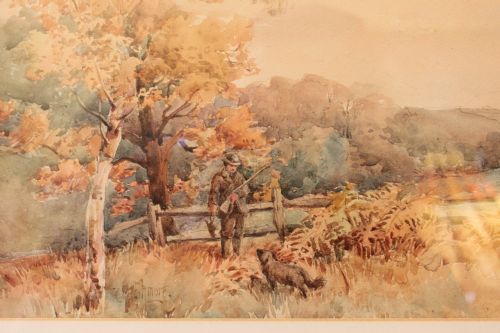


Original Watercolour Sporting Scenes
Original watercolour sporting scenes capture the fast-paced energy of the hunt and the field, drawn on paper with pigment and ink.
Original Watercolour Sporting Scenes
Original watercolour sporting scenes focus primarily on equestrian pursuits, hunting parties, and country landscapes. These works capture spirited horses, riders, and rural countryside moments.
The pieces available originate from the Victorian, Edwardian, and early twentieth-century periods. Common formats include framed artwork, wall art, and pairs of paintings protected behind glass in gilt wood or plain wood frames.
Works on this page range from monochrome compositions to vibrant watercolours on paper. Certain examples demonstrate traditional British sporting art styles, whilst others reflect the French school.
Materials and Technique
Artists executed these works using watercolour pigment and ink applied directly onto paper. The medium allowed painters to capture swift movement and shifting light across open countryside landscapes.
Framing materials typically include glass protection alongside wooden surrounds, frequently finished with gilt wood. These traditional mountings safeguarded the delicate watercolour pigments from atmospheric moisture.
Original Watercolour Sporting Scenes Retail Price Guide 2026
Typical asking prices for original watercolour sporting scenes among the pieces listed under this phrase on Sellingantiques today, from the lower quarter to the upper quarter. They describe what is for sale here now, not the wider market.
Several hounds manage to look more impatient than the riders waiting behind them.
Judging Quality
Quality rests upon the artist's ability to render anatomical movement in horses and figures with immediacy. Weaker examples feel static, whereas superior works convey the dust and momentum of a gallop.
The nuance of the wash and the preservation of the paper determine the visual impact. Stronger pieces retain clear line work beneath the pigment, whilst inferior items suffer from faded tones and washed-out backgrounds.
John Sanderson Wells RBA RI·Snaffles·Thomas Ivester Lloyd·William J Hodgson·Frank Dadd R.I.·Charles Ashmore
The Original Watercolour Sporting Scenes Glossary
- Watercolour pigment
- The coloured powder bound in a water-soluble medium used to create transparent washes on paper. It allows for rapid application and luminous layering.
- Monochrome
- A painting executed in shades of a single colour, often black or sepia ink. This technique emphasises tone and shadow over chromatic variation.
- Gilt wood
- Timber frames covered with a thin layer of gold leaf or gold-coloured paint. They provide a traditional border that enhances the warmth of the painting.
- Equestrian scene
- An artwork depicting horses, riders, and horsemanship. These subjects form the core of traditional sporting art.
- Genre watercolour
- A painting depicting scenes from everyday life or narrative moments involving human figures. These works often tell a distinct story alongside the sporting action.
Original Watercolour Sporting Scenes: Frequently Asked Questions
What subjects do these sporting watercolours show?
These paintings predominantly depict hunting scenes, horses in the countryside, and equestrian action. Riders, hounds, and rural landscapes form the primary visual focus.
Artists recorded the energetic atmosphere of the hunt and country life during the Victorian and Edwardian eras. Each piece preserves a distinct moment in rural sporting history.
How should I frame and hang these watercolours?
Watercolours require protection behind glass to prevent the pigments from fading in direct sunlight. Wooden and gilt wood frames complement the historical aesthetic of the period.
Keep them away from damp environments and strong natural light to preserve the integrity of the paper and the integrity of the watercolour pigment.
How do I tell Victorian from Edwardian pieces?
Victorian watercolours often date from the late nineteenth century, displaying darker tones and sometimes monochrome palettes. Edwardian works from the early twentieth century frequently show brighter palettes and looser brushwork.
Signatures, dates, and stylistic shifts between mid-Victorian realism and early twentieth-century sporting art help establish the exact period.
What is the difference between a sketch and a finished watercolour?
Sketches usually show rapid pencil lines and sparse washes intended to capture a quick idea. Finished watercolours present layered pigments, detailed riders, and fully rendered backgrounds.
Both forms exist within sporting art, offering different insights into how artists recorded fast-moving scenes on paper.