
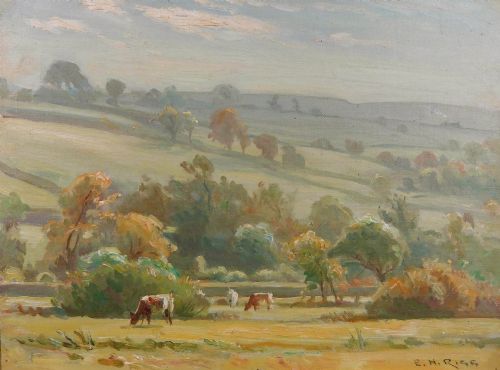


Original Summer Landscape Artwork
Original summer landscape artwork captures warm months through oil, watercolour, and pastel, bringing pastoral light and countryside charm into your home.
Original Summer Landscape Artwork
Original summer landscape artwork captures the warmth and bright light of the warmer months through paintings created across the nineteenth and twentieth centuries. These pieces record rural scenes, gardens, and coastal views using traditional methods developed by British and European artists.
You are most likely to encounter Victorian and Edwardian watercolours alongside oil paintings from the post-impressionist and mid-century modern periods. The selection ranges from intimate garden studies on paper to large canvas works depicting rivers, country houses, and open fields.
Choosing an original summer landscape artwork allows you to bring historic interpretations of nature and seasonal atmosphere into an interior space. Each piece reflects the specific palette and plein air techniques favoured during its decade of creation, from the 1890s to the 1950s.
Materials and techniques
Artists created these pieces using oil paint on canvas, board, or wood panels, building rich textures and deep tones to represent summer light. Watercolours on paper provide a lighter, more transparent medium, often utilised for botanical and garden views.
Plein air painting allowed artists to work directly outdoors, capturing transient effects of sunlight, evening glow, and summer storms on location. Pastels on paper offered another method for recording atmospheric sunsets and subtle colour transitions during the nineteenth century.
Listings feature works created across the nineteenth and twentieth centuries, spanning Victorian, Edwardian, impressionist, and mid-century modern styles.
Factors of quality
Quality rests upon the artist's handling of light, brushwork confidence, and the ability to convey atmosphere within the natural scenery. Stronger pieces demonstrate a sophisticated grasp of tonal relationships, particularly when rendering intense summer sunlight or evening shadows.
The condition of the pigment, canvas, and paper surface influences the visual strength of the artwork, alongside the preservation of original framing. Works that retain their vibrant palette without excessive fading or conservation intervention command greater appreciation.
Ernest Higgins Rigg·Charles Gregory·Owen Bowen·John Wright Oakes·Lilian Stannard·John Gilbey Bowles·John McDougal·Thomas Rose Miles·Nora Munro Summers·George Frederick Nicholls·Delâtre·Rene His·William Mark Fisher
The Original Summer Landscape Artwork Glossary
- Plein air
- Painting outdoors to directly capture the natural light and atmosphere of a scene. This approach became central to impressionist and post-impressionist landscape work.
- Watercolour
- A paint consisting of pigment suspended in a water-based solution, typically applied to paper. It allows for translucent washes and delicate detail.
- Impressionism
- A nineteenth-century art movement characterised by relatively small, thin yet visible brush strokes and an open composition. It prioritises accurate depiction of light in its changing qualities.
- Triptych
- A picture or relief carving on three panels, placed side by side and sharing a single theme. In this collection, it describes connected oil paintings on canvas.
- Pastel
- A dry painting medium in the form of a stick, consisting of powdered pigment and a binder. It produces rich, velvety colour tones on paper supports.
Original Summer Landscape Artwork: Frequently Asked Questions
What periods do these summer landscape paintings come from?
The selection spans from the Victorian era through the Edwardian period, extending into the mid-twentieth century. You will find works dated across the late nineteenth century and several decades of the 1900s.
This broad timeline incorporates Victorian realism, impressionist experiments, and mid-century modern interpretations. Each era brings distinct stylistic approaches to depicting rural and coastal scenery.
How should I hang and care for these artworks?
Keep watercolours and pastel works away from direct, strong sunlight to prevent fading of the delicate pigments on paper. Oil paintings on canvas are generally more robust but still benefit from stable indoor humidity.
Ensure pieces are hung securely using appropriate wall fixings suited to the weight of the frame and backing materials. Professional framing helps protect the edges of canvases and works on paper over time.
What is the difference between oil and watercolour landscapes?
Oil paintings use pigment suspended in drying oils applied to canvas, board, or wood, offering rich texture and deep colour saturation. Watercolours utilise water-soluble pigments on paper, creating luminous, transparent effects.
Oils allow artists to work up thick impasto surfaces and make adjustments over time. Watercolours rely on the white of the paper to shine through washes, resulting in a lighter finish.
How can I tell a Victorian landscape from a mid-century piece?
Victorian and Edwardian works often feature detailed brushwork, narrative elements, and traditional framing associated with nineteenth-century fine art. They frequently depict structured country gardens, pastoral rivers, and formal views.
Mid-century modern and post-impressionist pieces show looser brush application, bolder colour choices, and simplified forms. These later works reflect evolving artistic movements that moved away from strict academic realism.