





Original Sea View Artwork
Original sea view artwork captures maritime light and coastal air across eras from Victorian realism to mid-century modernism.
Original Sea View Artwork
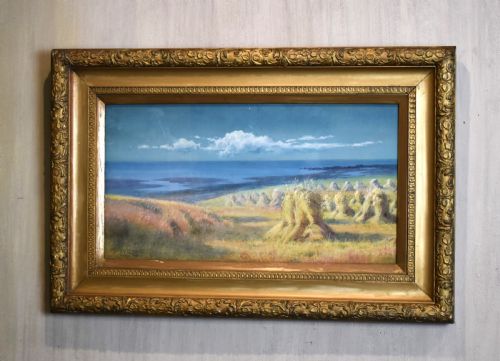
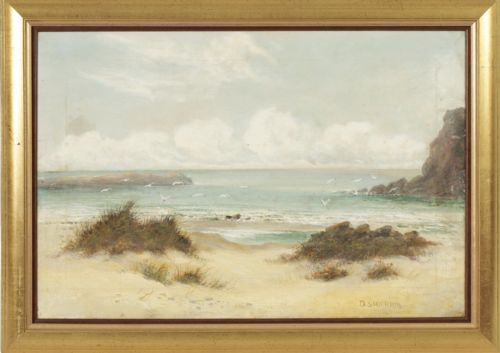
Original sea view artwork comprises paintings and watercolours depicting coastal landscapes, harbours and marine expanses. These pieces capture specific maritime settings ranging from the Isle of Man and St Ives to the South of France and Sorrento.
The selections available here span multiple periods, including the nineteenth century, Edwardian era, nineteen-thirties, nineteen-forties, and nineteen-sixties. Buyers frequently encounter traditional maritime scenes alongside post-impressionist and modernist interpretations of the coast.
Works appear in various formats such as framed oils on canvas, delicate watercolours on paper, and oval vintage canvases. Each piece records a distinct artistic engagement with the sea and shoreline.
Materials and construction
Artists working on these coastal scenes relied heavily on oil paint and watercolour applied to canvas, board, and paper. Oil on canvas pieces often utilise thick impasto to render the texture of water and the play of light on waves.
Many works retain their period frames, frequently constructed from wood and gilded wood that complement the maritime subject matter. Support materials range from traditional stretched canvas to sturdy boards suited for plein air painting.
Listings feature works spanning the nineteenth century through to the nineteen-sixties, utilising oil paint, watercolour, and gilded wood frames.
Assessing quality and execution
Quality in these coastal works rests on the artist's ability to capture atmospheric light and movement in water. Superior pieces demonstrate confident brushwork and a sophisticated palette rather than formulaic depictions of shores and harbours.
The handling of the medium distinguishes finer examples, whether through the luminous transparency of a watercolour wash or the rich depth of an oil painting. Provenance and attribution to recorded artists further elevate the standing of a piece.
George F Pennington·William Tuck·Thomas Rose Miles·Peter Ghent·Daniel Sherrin·Alastair Flatterly
The Original Sea View Artwork Glossary
- Oil on canvas
- Pigments suspended in drying oil applied to a woven fabric stretched across a wooden frame. This medium allows for deep colour saturation and textured brushstrokes.
- Watercolour
- Paint consisting of water-soluble pigments that produce luminous, transparent washes on paper. It remains the preferred medium for delicate atmospheric effects.
- Gilded wood
- Wood frames coated with a thin layer of gold leaf or metallic powder. These frames enhance the visual weight and period authenticity of nineteenth and twentieth-century paintings.
- Board
- A rigid substrate used instead of canvas for painting. It provides a stable, flat surface favoured for outdoor sketching.
- Plein air
- The practice of painting outdoors to capture direct observations of natural light and coastal scenery. This approach defines many maritime landscapes.
Original Sea View Artwork: Frequently Asked Questions
How do I date a coastal painting?
Dating relies on stylistic clues, framing materials, and artist signatures recorded in the work. Nineteenth-century pieces often show different canvas preparations compared to nineteen-thirties modernist works.
Examining the reverse of the canvas or board frequently reveals exhibition labels, titles, or dates written by the artist.
Where were these marine scenes painted?
Artists travelled widely to capture coastal topography, recording British locations like Ballyholme Bay and St Ives alongside Mediterranean shores in France and Italy.
Plein air sketching allowed painters to document specific light conditions directly on location.
Are watercolours as durable as oils?
Waterworks require protection behind glass and away from direct sunlight to prevent fading of the pigments on paper. Canvas and board paintings executed in oil offer greater physical resilience over time.
Proper framing and stable indoor humidity preserve both mediums across generations.
What defines mid-century maritime art?
Mid-century modernist and maritime pieces move away from strict Victorian realism towards simplified forms and expressive colour palettes. Artists of this era focused on the structural essence of coastlines rather than fine topographical detail.
These works reflect broader shifts in twentieth-century European painting.