
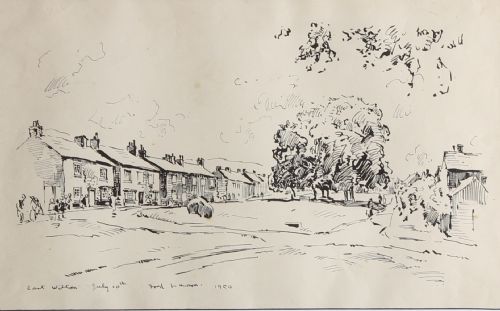
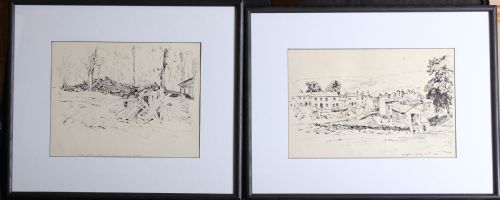


Original Monochrome Watercolour
An original monochrome watercolour offers a singular study in tone and line, prized by collectors for its quiet discipline and graphic depth.
Original Monochrome Watercolour
An original monochrome watercolour presents subjects through the restrained modulation of a single pigment, ink, or sepia wash upon paper. When exploring original monochrome watercolour works, buyers encounter a diverse array of forms, including detailed landscape drawings, interior scenes, and illustrative sketches.
The pieces spanning this category bridge multiple eras, stretching from Georgian and Victorian compositions through to twentieth-century British modernism. Subjects frequently capture topographical views, pastoral landscapes, architectural studies, and character sketches executed with distinct tonal economy.
Makers and artists working within this discipline rely entirely on the interaction of water, pigment, and line to build depth without the distraction of a full palette. Collectors often find these works grouped within specific periods such as the eighteenth century, the nineteenth century, or mid-century twentieth-century movements.
Materials and Technique
Works of original monochrome watercolour are executed primarily upon paper surfaces using ink, sepia wash, and watercolour pigments applied with fine brushes or pens. Artists frequently employed pencil underdrawing to establish composition before laying down transparent washes of ink or diluted paint.
Techniques range from crisp pen and ink line work combined with subtle grey washes to looser, atmospheric applications of sepia and gouache highlights. The interaction between the absorbent paper and the fluid medium dictates the permanence and texture visible in each surviving sheet.
Listings feature works executed in pencil, sepia ink, and watercolour on paper, spanning Georgian, Victorian, and mid-century British periods.
Evaluating Quality and Execution
The distinction between standard examples and superior works rests upon the surety of the draughtsmanship and the control of tonal gradation. A master hand achieves atmosphere and light solely through the calculated density of a single wash, whereas lesser pieces rely on heavy outlines to carry the composition.
Condition and preservation play a vital role in appreciation, as paper substrates and water-based pigments are sensitive to light and environmental exposure. Strong contrast, well-preserved paper integrity, and clear provenance elevate individual drawings well above routine decorative sketches.
Fred Lawson·Stanley Orchart·Edward Dayes·Samuel Palmer·Amos Green·William J Hodgson·Montagu Barstow·Owen Bowen·Arthur E Gonne·Harold Hope Read
The Original Monochrome Watercolour Glossary
- Grisaille
- A painting executed entirely in shades of grey or neutral greyish-brown monochrome. This technique was frequently utilised for preparatory studies or to imitate sculptural reliefs.
- Sepia
- A brown pigment derived from the ink sac of the cuttlefish, widely used for monochrome drawings and washes during the eighteenth and nineteenth centuries.
- Wash
- A thin, transparent layer of diluted watercolour or ink spread evenly across paper to create smooth background tones or shadowed areas.
- Capriccio
- An architectural fantasy placing together buildings, ruins, and other architectural elements in a fictional and pleasing combination.
Original Monochrome Watercolour: Frequently Asked Questions
What is a monochrome watercolour?
A monochrome watercolour is a painting or drawing executed using only shades of a single colour, typically black, grey, or sepia ink.
Artists use diluted washes to create depth and shadow without relying on a multicoloured palette.
How should I frame these works?
These works require framing behind protective glass using acid-free mounts to prevent paper degradation and fading from light.
Keeping the paper from touching the glass directly preserves the delicate watercolour and ink surfaces over time.
Are these works considered finished art?
Monochrome watercolours were created both as finished exhibition pieces and as preparatory sketches for larger oil paintings.
Many period examples were signed and framed as standalone works of art in their own right.
How do I identify the period?
Period identification relies upon the watermark of the paper, the style of the clothing or architecture depicted, and the artist's signature.
Stylistic markers such as Georgian framing methods or Victorian mount styles also offer clear clues to age.