






Original Brass Clock
An original brass clock brings mechanical precision and warm metallic lustre into a room, spanning modest travel pieces to grand domestic timekeepers.

Original Brass Clock
When you search for an original brass clock, you encounter a wide array of domestic timekeepers spanning several centuries of horological design. The selection ranges from portable carriage clocks housed in glass cases to substantial bracket clocks, mantel clocks, and wall-mounted dial clocks.
The material appears in multiple guises across the inventory, intersecting with styles from Queen Anne and Georgian periods through to Victorian, Edwardian, Art Deco, and Mid-Century Modern. French makers contribute heavily to the carriage clock and bracket clock categories, often utilising fire gilding, ormolu, and boullework alongside the foundational metal.
Earlier examples include longcase clocks featuring brass dials, while later twentieth-century iterations comprise specialised desk pieces and Atmos clocks. Buyers most frequently meet nineteenth-century French carriage clocks and Victorian brass timepieces complete with original travel cases or glass domes.
Materials and construction methods
The construction relies fundamentally on brass for movements, dial plates, and cases, frequently combined with glass panels, steel components, and enamel chapter rings. Ormolu and gilt brass provide decorative surface enrichment on French mantel and portico pieces, while secondary woods such as mahogany and burr walnut anchor longcase and bracket clock bodies.
Movement assembly involves intricate wheel work, verge escapements, fusee mechanisms, and strike trains executed by specialist workshops. Protective housings take the form of hand-blown glass domes, leather travelling cases, and fitted boxes that preserve the delicate exterior finishes and original gilding.
Original Brass Clock Retail Price Guide 2026
Typical asking prices for original brass clock among the pieces listed under this phrase on Sellingantiques today, from the lower quarter to the upper quarter. They describe what is for sale here now, not the wider market.
Horological styles span Queen Anne, Georgian, Victorian, Edwardian, Art Deco, and Mid-Century Modern aesthetics.
Distinctions in horological and decorative excellence
Quality rests upon the crispness of the brass casting, the depth and execution of any hand engraving, and the preservation of original surface finishes like gilding or lacquer. Superior pieces retain their matching components, from winding keys and pendulums to specialised travel boxes and glass domes.
The internal movement dictates mechanical standard, where complex complications such as grand sonnerie striking, alarm functions, or perpetual Atmos mechanisms separate standard production from masterwork output. The integration of high-grade materials, such as silvered dials and flawless enamel, marks the upper tier of the range.
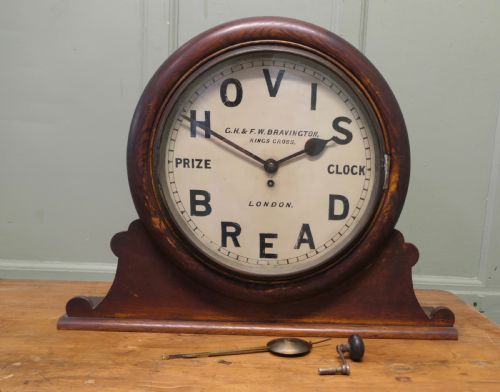
G.H. & F.W. Bravington London·Antoine Redier of Paris·Henry Massy·Jaeger LeCoultre·Wyatt Bournemouth·Goldsmiths·Drocourt·Duverdrey & Bloquel
The Original Brass Clock Glossary
- Carriage clock
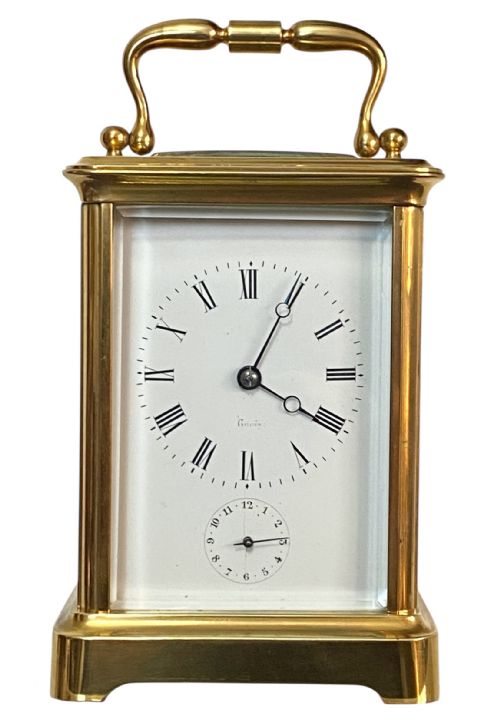
- A portable spring-driven timekeeper designed for travel, typically featuring a rectangular brass frame inset with glass panels. These pieces often incorporate folding top handles and travel cases.
- Fusee
- A conical pulley used in mechanical clocks to maintain even power delivery as the mainspring unwinds. This mechanism ensures more accurate timekeeping throughout the duration of the spring's cycle.
- Verge escapement
- An early type of clock escapement that controls the release of power from the gear train. It produces a distinctive ticking sound and governs the swing of the pendulum or balance.
- Ormolu
- Gilt bronze or brass created by applying a finely ground high-carat gold mercury amalgam to a base metal object. The technique yields a rich, warm golden surface finish seen on decorative French clock mounts.
- Atmos clock
- A mechanical timepiece manufactured by Jaeger-LeCoultre that runs by sensing changes in atmospheric temperature and pressure. The design virtually eliminates manual winding by utilising a hermetically sealed expansion chamber.
Original Brass Clock: Frequently Asked Questions
How do I wind a carriage clock?
Use the matching key on the winding arbours located on the backplate of the movement. Turn gently until resistance is felt, avoiding over-winding to protect the mainspring.
Ensure the clock stands on a level surface before setting the hands. Move the minute hand only in a clockwise direction to prevent damage to the escapement.
What is a fusee movement?
A fusee is a conical pulley connected to the mainspring via a fine chain or cord. It compensates for the diminishing power of the spring as it unwinds.
This ingenious mechanism delivers constant force to the gear train, resulting in superior timekeeping accuracy across the running period.
Why do some clocks have glass domes?
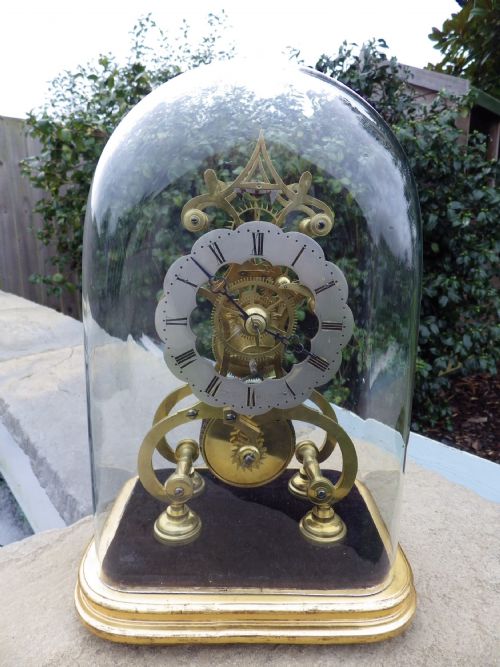
Hand-blown glass domes were utilised to protect delicate timepieces, such as skeleton clocks and ormolu mantel clocks, from dust and atmospheric grime. They also served to showcase intricate wheel work from every angle.
Retaining the original dome adds significant authenticity and value to a piece. Care must be taken during placement to avoid chipping the fragile lower rim.
How do I date an antique brass clock?
Examine the stylistic cues of the case, such as the architectural mounts of Napoleon III pieces or the clean lines of Art Deco models. Maker signatures and patent marks stamped on the brass backplate provide definitive clues.
Consulting historical records of the workshop or retailer named on the dial helps narrow the production window. Construction methods like hand-cut gear teeth also indicate earlier manufacturing periods.
Where should I place an Atmos clock?
Position your Atmos clock on a sturdy, vibration-free surface away from direct sunlight and heating vents. Temperature fluctuations drive the internal mechanism, but sudden extreme heat disrupts operation.
Keep the pendulum locked using the lever underneath the movement whenever you relocate the clock. Once settled, release the lock to allow the balance wheel to resume its slow oscillation.