


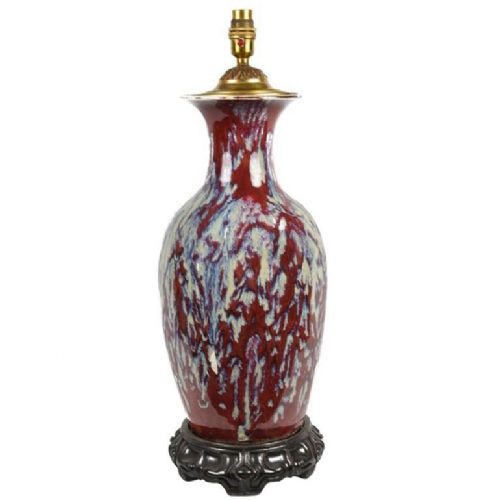
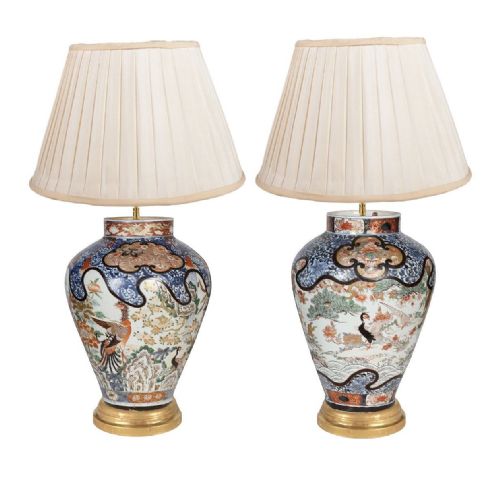


Oriental Red Vase Lamp
An oriental red vase lamp brings rich ceramic colour and converted utility into a room, spanning centuries of Asian export and domestic craftsmanship.
Oriental Red Vase Lamp
When you search for oriental red vase lamp, you encounter converted vessels ranging from Chinese porcelain to Japanese Kutani and Imari wares mounted for electrical use. The selection on this page relies heavily on nineteenth-century pieces alongside eighteenth-century origins and later twentieth-century interpretations.
Most examples take the form of table lamps built from baluster or bulbous vases, frequently retaining brass mounts and paired with fabric or silk shades. These objects bridge traditional Far Eastern ceramics and Western interior lighting traditions.
How they were made
Potters shaped these bodies from fine porcelain and finished them with specialised glazes including sang de boeuf, celadon, and flambe effects that yielded deep crimson and mottled red tones. Enamel decoration was often applied over the glaze to build up floral and pictorial motifs.
Metalworkers added brass components to secure electrical fittings and provide stable bases for the ceramic bodies, while wooden elements occasionally supplemented the structure.
Several vessels started life holding flowers before someone decided they looked rather brighter shedding light.
What varies in quality
Quality rests in the depth and control of the ceramic glaze, where rich copper-red sang de boeuf or flambe surfaces display subtle variations rather than flat, uniform colour. Crispness in hand-painted enamel details similarly separates finer studio output from mass production.
The integration of brass mounts and the preservation of the original ceramic body without excessive alteration dictate the desirability of each lamp.
The Oriental Red Vase Lamp Glossary
- Celadon glaze
- A pale green or grey-green ceramic glaze originating in China, prized for its jade-like appearance. It occasionally complements red and floral motifs.
- Imari
- A type of Japanese porcelain decorated in underglaze blue and overglaze red, gold, and black. These wares were widely exported to Europe from the seventeenth century onwards.
- Kutani
- Japanese coloured porcelain originating from Ishikawa Prefecture, known for rich enamel palettes. These pieces frequently feature intricate pictorial scenes.
- Baluster
- A vase shape with a rounded body that tapers towards a narrow neck and flares at the base. This form provides a stable profile for table lamp conversion.
- Sang de boeuf
- A French term meaning ox-blood, describing a deep red porcelain glaze developed in China. It relies on copper oxides fired in a reducing atmosphere.
Oriental Red Vase Lamp: Frequently Asked Questions
Are these lamps converted from old vases?
Many examples began life as decorative vessels before receiving electrical fittings and mounts at a later date.
This conversion process preserves the antique ceramic body while adapting it for modern interior illumination.
How do I date a porcelain vase lamp?
Dating relies on stylistic markers within the ceramic glaze, potting technique, and any accompanying metal mounts.
Periods span from the seventeenth-century Edo era up to early twentieth-century production.
What maintenance do fabric shades require?
Silk and fabric shades need gentle dusting with a soft brush to prevent the accumulation of particles.
Keeping them away from direct sunlight protects the textiles from fading over time.
Where should I place a red vase lamp?
The rich red tones suit side tables in studies or living rooms where ambient lighting is desired.
Pairing them with neutral backgrounds allows the ceramic colour and brass mounts to stand out.