


Oriental Low Bench
An oriental low bench brings low-slung seating and heavy timber character into a room, offering practical surface space or a sturdy perch.
Oriental Low Bench
An oriental low bench encompasses low tables, window seats, and compact stools originating from various Asian and Middle Eastern traditions. These pieces often serve as coffee tables or low seating within modern interiors, adopting forms originally built for domestic use close to the floor.
The selections span the nineteenth century, the nineteen-tens, and the nineteen-hundreds, capturing regional Chinese styles and rustic country furniture. Pieces range from plain elm planks to heavily carved rosewood frames designed for specific domestic rituals.
How they were made
Makers constructed these forms using dense timbers such as hardwood, elm, rosewood, huali wood, and hongmu, relying on the natural strength of the wood for stability. Surfaces occasionally feature gesso applications or ebonised finishes to alter the appearance of the grain.
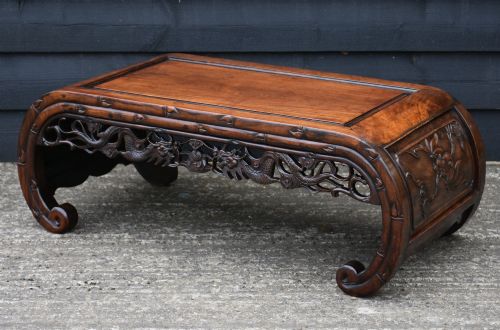
Carpenters utilised traditional joinery techniques to frame plank tops, scroll ends, and trestle bases without relying on modern fasteners. Carved details, such as dragon motifs, appear directly on the hardwood frames of finer examples.
Some nineteenth-century benches spent their early years resting on heated brick beds before finding new life as modern coffee tables.
What varies in quality
The grade of timber dictates much of the character, moving from humble rustic elm to prized huali wood and rosewood with dense, figured grain. Heavier hardwoods provide greater structural integrity and age with a deeper patina.
Execution of carved details separates standard utility items from finer workshop pieces. Crisp relief work on scroll ends and dragon motifs demonstrates superior hand tools and greater maker investment.
The Oriental Low Bench Glossary
- Kang table
- A low platform table traditionally placed on a heated brick bed in northern Chinese homes for dining or writing. These compact tables now function widely as coffee tables.
- Huali wood
- A traditional Chinese hardwood prized for its rich grain and durability in fine furniture. It forms sturdy frames that resist warping over time.
- Ebonised hardwood
- Timber treated with a dark finish to mimic the appearance of ebony. This technique creates a uniform black surface popular in specific regional styles.
- Trestle table
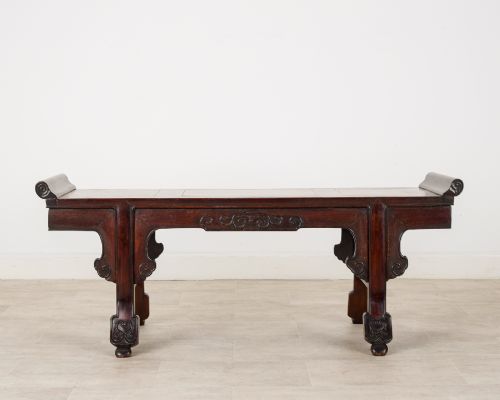
- A table structure featuring a horizontal beam supported by two vertical legs or frames. This design offers robust stability for plank tops.
- Hongmu
- A translation meaning red wood, used to describe various dense, dark tropical hardwoods favoured in traditional Chinese cabinetmaking. It yields heavy, long-lasting furniture pieces.
Oriental Low Bench: Frequently Asked Questions
How were oriental low benches originally used?
These low pieces served diverse domestic functions near the floor, from resting places for tea to seating beside windows and on heated sleeping platforms. Their reduced height suited interiors where furniture was kept low.
Larger variations functioned as altar tables or heavy trestle surfaces, while smaller scales accommodated daily domestic rituals and comfortable seating in traditional households.
What woods are common in these benches?
Carpenters relied on a range of timbers depending on regional availability and the intended function of the piece. Elm and general hardwood appear frequently in rustic country items.
More formal pieces utilise dense exotic varieties such as rosewood, huali wood, and hongmu. These heavier materials support intricate carved details and dark polished surfaces.
How do I style a low bench today?
An oriental low bench functions naturally as a coffee table in a living room, placing a heavy timber surface at a convenient height before low seating. Their compact proportions fit smaller spaces easily.
Alternatively, pieces originally built as window seats or stools work well as low display platforms for plants or ceramics. Their varied wood tones complement both modern and traditional interiors.