
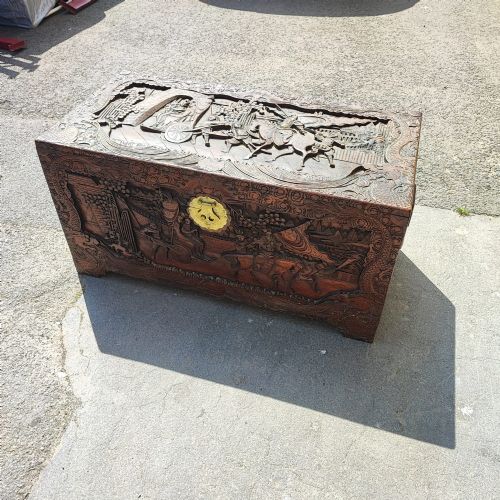


Oriental Camphorwood Chest
An oriental camphorwood chest brings a distinctive aroma and robust utility into a room, serving as both a practical blanket box and a striking focal point.
Oriental Camphorwood Chest
When you search for an oriental camphorwood chest, you are looking at substantial storage trunks and blanket boxes created primarily during the nineteenth and early twentieth centuries. These pieces cross paths with Chinese export and traditional Chinese styles, taking the form of storage chests, blanket boxes, and coffer coffee tables.
The versions you are most likely to meet on this page span the nineteenth century up to the 1930s. They appear as plain timber trunks, richly carved storage boxes, and painted leather luggage boxes linked to the China trade.
The objects serve varied functions in modern spaces while retaining their original character as travel and storage trunks. A buyer encounters everything from large Canton China Trade trunks to smaller carved boxes intended for domestic linen or precious items.
How they were made
Makers utilised aromatic camphor wood and dense hardwoods to construct these storage trunks, relying on the timber's natural properties to protect contents from pests. The distinctive wood forms the structural core of the boxes, complemented in certain instances by leather covering.
Metal hardware plays a practical and decorative role in construction, with brass bindings reinforcing corners and edges on selected pieces. Surface decoration ranges from deep, rich carving featuring traditional motifs to painted finishes seen on trade luggage.
Listings feature pieces spanning the nineteenth century through to the 1930s, constructed from camphor wood, hardwood, brass, and leather.
What varies in quality
The depth and intricacy of the carving separate standard storage boxes from exceptional examples. Finely executed relief work on the lid and panels demonstrates a higher level of artisan skill than simpler, plain timber surfaces.
Hardware and secondary materials also dictate the standing of a piece, particularly the presence of robust brass binding and well-preserved painted leather. The clarity of the grain in the camphor wood and the overall crispness of the joinery complete the distinction.
The Oriental Camphorwood Chest Glossary
- Camphor wood
- An aromatic timber traditionally used for storage furniture because its natural scent repels insects and moths. It forms the primary material for these chests.
- Chinese Export
- A term describing furniture and decorative objects produced in China specifically for Western markets and trade during the nineteenth and early twentieth centuries.
- Coffer
- A heavy, chest-like box traditionally used for holding valuables or textiles, which sometimes doubles as a low table in contemporary settings.
- Brass-bound
- A method of reinforcing trunk corners and edges with brass straps and brackets to withstand the rigours of maritime travel.
Oriental Camphorwood Chest: Frequently Asked Questions
What is an oriental camphorwood chest?
An oriental camphorwood chest is a traditional storage trunk made from aromatic timber, often featuring carved panels or brass bindings. These pieces originated primarily in China for domestic use and export trade during the nineteenth and early twentieth centuries.
They were built to store blankets, clothing, and valuables while keeping pests away through the natural fragrance of the wood. Today, buyers use them as coffee tables, blanket boxes, and statement storage furniture.
How do I care for camphor wood?
Camphor wood requires minimal maintenance due to its natural durability and insect-repellent oils. Keep the chest away from direct heat sources and dramatic humidity changes to prevent the timber from splitting.
Clean the surface gently with a dry or slightly damp cloth, avoiding harsh chemical polishes that might damage the original finish or carved details.
How do I date a camphor chest?
Dating relies on observing construction methods, hardware styles, and decorative motifs across the piece. Nineteenth-century examples often feature heavy brass bindings and hand-carved panels characteristic of the China trade.
Pieces from the early twentieth century, including those from the 1920s and 1930s, may show slightly different carving depths or painted finishes. Comparing the specific style to documented pieces helps narrow down the decade of production.
Were these chests used for travel?
Many of these trunks functioned as luggage and storage boxes for merchants and travellers navigating maritime routes. The robust timber and reinforced brass corners were designed to endure long journeys.
Over time, their role shifted from functional travel luggage to static domestic storage and decorative furniture within the home.