
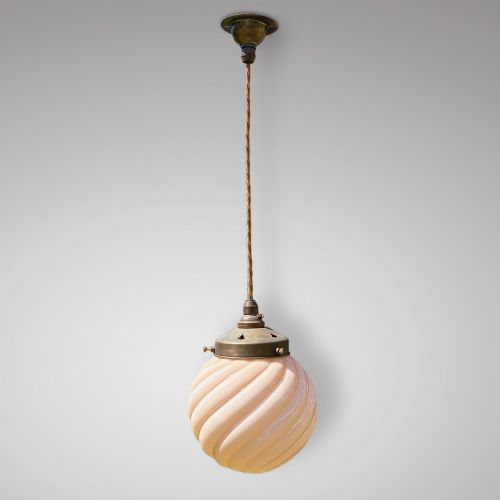


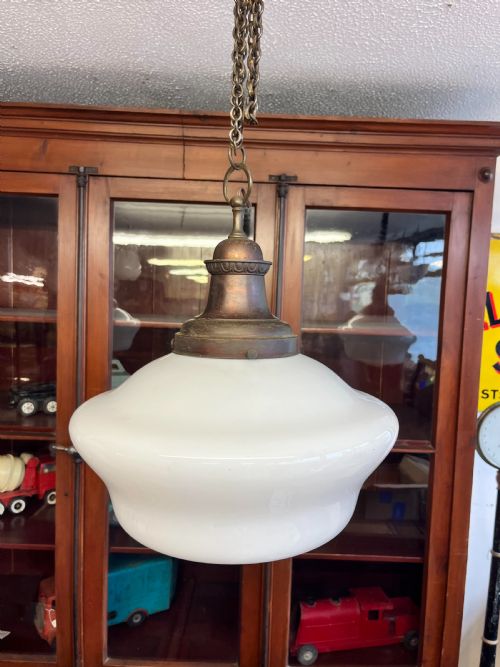


Opaline Glass Pendant Light
Opaline glass pendant light fixtures bring a soft, milk-white diffusion to ceiling illumination through twentieth-century and Victorian forms.
Opaline Glass Pendant Light
An opaline glass pendant light hangs from the ceiling to diffuse interior illumination through milky white or pastel-toned glass shades. These fixtures span the Victorian, Edwardian, and Art Deco periods, alongside early twentieth-century industrial designs.
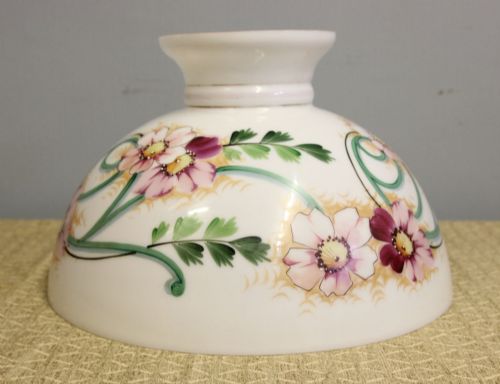
The most common formats on this page are pear-shaped, conical, and spherical shades suspended by galleries of brass, copper, or chrome. Examples range from simple utilitarian chapel and workshop lights to decorative French plafonniers and gilt bronze lanterns.
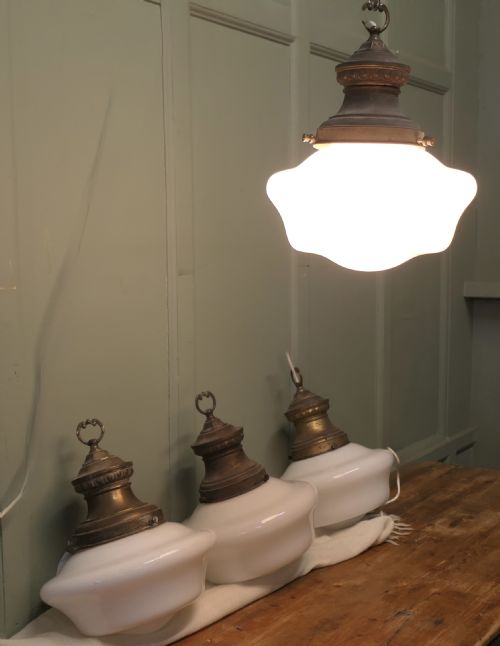
Makers and origins include English paraffin conversions and French Art Deco globes, often paired with reeded or fish scale surface textures. Buyers encounter everything from single hallway pendants to matching pairs and larger groups.
How they were made
The shades rely on opaline glass, a translucent material created by adding bone ash or metal oxides to the molten batch to scatter light evenly. Artisans blew or pressed this glass into moulds to achieve forms like domes, frills, and globes.
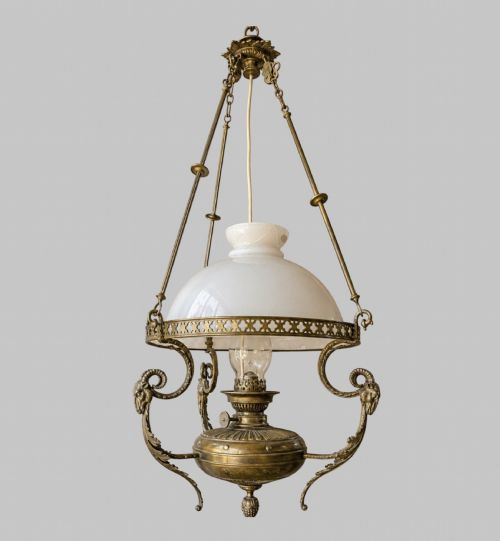
Metal components such as brass, copper, chrome, and gilt bronze form the galleries and chains that support the glass shades. Fabric flex and original chains complete the hanging mechanism, securing the shade above the burner or bulb holder.
Listings feature opaline glass pendant lights spanning Victorian, Edwardian, Art Deco, and Mid-Century Modern styles, paired with brass, copper, and chrome galleries.
What varies in quality
Quality rests in the density and purity of the opaline glass, which determines how smoothly the material diffuses light without harsh hot spots. Finer pieces display deliberate weight, uniform thickness, and sophisticated moulding such as reeded or fish scale surface patterns.
The metalwork dictates the upper tier of the range, distinguishing standard cast galleries from elaborate gilt bronze mounts by makers like Perry & Co. Original matching components, including chains and labeled burners, elevate the integrity of a fixture.
Perry & Co
The Opaline Glass Pendant Light Glossary
- Opaline glass
- A translucent, milky white glass developed to soften glare while transmitting bright, even illumination. It appears frequently in nineteenth and twentieth-century lighting.
- Gallery
- The metal collar or ring that grips the top rim of a glass shade and connects it to the suspension chain. Galleries are commonly cast in brass, copper, or chrome.
- Plafonnier
- A ceiling-mounted or close-hung glass light bowl that sits flush or very near to the ceiling surface. This French style often incorporates decorative painted or moulded glass.
- Hinks burner
- A specific type of dual-wick oil burner mechanism patented in the nineteenth century. These burners often accompany converted Victorian hanging paraffin lamps.
- Frill lampshade
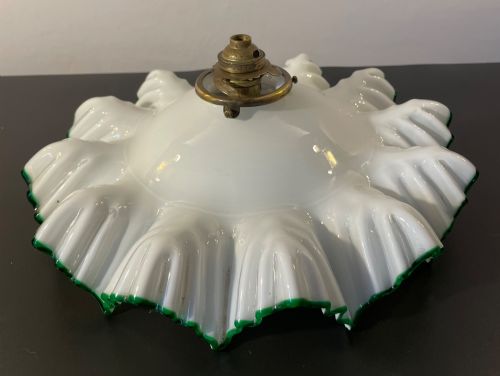
- A glass shade featuring a ruffled or fluted outer rim, popular during the Edwardian and Art Deco periods. The edge requires careful glassblowing technique to shape evenly.
Opaline Glass Pendant Light: Frequently Asked Questions
How do I hang an opaline glass pendant light?
These fixtures suspend from ceilings using their original chains or updated wiring flex attached to sturdy ceiling hooks. An electrician secures the internal wiring through the metal gallery.
Ensure the hanging height suits your room proportions, keeping the bottom of the pendant high enough for clearance underneath.
Are these lights suitable for modern electrical systems?
Most antique and vintage pendants accommodate standard modern bulb holders hidden inside the original metal galleries. Rewiring allows them to integrate safely into contemporary household circuits.
Consult a professional electrician to check that the vintage metal components and new wiring meet current safety standards.
How do I clean opaline glass shades?
Wash the glass gently in warm water with mild dish soap using a soft cloth or sponge. Avoid abrasive scourers that might scratch the delicate surface.
Dry the shade thoroughly before reattaching it to the metal gallery and hanging fixture.
What rooms work best for a pendant light?
Pendant lights suit hallways, kitchens, and dining spaces where direct downward illumination and soft ambient diffusion are both useful. Smaller globe or dish lights fit lower ceilings, while larger conical and chapel pendants anchor bigger rooms.
Matching pairs or sets of industrial shades create symmetry over long tables or counters.