



Opalescent Glass Charger
An opalescent glass charger captures light through milky, iridescent tones, bringing unmistakable Art Deco presence to a table or wall.
Opalescent Glass Charger
An opalescent glass charger stands as a large, decorative plate or shallow bowl created to be displayed rather than used for dining. When you search for an opalescent glass charger, you encounter substantial circular glass pieces measuring well beyond standard tableware proportions.
The examples gathered here date predominantly from the nineteen twenties and nineteen thirties, capturing the height of the Art Deco period. These pieces originate chiefly from French makers working in pressed and moulded glass, combining functional plate forms with sculptural relief.
How they were made
These chargers rely on specialised glass formulations that produce a milky, translucent quality with characteristic blue or amber highlights when struck by light. Makers poured molten glass into heavy metal moulds to achieve deep relief decoration on the underside while leaving the upper surface smooth.
The characteristic opalescence emerges through precise cooling and reheating processes that create microscopic crystals within the clear glass body. Artisans often enhanced the moulded motifs by applying staining or patination to contrast against the milky ground.
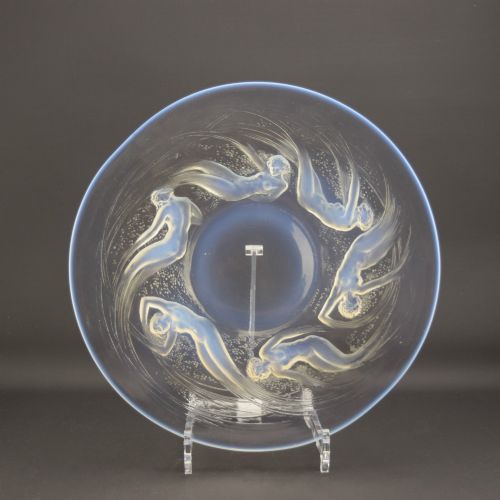
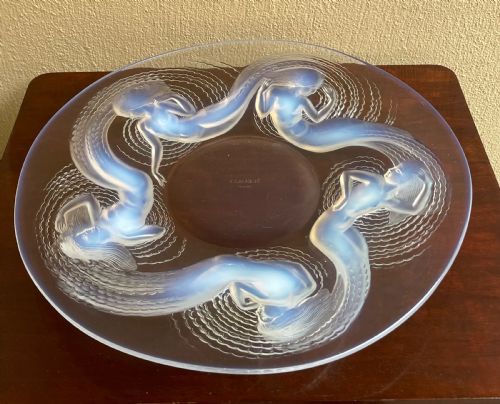
Underwater scenes involving swimming fish and water nymphs proved immensely popular for catching the milky refraction of light.
What varies in quality
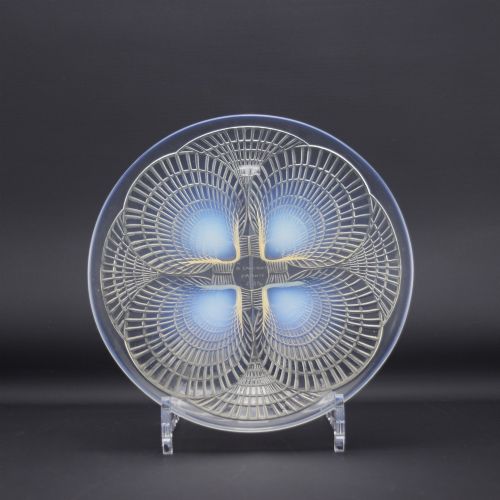
Quality rests upon the crispness of the moulded relief and the depth of the opalescent effect within the glass. Finer pieces display sharp detailing in complex figural or botanical motifs, whereas lesser examples show softer definition and a flatter milky tone.
The weight and thickness of the glass also distinguish the standard of production, alongside the preservation of any original surface staining. Pieces that retain their intended contrast and show minimal surface wear command greater appreciation.
Rene Lalique·Sabino·Verlys·Etling
The Opalescent Glass Charger Glossary
- Charger
- A large decorative plate or platter used for display or as a base setting rather than for serving food. These pieces measure significantly larger than standard dinner plates.
- Opalescent glass
- Glass that exhibits a milky appearance with shifting translucent tones, often showing blue highlights in reflected light and amber in transmitted light. This effect results from specific chemical agents added during the melt.
- Art Deco
- The dominant design style of the nineteen twenties and nineteen thirties, characterised by stylised motifs, symmetry, and bold geometric or organic forms. Chargers from this era frequently feature moulded fish, flowers, or naked figures.
- Moulded glass
- Glass formed by pressing molten material into an iron or steel matrix to create raised patterns. This technique allowed makers to produce intricate, consistent relief work across large decorative items.
- Salver
- A flat tray or large shallow plate typically used for display. In this context, it functions interchangeably with the term charger.
Opalescent Glass Charger: Frequently Asked Questions
Were these chargers used for food?
These large glass pieces served primarily as decorative items or display salvers rather than practical tableware for dining. Their delicate surfaces and moulded relief designs meant they were meant for visual admiration.
Owners typically placed them on sideboards, tables, or mounted them on walls to catch the shifting light.
How do I clean an opalescent glass charger?
Cleaning requires only warm water and a mild, non-abrasive detergent applied with a soft cloth. Avoid harsh scrubbing or soaking, particularly if the piece retains original staining or patination in the recessed details.
Dry the glass immediately with a lint-free cloth to prevent water spots and preserve the translucent finish.
How can I tell a nineteen twenties piece from a thirties one?
Dating relies heavily on stylistic shifts and documented maker production years. Pieces from the early nineteen twenties often feature more naturalistic floral or fluid classical motifs.
By the nineteen thirties, designs tended towards bolder stylisation and heavier geometric framing, though many makers continued both aesthetics concurrently.
Where should I display a heavy glass charger?
Display requires a sturdy surface or a specialised plate stand designed to bear significant weight safely. Because these chargers are substantial and made of heavy glass, they need secure placement away from table edges.
Positioning them near natural light sources allows the opalescent qualities and moulded details to stand out fully.