


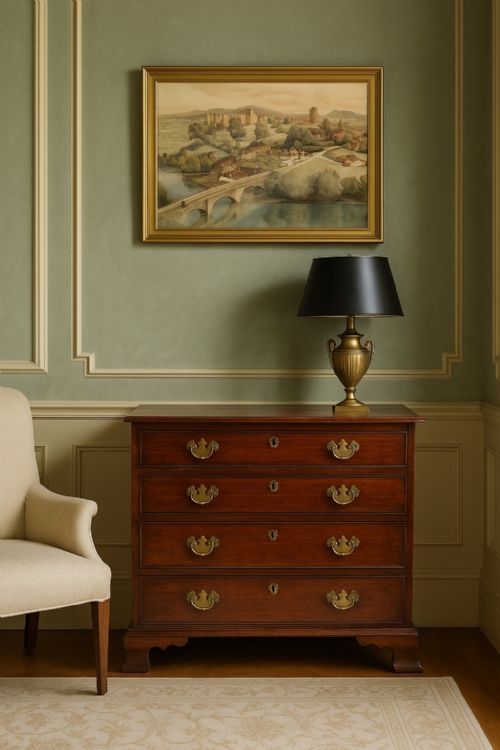


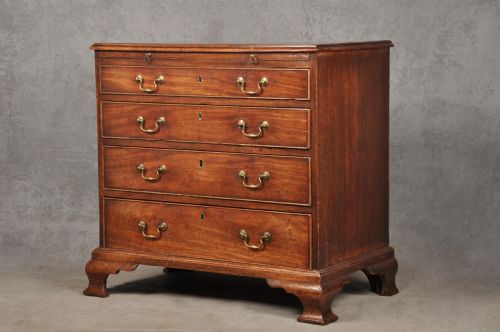

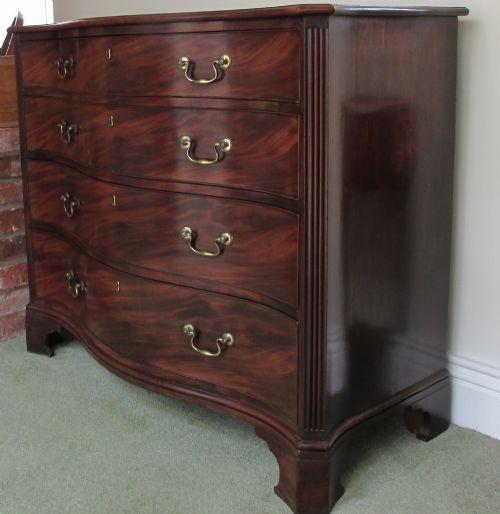
Ogee Foot Chest of Drawers
An ogee foot chest of drawers brings robust eighteenth-century timberwork and signature bracket feet to any room.
Ogee Foot Chest of Drawers
An ogee foot chest of drawers combines solid storage with the distinct scrolling profile of the bracket base. Buyers searching for an ogee foot chest of drawers encounter mahogany and oak forms dating from the eighteenth century through to late nineteenth-century revivals.
Most examples on this page date to the Georgian period, particularly the reign of George III, alongside Chippendale style interpretations. Formats range from standard drawer configurations to serpentine fronts and mule chests incorporating lower drawers.
How they were made
Cabinet makers constructed these pieces primarily in mahogany and oak, occasionally incorporating fruitwood inlay and pine secondary woods for drawer linings and internals. Timber selection dictated the weight and durability of the carcase.
Construction relied on traditional joinery techniques, paired with cast brass hardware for drawer pulls and escutcheons. The characteristic ogee foot was shaped directly into the bracket base to elevate the heavy timber frame.
Some mule chests doubled as makeshift luggage for travelling gentlemen before fitted wardrobes became standard bedroom furniture.
What varies in quality
Quality rests in the crispness of the timber carving and the integrity of the original feet. Fine examples display well-figured mahogany grain and harmonious proportions across the drawer tiers.
The presence of original elements such as brushing slides and brass furniture elevates a piece. Superior proportion and retained patination separate standard regional work from high-style London production.
The Ogee Foot Chest of Drawers Glossary
- Ogee
- A moulding profile composed of a double curve, resembling an S-shape, used extensively on bracket feet. This scrollwork provides a transition between the heavy body of the chest and the floor.
- Brushing slide
- A pull-out shelf integrated above the top drawers, designed for folding clothes or writing. It slides flush into the carcase when not in use.
- Serpentine
- A front profile shaped with a convex centre flanked by concave curves, requiring skilled woodworking. This flowing line adds visual movement to heavy timber furniture.
- Mule chest
- A storage chest fitted with one or more working drawers at the base beneath the primary compartment. It bridges the transition between a traditional blanket chest and a chest of drawers.
Ogee Foot Chest of Drawers: Frequently Asked Questions
What is an ogee foot?
An ogee foot is a distinctive bracket base featuring an S-shaped curving profile that gently flares outward and upward. It provides a decorative architectural termination to the bottom corners of antique furniture.
Cabinet makers shaped this profile from solid timber blocks to lift the heavy carcase slightly off the floor. It remains a hallmark of finer Georgian case pieces.
How old are these chests?
Most pieces date from the eighteenth century, spanning the Georgian period from the early reigns through the George III era. Later interpretations also appear from the late nineteenth century.
Construction details, timber ageing, and secondary woods help confirm the manufacturing era of each individual example.
What is a brushing slide?
A brushing slide is a pull-out wooden board integrated directly beneath the top surface or above the uppermost drawer. Historically, individuals used it to brush garments or sort items without laying them flat on the main surface.
They appear primarily on better quality eighteenth-century mahogany chests and remain a desirable functional feature.
Are these pieces made of solid mahogany?
Eighteenth-century examples typically employ solid mahogany for primary visible surfaces, drawer fronts, and top boards. Secondary woods like oak or pine often appear inside drawer linings and back panels.
Craftsmen selected robust timbers to ensure the structural longevity of heavy multi-drawer carcases.