





Off White French Mirror
An off white french mirror brings character and soft light to a room through traditional painted timber and architectural forms.
Off White French Mirror
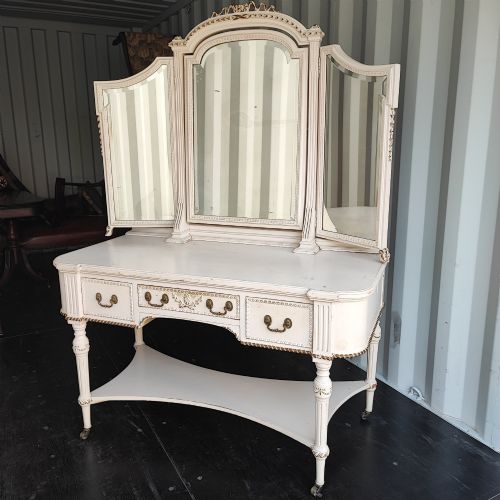
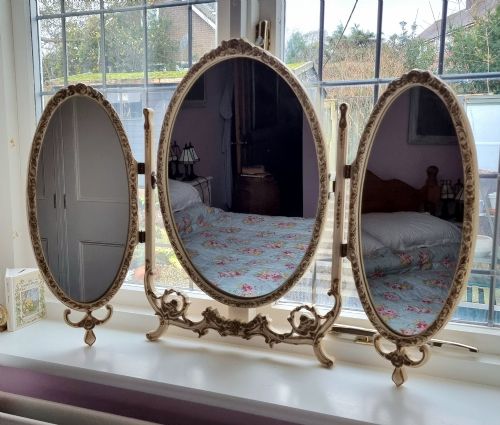
An off white french mirror encompasses various forms from overmantel pieces to large wall mirrors and triple mirror dressing tables. These items originate across the nineteenth and early twentieth centuries, spanning periods such as Victorian, Edwardian, and the nineteen-twenties.
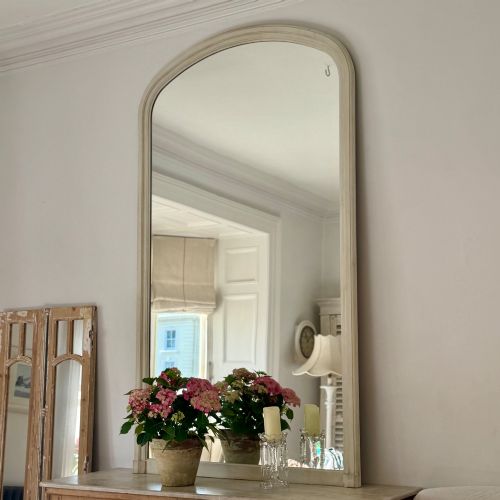
The aesthetic draws heavily on classical French design vocabulary, including French chateau, provincial, rococo revival, and Louis XVI revival styles. Architectural elements like arched tops and shaped frames appear frequently across the selection.
Pieces range from grand proportions suitable for placement above a fireplace to smaller, free-standing dressing table accessories. Painted timber surfaces in neutral, off-white tones define the visual identity of these mirrors.
How they were made
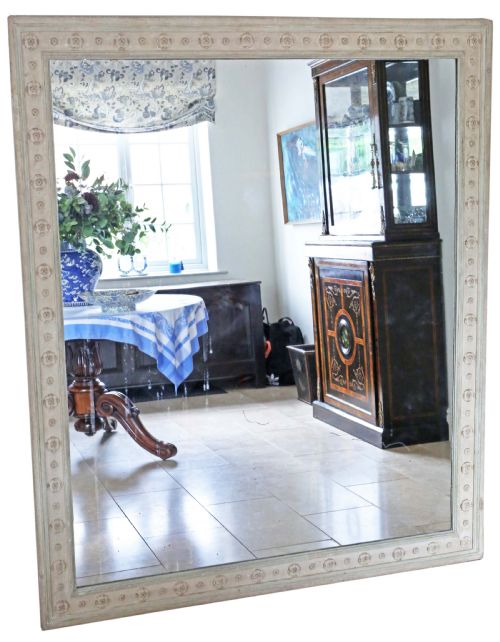
Makers constructed these frames predominantly from wood, timber, and carved wood, frequently applying layers of gesso to build up intricate surface detail and decorative moulding before painting.
Surface treatments rely on paint, over-painted finishes, and original paint applications over timber or gesso, creating a muted off-white palette that sometimes reveals earlier gilt beneath.
Glazing involved fitted glass panels secured within the frames, while occasional brass hardware or fittings provided structural or decorative accents on dressing table variants.
What varies in quality
The depth and precision of the carved wood and gesso ornamentation separate standard production pieces from finer examples, particularly where floral motifs or architectural moulding are hand-modelled.
Surface treatment integrity distinguishes the range, where original paint layers with natural patina hold more interest than later, heavy-handed over-painting.
Subtlety of proportions in arched tops and frame symmetry dictates the overall visual success of the piece within an interior setting.
Maples of London and Paris
The Off White French Mirror Glossary
- Gesso
- A plaster-like mixture applied to wood frames to create a smooth surface for painting or to build up low-relief carved ornamentation. It provides the crisp edge detail seen on many nineteenth-century frames.
- Overmantel Mirror
- A large mirror designed specifically to hang on the wall directly above a fireplace mantelpiece. These pieces often feature wide proportions to match the width of the hearth below.
- Trumeau Mirror
- An architectural mirror incorporating a painted panel or artwork directly above the glass plate within a single framed structure. Originating in neoclassical interior design, these pieces served as permanent wall decorations.
- Louis XVI Revival
- A nineteenth-century design style emulating the neoclassical restraint, symmetry, and straight lines of the French royal court during the late eighteenth century. It contrasts with the more flowing curves of earlier rococo forms.
Off White French Mirror: Frequently Asked Questions
How do I hang a heavy overmantel mirror?
Large overmantel mirrors require secure fixing directly into wall studs or masonry using heavy-duty brackets suited to the weight of timber and glass.
Professional installation is recommended for substantial nineteenth-century pieces to ensure the frame remains stable against the wall.
Where should I place an arched mirror?
Arched mirrors work effectively above mantelpieces, console tables, or as focal points on plain walls to create an illusion of increased space and height.
Positioning them opposite a window helps maximise natural light distribution throughout the room.
Are these mirrors French or English?
The selection includes pieces made in France adhering to chateau and provincial styles, alongside English interpretations influenced by French neoclassical design.
Maker details and specific decorative motifs often indicate the regional workshop origin of each frame.
How do I care for painted wood and gesso frames?
Dust the carved wooden and gesso surfaces gently with a soft, dry cloth to prevent accumulation without disturbing the painted finish.
Avoid liquid cleaners and damp cloths, which can damage aged gesso and nineteenth-century paint layers.