


Oak Swivel Desk Armchair
An oak swivel desk armchair brings solid timber construction and practical mechanical movement to a working study.
Oak Swivel Desk Armchair
An oak swivel desk armchair combines a revolving seat mechanism with supportive armrests, designed specifically for prolonged administrative labour in studies, offices and libraries. Buyers searching for an oak swivel desk armchair will find examples ranging from late Victorian to early twentieth-century production, spanning Edwardian, Arts and Crafts and Gothic Revival styles.
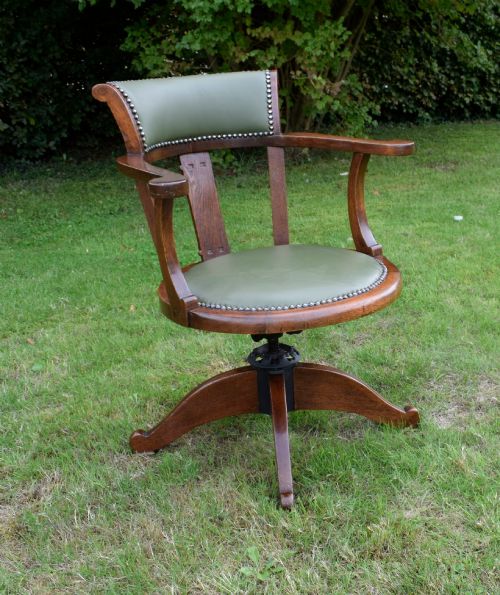
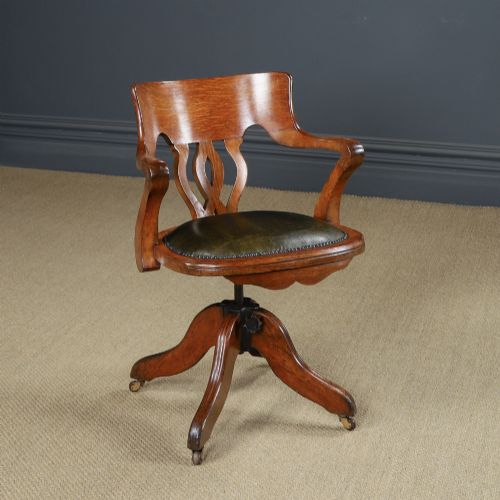
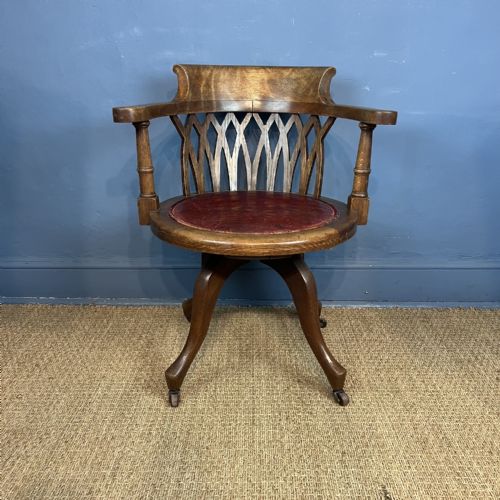
The prevailing form is the revolving office chair or captain's chair, often featuring a central wooden spindle mechanism that permits height adjustment and tilting. Many pieces incorporate supportive curved backrests joined to low arms, creating a sturdy seating position suited to a writing desk.
Origins represented in these chairs include both English and American workshops, with variations running from utilitarian office seating to heavily carved maritime and library armchairs. The standard version encountered here pairs solid oak frames with swivel action, sometimes supported on cast iron and brass underframes.
Materials and Construction Methods
Makers utilised solid oak for the primary frame, back bow and legs, frequently supplementing the structure with secondary timbers such as beech or birch. Metal components, including cast iron mechanisms, brass spindle screws and castors, provide the functional rotation and tilt required for daily office use.
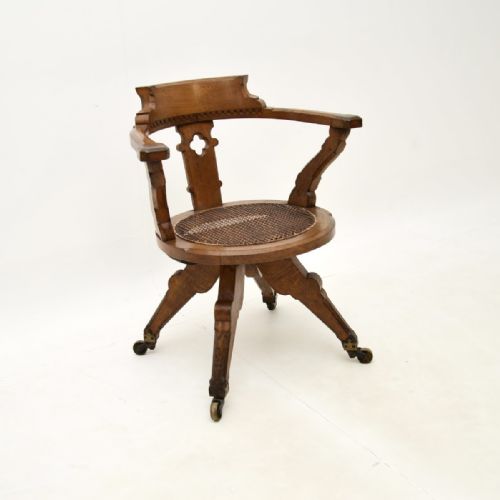
Upholstery materials typically comprise leather hides in green, tan or dark tones, alongside woven cane or solid timber seats. Mechanics rely on threaded iron spindles and four-legged or five-legged wooden bases secured with metal brackets to withstand the turning motion.
Styles recorded in the archive range from heavy Gothic Revival and Aesthetic Movement to Arts and Crafts and Art Deco designs.
Distinctions in Quality and Execution
Quality rests upon the robustness of the revolving mechanism and the integrity of the timber frame, distinguishing heavy institutional seating from lighter domestic variants. Superior examples display intricate hand-carving, well-fitted joinery and sophisticated tilt-and-swivel adjustments that operate smoothly without excessive play.
The presence of original upholstery materials, such as supple leather secured with brass studs, elevates a piece above those altered or re-webbed in later periods. Furthermore, robust framing featuring multi-spindle backrests and heavy cast-iron underpinnings indicates higher manufacturing standards intended for heavy commercial or library use.
S&H Jewell·Kendrick & Jefferson·Edward William Godwin
The Oak Swivel Desk Armchair Glossary
- Swivel mechanism
- The rotating assembly beneath the seat, usually constructed from iron and brass, which allows the chair to turn full circle. This permits lateral movement while seated at a large partners desk.
- Captain's chair
- A sturdy wooden armchair with a low, curved back rail supported by a series of vertical spindles. These seats were originally favoured in ships' cabins and executive offices.
- Bergere
- A type of upholstered armchair featuring exposed wooden framing and woven cane panels forming the back or sides. The technique adds lightness to heavy oak office seating.
- Gothic Revival
- A nineteenth-century architectural and decorative style characterised by pointed arches, trefoils and heavy carved ornamentation. Pieces in this manner display deep relief work and architectural motifs.
- Tilt action
- A mechanical function allowing the backrest to lean backward against a tension spring. It provides ergonomic flexibility for the user during long hours of work.
Oak Swivel Desk Armchair: Frequently Asked Questions
How do I adjust the height?
Height adjustment on these chairs is typically achieved by rotating the seat itself, which screws up or down along a central threaded iron spindle. Some models also incorporate a tension screw beneath the seat to regulate the tilt.
To raise or lower the position, simply spin the wooden upper section clockwise or anticlockwise until the desired seating level is reached, then secure any locking nut if fitted.
Are these chairs comfortable for daily use?
These office chairs were built for sustained administrative work, offering lumbar support through curved wooden back rails and padded armrests. Leather-upholstered variants provide additional cushioning suitable for modern working hours.
The inclusion of swivel and tilt functions allows the user to shift posture easily throughout the day, mirroring the ergonomic intent of contemporary seating.
How do I care for the leather seat?
Leather upholstery requires regular dusting with a dry cloth and occasional treatment with a neutral leather balm or wax to prevent cracking. Avoid placing the chair near direct heat sources or strong sunlight, which dries out nineteenth-century hides.
Preserving the original surface involves gentle cleaning rather than heavy chemical restoration, maintaining the natural patina developed over decades of use.
How can I tell a Victorian chair from an Edwardian one?
Victorian examples tend to feature darker finishes, heavier carving, and robust Gothic Revival or Aesthetic Movement influences. The construction often employs thicker oak components and dense cast-iron bases.
Edwardian pieces generally present a slightly lighter aesthetic, occasionally pairing oak with beech or birch, and reflect simpler lines associated with early twentieth-century office standardisation.